 Blaine Window
 Siding Repair in Sumas: Built for a Tough Coastal Climate
Sumas sits close enough to the water and the Cascade foothills that homes here take a beating most inland siding never has to withstand. Salt-laden air drifts in off the Strait of Georgia and Puget Sound, driving rain comes in sideways during winter storms, and a long, damp moss season settles in every fall and doesn't let go until late spring. Add the border-town microclimate — cooler nights, heavier dew, and long stretches of overcast humidity — and you get siding that ages faster here than it would forty miles inland. Siding repair in this corner of Whatcom County isn't just cosmetic work. Done wrong, a patched section can trap moisture behind it and turn a small problem into a rot repair six months later.
We work on homes throughout Blaine and the surrounding Whatcom County communities, including Sumas, and we see the same failure patterns repeat: caulk that's cracked and let water behind trim, moss holding moisture against north-facing walls, and siding seams that were never properly flashed to begin with. A repair that doesn't account for how this climate behaves is a repair you'll be paying for again in a year or two.
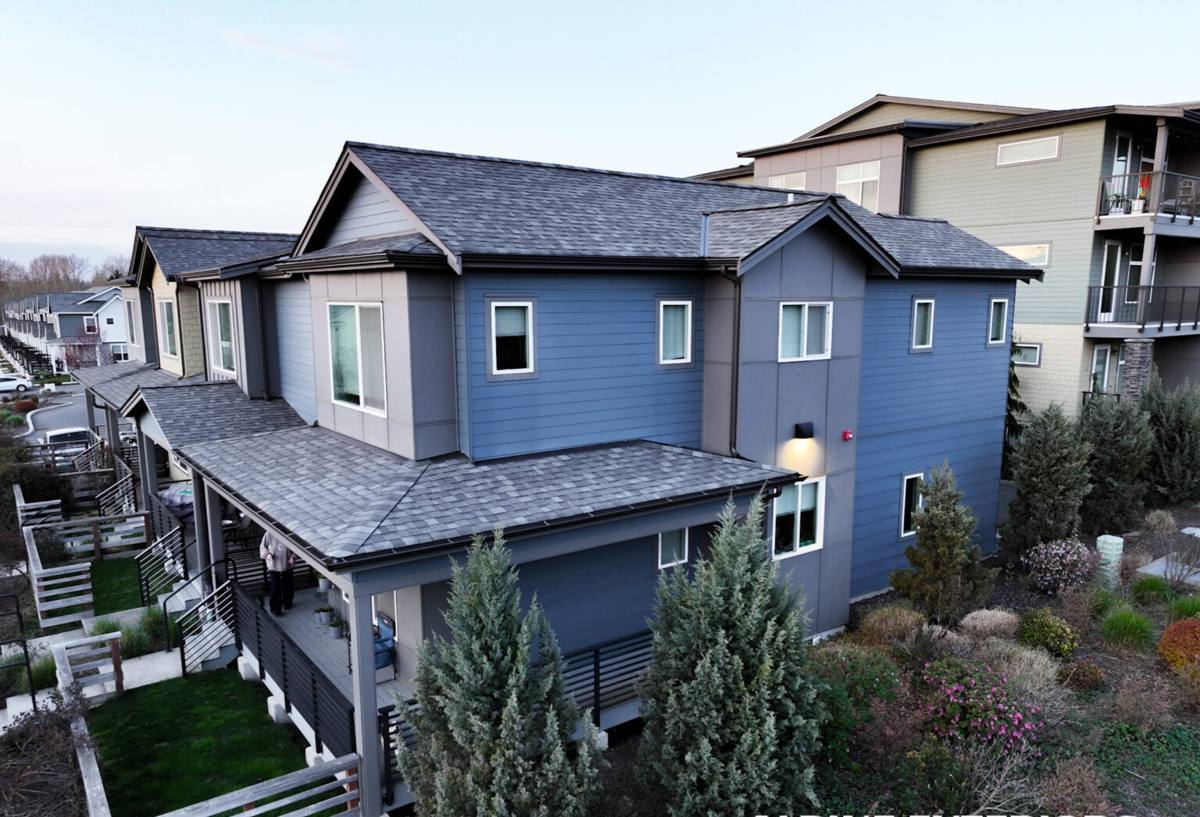
Signs Your Sumas Home Needs Siding Repair
Most siding damage doesn't announce itself. It shows up as small, easy-to-miss cues long before anything looks obviously broken. If you're not sure whether your siding needs attention, walk the exterior and check for these:
- Soft or spongy spots when you press on the siding, especially near the bottom courses and around window trim
- Visible cracking, buckling, or warping in individual boards or panels
- Paint that's peeling, bubbling, or failing faster than it should on one section of the house but not others
- Dark streaking or green-black growth that keeps coming back after cleaning, particularly on shaded or north-facing walls
- Gaps opening up at seams, corners, or where siding meets trim, window frames, or the foundation
- A musty smell or visible staining on interior walls that share an exterior wall with damaged siding
- Nail heads popping out or fasteners that have rusted and stained the surrounding material
Any one of these on its own might be minor. Several of them clustered in the same area usually means water has been getting behind the siding for a while, and the visible symptom is only part of the story.
Why Moss and Moisture Hit This Area Harder
The Moss Season Problem
Whatcom County's wet, mild winters are exactly the conditions moss needs to establish itself — shade, consistent moisture, and temperatures that rarely freeze hard enough to kill it off. Once moss gets a foothold on a roofline or a shaded siding section, it holds water against the surface far longer than open air ever would. On wood and engineered wood products, that constant dampness is what starts rot. On any siding material, it's what breaks down caulking and finish coatings prematurely.
Salt Air and Driving Rain
Salt air accelerates the corrosion of fasteners, flashing, and any exposed metal trim, and it can degrade certain paint and coating systems faster than a dry inland environment would. Driving rain — wind-driven storms that push water horizontally instead of straight down — tests every seam, joint, and piece of flashing on a house. Siding that would perform fine in a calm rain can still leak under wind-driven conditions if the laps, caulking, or flashing details weren't done correctly the first time.
Common Siding Repair Issues by Material
What a repair actually involves depends heavily on what's already on the house. Sumas has a mix of older wood siding, vinyl, engineered wood, and some fiber cement, and each behaves differently once water gets involved.
| Material | Typical Failure Mode Locally | Repair Difficulty |
|---|---|---|
| Cedar or primed wood siding | Rot at butt joints and bottom courses, paint failure from moisture cycling | Often requires full board replacement; patch repairs rarely hold long-term |
| Vinyl siding | Cracking in cold snaps, warping near heat sources, water intrusion behind panels | Individual panels can be swapped, but color matching aged vinyl is difficult |
| LP SmartSide / engineered wood | Edge swelling and delamination where caulking has failed | Damaged sections usually need full panel replacement, not spot patching |
| Fiber cement (James Hardie) | Failed caulk joints, damage from impact, occasional installation-error moisture entry | Sound approach: cut out and replace the damaged board section cleanly |
We don't install every product on this list — we'll get to why below — but we do repair what's already on your home when a repair is the right call, and we'll tell you honestly when it isn't.
What a Correct Siding Repair Actually Involves
Diagnosing Past the Surface
A repair that only addresses what's visible is a repair that misses the point. Before we touch anything, we check for moisture intrusion behind the siding, look at the condition of the water-resistive barrier underneath, and inspect flashing at windows, doors, and any place two different materials meet. Damaged siding is often a symptom — the real cause is usually a flashing gap, a failed sealant joint, or a spot where water has had a path in for months.
Matching and Integrating the Repair
Once we know what's actually failed, the repair has to tie back into the surrounding siding correctly — same lap spacing, same fastening pattern, and flashing details that shed water the way the rest of the wall does. A patch that looks fine but doesn't integrate with the drainage plane behind it will fail again, usually in the same spot.
Sealing and Finishing
Caulking and sealant selection matters more here than in a drier climate. We use sealants rated for the temperature swings and sustained moisture exposure Whatcom County sees, not whatever's fastest to apply. On painted or factory-finished materials, we match the finish as closely as the product allows so the repair doesn't stand out as an obvious patch.
Repair vs. Replace: How We Help You Decide
Not every damaged section needs to become a full re-side. But there's a point where patching becomes false economy. Here's how we walk homeowners through that decision:
| Factor | Favors Repair | Favors Replacement |
|---|---|---|
| Extent of damage | Isolated to one or two sections | Recurring problems across multiple walls |
| Age of existing siding | Siding is relatively young and otherwise sound | Siding is near or past its expected service life |
| Underlying moisture barrier | Intact, no widespread water intrusion | Compromised behind multiple areas |
| Material condition | Board or panel type still performing as designed | Material itself is prone to repeat failure (delamination, chronic rot) |
| Cost over time | Repair cost is a small fraction of replacement | Repeated repairs are approaching replacement cost anyway |
When damage is contained and the rest of the siding is sound, repair is the honest recommendation, and that's what we'll tell you. When we're looking at a pattern of failures tied to the material itself — chronic moisture problems in engineered wood, or wood siding that's rotted in multiple locations — we'll say so plainly and talk through what replacement with James Hardie fiber cement siding would look like instead. It's the only siding we install, because it's non-combustible, holds a factory-baked ColorPlus finish that doesn't rely on field painting to perform, and is engineered in a moisture-resistant HZ formulation built for exactly the wet Pacific Northwest conditions Sumas sees every winter.
Our Siding Repair Process in Sumas
1. On-Site Inspection
We walk the full exterior, not just the section you called about, since moisture problems in this climate rarely stay isolated. We check flashing, caulking, and the areas most exposed to driving rain and shade-driven moss growth.
2. Honest Assessment
You get a straight answer on whether this is a repair, a partial re-side, or something bigger — along with the reasoning, not just a number.
3. Repair Work
Damaged material is removed back to sound substrate, the water-resistive barrier and flashing are corrected where needed, and new material is integrated to match the surrounding siding's drainage and fastening pattern.
4. Sealing and Cleanup
Sealant appropriate to this climate is applied at every joint, and we clean up thoroughly before we consider the job done.
5. Follow-Up
If the repair was tied to a larger issue — chronic moss, a failing water barrier, siding nearing end of life — we'll tell you what to watch for and when it's worth planning a longer-term fix.
Why Hiring a Crew That Already Works in Sumas Matters
Siding repair isn't a generic skill you can apply the same way everywhere. A crew that works Blaine and Whatcom County regularly already knows how driving rain behaves against this area's typical wall orientations, how fast moss re-establishes on shaded north walls here, and which flashing details tend to fail first in this specific climate. That local pattern recognition is the difference between a repair that lasts and one that's a temporary cosmetic fix. It also means faster diagnosis — we're not guessing at what a Sumas winter does to a wall assembly, we've seen it directly, repeatedly, on homes near yours.
Keeping Repaired Siding Sound After We Leave
A good repair buys you time, but ongoing exposure to this climate means a little seasonal attention keeps it that way:
- Rinse moss and algae growth off shaded siding sections before it has a chance to establish, rather than after it's thick
- Keep gutters and downspouts clear so runoff isn't sheeting directly down siding walls
- Trim back vegetation and tree cover that keeps siding shaded and damp longer than the rest of the house
- Inspect caulking at trim and window joints annually, since sealant is usually the first thing to fail in this climate
- Address small issues — a cracked board, a lifted seam — before the next wet season rather than waiting
If you're seeing signs of trouble on your Sumas-area home, or you just want an honest read on whether it's a repair or something bigger, we're glad to take a look. We offer a free, no-pressure estimate — no obligation, just a straight assessment of what your siding actually needs.