 Blaine Window
 Siding in Sumas: A Climate That Doesn't Forgive Shortcuts
Sumas sits inland along the Nooksack River valley, tucked against the US-Canada border in Whatcom County. It doesn't get the same ocean spray as the coastline out toward Blaine, but the same Pacific Northwest weather pattern still runs straight through the valley — long stretches of driving rain, heavy fall and winter humidity, and a moss and algae season that can stretch from October well into spring. Valley fog and cooler overnight temperatures add their own wrinkle: siding here goes through more freeze-thaw and damp-to-dry cycling than homes closer to open water, because the moisture has nowhere to go and the sun takes longer to burn it off between storms.
None of that is dramatic on its own. What it does is punish siding that can't handle repeated wetting and drying without swelling, delaminating, or feeding mold and moss growth. Over a few winters, a product that's marginal for this climate starts to show it — soft spots at the bottom courses, paint failure, trim that's pulling away from the wall. A product engineered for it just keeps doing its job.
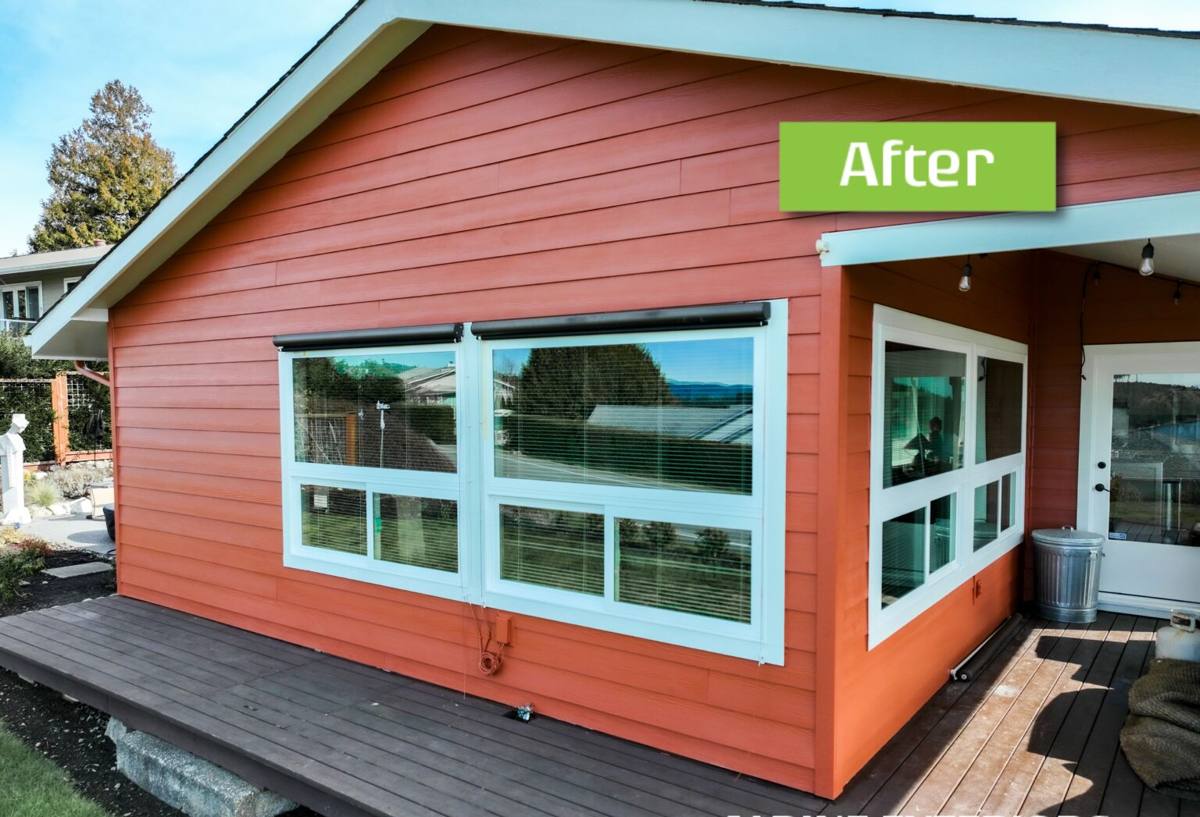
Why We Only Install James Hardie Siding on Sumas Homes
We don't install vinyl, LP SmartSide, cedar, or primed spruce, and we're upfront about why. Each of those products has real strengths — vinyl is inexpensive, wood has a look people love, engineered wood is lighter to work with — but each also has a moisture or maintenance trade-off that we've decided isn't worth putting on a home in this climate. Wood and engineered wood siding rely on a paint or primer film to keep water out; once that film is compromised at a cut edge, fastener hole, or joint, the substrate underneath can start absorbing moisture. Vinyl sheds water well enough but softens, fades, and can crack in cold snaps, and it doesn't offer the fire performance homeowners increasingly ask about.
James Hardie fiber cement is cement, sand, and cellulose fiber — it doesn't have an organic core to rot, it's non-combustible, and it's manufactured in HZ5 formulation specifically for the wet, cool Pacific Northwest climate zone that includes Whatcom County. It ships with a factory-applied ColorPlus finish baked on under controlled conditions, which holds color and resists the fade, chip, and peel that field-applied paint struggles with out here. That's the whole reason we standardized on one product line instead of offering a menu of options — we'd rather install one thing correctly than install several things and hope the weather's kind to all of them.
What Correct Installation Actually Involves
Water Management Comes First
Fiber cement siding is only as good as what's behind it. A correct install starts with a continuous water-resistive barrier — housewrap or building paper, lapped shingle-style and taped at every seam — installed before a single piece of siding goes up. Every window, door, and penetration gets flashed so water is directed out and down, never trapped behind the cladding. On a lot of older Sumas homes, this step means addressing whatever's already on the wall: sheathing that's absorbed years of moisture, old barrier material that's failed at the seams, or trim details that were never flashed properly in the first place. Skipping straight to new siding over a compromised water barrier just locks the problem in behind a nice-looking wall.
Fastening, Clearances, and Gaps
James Hardie publishes exact fastener types, spacing, and nailing patterns for each product line and climate zone, and those specs aren't optional extras — they're what the warranty is actually based on. Boards need proper clearance from grade, roofing, decks, and patios (generally a minimum of several inches) so splash-back and standing water don't sit against the bottom edge. Panels need blind or face-nailing per the manufacturer's pattern, not whatever's fastest with a nail gun. Get the clearances or fastening wrong and you can void the warranty even though the siding itself is installed.
Where Caulk Belongs — and Where It Doesn't
A common mistake is caulking every joint on a fiber cement installation, thinking more sealant equals more protection. James Hardie's details actually call for some joints to stay open or shingled so any moisture that gets behind the cladding can drain and dry out. Over-caulking traps water instead of shedding it, which defeats the point. Knowing which joints get sealed and which get left to breathe is a detail that separates a correct install from one that just looks finished.
Choosing the Right Hardie Product for a Sumas Home
Lap, Panel, or Shingle Profile
HardiePlank lap siding is the most common choice for traditional and craftsman-style homes and comes in a range of exposures and textures, from smooth to a cedar-mill woodgrain look. HardiePanel vertical siding works well for modern designs, gable accents, or mixing with lap siding for visual breaks. HardieShingle gives a staggered or straight-edge shingle look for homes going for a cottage or coastal aesthetic, without the maintenance burden of real cedar shingles. HardieTrim finishes out corners, fascia, and window and door surrounds so the whole exterior reads as one coordinated system rather than mismatched materials.
Factory Finish vs. Field Paint
ColorPlus Technology bakes color onto the board at the factory in multiple coats, which is more durable and more color-stable over time than paint applied on site after installation. It also comes with matching factory touch-up product for any nicks from installation or later work. Primed Hardie boards, meant to be field-painted, are available too, but for most Sumas homeowners the ColorPlus route means fewer repaint cycles over the life of the siding — a real advantage in a climate that's hard on exterior paint.
How Hardie Fiber Cement Compares to the Alternatives
| Factor | James Hardie Fiber Cement | Vinyl | Wood / Engineered Wood |
|---|---|---|---|
| Moisture behavior | Non-organic core, resists swelling and rot | Sheds water but can warp in heat/cold | Organic substrate vulnerable if finish fails |
| Fire performance | Non-combustible | Combustible, can melt/deform | Combustible |
| Finish durability | Factory ColorPlus finish, long fade resistance | Color molded in but can chalk/fade | Depends entirely on paint/primer maintenance |
| Maintenance | Occasional wash, minimal repainting | Low, but cracks are hard to repair invisibly | Regular repainting/resealing needed |
| Warranty structure | Long manufacturer warranty, transferable | Varies widely by manufacturer and grade | Product warranty rarely covers finish failure |
This isn't a claim that the alternatives are bad products — it's why, given this climate and given that we install one thing and stand behind it, fiber cement is the one we chose.
What Drives the Cost of a Sumas Siding Project
| Cost Factor | Why It Matters |
|---|---|
| Tear-off vs. re-side | Removing old siding down to the sheathing costs more but lets us fix hidden moisture or barrier issues instead of covering them up |
| Home size and wall complexity | Dormers, gables, and multiple roof lines add flashing detail and labor beyond flat square footage |
| Sheathing condition | Rot or soft spots found during tear-off need repair before new siding goes on, which is common on older valley homes |
| Product line and profile | HardiePlank, HardiePanel, and HardieShingle carry different material and install costs |
| Trim and accessory scope | Full trim replacement, soffit, and fascia work add scope beyond the wall panels themselves |
Our Process From First Call to Finished Walls
- On-site inspection — we walk the exterior, check existing siding and trim condition, and look for signs of moisture behind the wall.
- Written estimate — a clear scope covering tear-off or overlay, product line, trim, and any sheathing allowance, with no surprise add-ons hidden in vague language.
- Scheduling around the weather — we plan install windows with Sumas's rain patterns in mind so the water-resistive barrier isn't exposed longer than it has to be.
- Tear-off and substrate check — removing old cladding to inspect and repair sheathing before anything new goes up.
- Barrier, flashing, and siding installation — installed to James Hardie's published specifications for fastening, clearance, and joint treatment.
- Trim, caulking, and touch-up — finished out with HardieTrim and manufacturer-matched touch-up where needed.
- Final walkthrough — we go over the finished exterior with the homeowner before calling the job done.
Caring for Hardie Siding After Installation
Fiber cement is low-maintenance compared to wood, but "low-maintenance" isn't "no-maintenance," especially with a moss season this long. A little seasonal attention keeps it looking right for decades:
- Rinse the exterior once or twice a year with a garden hose and soft brush — avoid high-pressure washing directly into joints and seams
- Keep gutters clear so overflow doesn't run down the siding face or pool at the bottom courses
- Trim back landscaping and tree branches so foliage doesn't hold moisture against the wall
- Check caulked joints around windows and doors annually and have any cracked sealant redone
- Watch for moss or algae buildup in shaded, north-facing sections and clean it before it spreads
- Touch up any chips or scrapes with manufacturer-matched ColorPlus touch-up rather than mismatched paint
Why Hiring a Crew That Already Works in Sumas Matters
Sumas is a small border community, and it has its own quirks that a crew unfamiliar with the area can miss. The valley's flood history along the Nooksack means moisture management at the base of a wall and around the foundation transition isn't a formality here — it's a detail worth getting right the first time. Local permitting, whether through the City of Sumas or Whatcom County depending on the property, has its own process that a crew working the area regularly already knows how to navigate without slowing the job down. And because we've worked on homes throughout Whatcom County, we've seen how the valley's damp, cooler microclimate treats siding differently than homes right on the coast — which shapes decisions on trim details, drainage planning, and install timing that a generic out-of-area contractor wouldn't think twice about.
If you're weighing a siding replacement or new-construction siding for a home in Sumas, we're happy to take a look, walk you through what we're seeing, and put together a straightforward, no-pressure estimate — no obligation, no pressure to decide on the spot. Use the form below to get started.