 Blaine Window
 Building a Deck for Sandy Point's Waterfront Conditions
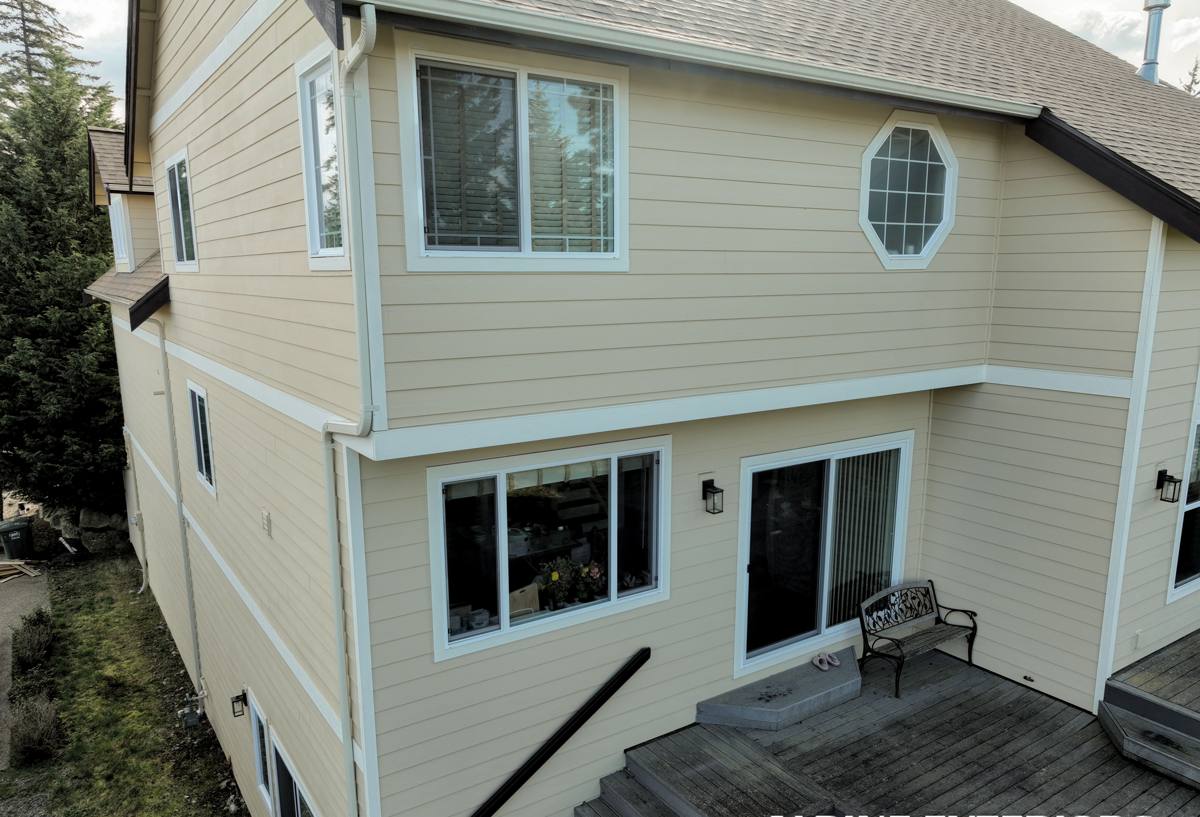
Sandy Point sits right up against the water on the edge of Blaine, and that location is exactly what makes decking here different from a deck build in a typical inland Whatcom County neighborhood. Homes along the canals and shoreline take on salt-laden air coming off the water, near-constant winter rain, and long stretches of low sun and shade that keep surfaces damp far longer than you'd expect. A deck built without that in mind will show it within a couple of seasons — soft spots in the wrong wood, corroding hardware, and a slick green film that shows up every fall and doesn't fully leave until late spring.
Composite decking holds up well here, but only when it's installed with the local conditions in mind. The board itself is only part of the equation. The framing underneath, the fasteners holding it together, and how the whole system handles water and airflow matter just as much as which composite product you pick.
What Salt Air, Rain, and Moss Actually Do to a Deck
Three things drive most of the deck problems we see on the Blaine waterfront, and Sandy Point gets a heavier dose of all three than most of the surrounding area:
- Salt air accelerates corrosion on any exposed metal — screw heads, joist hangers, railing brackets — long before it does visible damage to the decking itself.
- Driving rain off the water pushes moisture sideways into board ends, fascia, and ledger connections that a straight-down rain wouldn't reach.
- Moss and algae take hold anywhere a deck stays shaded and damp, and composite boards with the wrong surface texture or drainage gaps can hold that moisture right at the walking surface.
None of these are reasons to avoid composite decking — they're reasons to be deliberate about how it's built. A well-built composite deck in this environment can outperform wood by a wide margin, because it doesn't rot, splinter, or need refinishing. But the parts around the board — fasteners, framing, flashing — need to be chosen for salt exposure specifically, not just for "outdoor use."
What a Correct Composite Deck Build Involves
Substructure and Fasteners
The framing is where most premature deck failures start, and it's the part homeowners see least. For Sandy Point projects we use pressure-treated framing rated for ground contact where it's near grade, and we're picky about fastener material — stainless steel or heavy-duty coated fasteners rated for coastal/marine exposure, not the standard exterior-grade hardware that's fine fifteen miles inland but corrodes faster right on the water. Joist hangers, post bases, and any structural connector get the same treatment. It costs a bit more up front and saves a full hardware replacement down the line.
Board Selection, Grooves, and Airflow
Composite boards vary in how they handle moisture and grip. Capped composite boards (with a plastic shell wrapped around a wood-composite core) resist moisture absorption far better than uncapped boards, which matters more here than in a drier part of the state. We also pay attention to surface texture — a heavily embossed, low-traction surface can hold a thin film of moisture and moss spores longer than a board with a cleaner brushed finish. Proper spacing between boards and adequate airflow underneath the deck keep the whole system drying out between rain events instead of staying damp.
Ledger and Flashing Details
Where a deck attaches to the house, flashing is non-negotiable. A deck ledger without correct flashing is one of the most common sources of hidden water damage to the house itself, and with driving rain off the water pushing moisture sideways, a marginal flashing detail that might get away with it elsewhere won't hold up at Sandy Point.
Composite Decking vs. Other Materials for a Sandy Point Deck
Homeowners near the water often ask us to compare composite against wood and PVC directly, since all three get pitched as "low maintenance" at some point. Here's how they actually compare for this specific setting:
| Material | Salt Air / Moisture Behavior | Maintenance | Typical Lifespan Here |
|---|---|---|---|
| Pressure-treated wood | Absorbs moisture, prone to splitting and rot at fastener points near the water | Annual sealing/staining, ongoing repairs | 10-15 years before major repair or replacement |
| Capped composite | Resists moisture absorption, doesn't rot or splinter, holds up well to salt exposure | Periodic cleaning, no sealing or staining | 25-30+ years, backed by manufacturer warranty |
| PVC decking | Fully moisture-resistant, very stable in wet/salty conditions | Low, similar to composite | Comparable to composite, generally higher upfront cost |
We install composite as our standard recommendation for most Sandy Point homeowners because it strikes the best balance of cost, appearance, and long-term performance in this climate. PVC is a legitimate option for homeowners who want maximum moisture resistance and are comfortable with the added cost; we're happy to walk through both when we scope a project.
Seasonal Maintenance: What to Expect
One of the real advantages of composite is how little it asks of you compared to wood, but "low maintenance" doesn't mean "no maintenance" — especially this close to the water.
- Fall: clear fallen leaves and debris promptly so they don't trap moisture against the board surface as moss season ramps up.
- Winter: periodic rinsing or light brushing in shaded, low-traffic areas keeps early moss growth from getting established.
- Spring: a general wash-down (a soft-bristle brush and mild soap, or a low-pressure rinse) removes the winter's accumulated grime and any moss film before it sets in for good.
- Ongoing: a quick visual check of fasteners, railing posts, and stair connections once or twice a year catches hardware issues before they become structural ones.
This is lighter upkeep than a wood deck needs by a wide margin — no annual sealing, staining, or sanding — but it's not zero, and homeowners who skip the seasonal rinse are the ones who end up with a stubborn moss layer that takes real effort to remove.
Our Process, Start to Finish
Every Sandy Point deck project follows the same basic sequence, though the details get adjusted to the specific lot and exposure:
- On-site assessment — we look at the deck's exposure to prevailing wind and rain, existing framing condition if it's a rebuild, drainage under the deck, and any ledger/flashing concerns at the house connection.
- Written estimate — a clear scope covering framing, fastener spec, board selection, railings, and any permit work, with pricing broken out so you know what you're paying for.
- Framing and structural work — corrosion-resistant hardware throughout, proper joist spacing for the composite product chosen, and flashing at all house connections.
- Decking installation — hidden fastener systems where the product supports it, correct board spacing for drainage and airflow, and attention to how the layout sheds water.
- Railings and finish work — code-compliant railings and stairs, with hardware matched to the same coastal-duty standard as the framing.
- Final walkthrough — we go over basic seasonal care so the deck performs the way it's supposed to for the long haul.
Mistakes We Commonly Find on Older Waterfront Decks
When we're called out to look at a failing or aging deck near the water — whether to repair it or plan a full replacement — the same handful of issues show up repeatedly:
- Standard (non-marine-rated) fasteners that have visibly corroded and stained the surrounding boards.
- Missing or inadequate ledger flashing, leading to rot at the house-to-deck connection.
- Boards installed with insufficient gap for drainage, trapping water and speeding up moss growth.
- Framing too close to grade with no ventilation, keeping the underside of the deck perpetually damp.
- Railing posts anchored with hardware that wasn't rated for the exposure, leading to loosening over time.
Every one of these is preventable with the right materials and installation approach from the start, which is a large part of why we treat the framing and fastener spec as seriously as the visible decking.
Permits and Railing Requirements
Deck projects in Blaine and unincorporated Whatcom County generally require a permit once you're past a certain size or height threshold, and any deck with a walking surface more than a modest distance above grade needs a code-compliant guardrail with specific baluster spacing. We handle the permit application and inspection process as part of the project scope, so you're not left tracking down requirements on your own. If you're replacing an existing deck, we'll also flag anything on the current structure that wouldn't pass inspection today, even if it was compliant when it was originally built.
Why It Matters to Hire a Crew That Already Works Sandy Point
A lot of decking crews do solid work in general but don't build differently for a waterfront lot than they would for a house a few miles inland. That difference — the fastener grade, the flashing detail, the board spacing for drainage — is exactly what determines whether a deck is still solid in fifteen years or needs hardware replaced in five. We work on homes throughout Blaine and the surrounding Whatcom County shoreline regularly enough to know which details matter most in this specific environment, and we spec every project accordingly rather than treating a Sandy Point deck the same as one built anywhere else.
If you're planning a new composite deck or replacing one that's showing its age, we're glad to take a look and put together a straightforward estimate — no pressure, no obligation. Fill out the form below and we'll get back to you to schedule a time to come take a look at your property.