 Blaine Window
 Custom Decks Built for a Peninsula That Gets Hit From Every Side
Point Roberts sits on its own small peninsula south of the Canadian border, surrounded on three sides by Boundary Bay and the Strait of Georgia. That geography makes it one of the more exposed residential settings in Whatcom County — there's no inland buffer of hills or tree cover to slow down weather before it reaches a house here. Wind comes off open water in more than one direction depending on the season, salt-laden air is a near-constant presence, and the same mild, wet weather pattern that defines this part of Washington sticks around long enough each year to grow moss on anything that stays damp and shaded.
A deck is one of the most exposed structures on any property — it sits outside, low to the ground or elevated over a slope, catching rain, sun, and salt spray with no roof overhead and no siding to shed water away from the frame. Built the way a lot of decks get built for a drier, more sheltered inland lot, a deck on Point Roberts will show fastener corrosion, moss buildup, and soft framing years before it should. Built correctly for this specific exposure, it can hold up for decades. The difference comes down to material choice, structural detail, and whether the crew doing the work actually understands what this peninsula does to an outdoor structure over time.
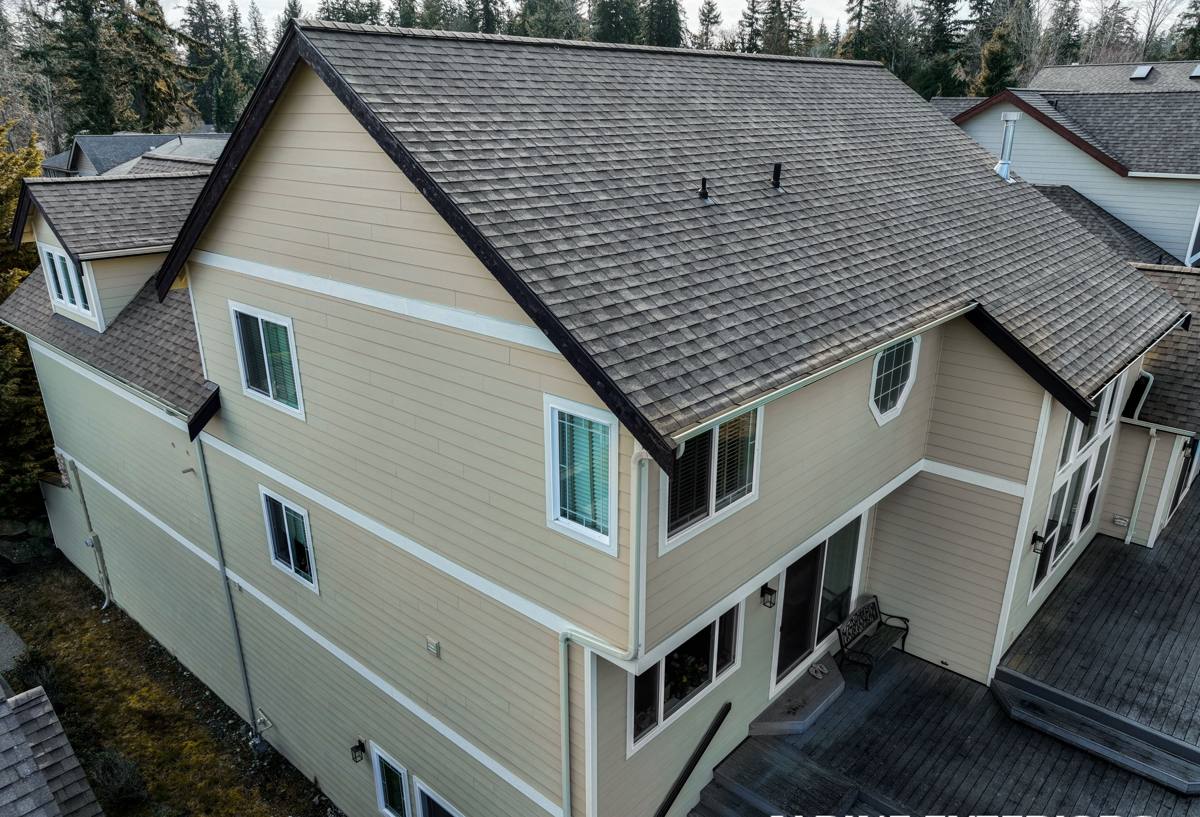
What Point Roberts' Climate Does to a Deck Over Time
Salt-Laden Air and Fastener Corrosion
Being surrounded by saltwater on multiple sides means Point Roberts properties see more airborne salt than a lot of inland Whatcom County lots, even ones just a few miles away. Salt air accelerates corrosion in standard fasteners, joist hangers, and hidden hardware — the metal parts of a deck that you don't see once the boards are down but that the entire structure depends on. A screw or hanger that would last for decades in a dry climate can start pitting, staining the surrounding wood, or losing holding strength years earlier out here.
Wind-Driven Rain and Ledger Connections
Open water on multiple exposures means storms don't have to line up perfectly to drive rain sideways into a house. For a deck, the point of greatest risk is the ledger board — the framing member that bolts the deck structure directly to the house. A ledger that isn't flashed correctly lets wind-driven rain track behind the siding and into the house's framing at exactly the spot where two structures meet, which is a much bigger problem than anything happening to the deck boards themselves.
Moss, Algae, and Slippery Surfaces
Whatcom County's mild, damp weather pattern supports a long moss and algae season, and decks are a prime surface for it — horizontal, often partially shaded by the house or nearby trees, and slow to dry between rain events for much of the year. Moss and algae on deck boards aren't just a cosmetic problem; they create a genuinely slick surface, especially on composite or painted wood decking, and they hold moisture against the board surface longer than bare wood would dry on its own.
Freeze-Thaw Cycling and Footings
Whatcom County doesn't see the deep, sustained freezes of a continental climate, but it does see enough freeze-thaw cycling through the winter to matter for anything below grade. Deck footings that aren't poured to the correct depth and on solid, well-drained soil can shift slightly over repeated freeze-thaw cycles, which shows up years later as a deck that's developed a slope, a bounce, or a gap where it used to sit flush against the house.
Choosing a Decking Material That Can Actually Handle It
Every decking material sold today can technically be installed on a Point Roberts property. Not every one of them is a good match for the exposure this peninsula sees. The table below reflects how these materials tend to actually perform in a salt-air, high-moisture, long-moss-season environment rather than how they perform in a catalog photo.
| Material | Salt Air / Moisture Behavior | Moss & Algae Resistance | Maintenance Burden | Relative Cost |
|---|---|---|---|---|
| Pressure-treated lumber | Resists rot with proper sealing, but end grain and cut edges are vulnerable if not treated after cutting | Low — porous surface holds moisture and grows moss readily if not maintained | High — needs regular cleaning, sealing, and re-staining | Lowest upfront |
| Cedar | Naturally rot-resistant but still needs sealing in this exposure; can gray and check faster near open water | Low to moderate — better than treated pine but still needs regular cleaning | Moderate to high — sealing and cleaning on a set schedule | Moderate |
| Composite decking | Doesn't absorb moisture the way wood does; performs well in salt air with correct fasteners | Moderate to good, depending on the product's surface texture and cap layer | Low — periodic cleaning, no sealing or staining | Higher upfront |
| PVC / cellular decking | Fully resists moisture absorption; strong choice for direct salt exposure | Good — smooth, non-porous surface sheds moisture and resists staining | Lowest — cleaning only | Highest upfront |
We'll walk through this trade-off honestly rather than steering every homeowner toward the most expensive option. A well-built, correctly sealed cedar or pressure-treated deck can look great and last a long time on this peninsula if the homeowner is genuinely willing to keep up with cleaning and resealing on schedule. Composite and PVC decking cost more upfront but trade ongoing maintenance labor for material durability — a fair trade for a lot of Point Roberts homeowners who don't want a recurring weekend project.
Structural Details That Actually Determine Whether a Deck Lasts
Ledger Flashing and Attachment
The ledger board attachment is the single most important structural detail on any deck, and it's the one most likely to get shortcut on a lower-bid job. Correct ledger installation means through-bolting or lag-screwing into solid framing, not just the siding or sheathing, combined with properly lapped flashing that sheds water down and away from the house rather than trapping it behind the ledger. We treat this as a non-negotiable part of every deck we build, not an upgrade.
Joist Protection and Fastener Selection
Framing lumber that sits under decking boards takes on moisture from above even when the surface material handles water well, since rain finds its way through gaps between boards. Joist tape or a comparable protective barrier on top of each joist keeps standing water off the wood and extends the life of the frame significantly. Given how much salt air this property sees, we specify stainless steel or heavy-coated corrosion-resistant fasteners and hardware throughout rather than standard galvanized hardware, which is the first thing to fail in this exposure.
Footings and Frost Depth
Footings need to be sized and set to the depth required for this soil and climate, on solid bearing ground rather than fill or disturbed soil. Skipping this step to save time is one of the most common causes of a deck that develops a slope or separation from the house years down the road — and it's also one of the most expensive problems to fix after the fact, since it usually means partially dismantling the deck to correct.
Board Spacing and Drainage
Correct gap spacing between deck boards lets water drain through rather than pool on the surface, which matters directly for how much moss and algae growth a deck develops over time. Too tight a gap and the deck holds water and grows moss faster; too wide and boards can feel uneven underfoot or catch debris. Getting this detail right during installation is a lot easier than trying to fix it after the fact.
Permits, Access, and the Realities of Building on Point Roberts
Point Roberts is part of Whatcom County and follows the same Washington building code and permitting requirements as the rest of the county, but it's physically separated from the rest of the county and the mainland United States by water and by Canadian territory. That geography has real, practical effects on a construction project that have nothing to do with the deck design itself. Material deliveries, equipment access, and scheduling all take more planning on Point Roberts than they would on a mainland Whatcom County lot, and a crew that hasn't worked out how to handle that logistics ahead of time will pass the friction — and the delays — on to the homeowner.
Permitting still applies here the same as anywhere else in the county: most new deck construction and many significant repairs require a building permit and inspection, particularly for elevated decks, structural ledger attachments, and anything involving footings. We handle that permitting process as a standard part of the job rather than leaving it for the homeowner to navigate.
Signs an Existing Point Roberts Deck Needs Attention
- Deck boards that feel soft, spongy, or spring underfoot when walked on
- Visible moss, algae, or persistent green or black staining across the deck surface
- Rust staining running down from screws, bolts, or joist hangers
- Any gap, slope, or separation where the deck meets the house
- A railing or post that wobbles or flexes when pushed on
- Fasteners that are visibly popped, corroded, or missing entirely
- Water pooling on the surface instead of draining through the board gaps
Any one of these on its own might be a minor fix. Several of them together, especially near the ledger connection to the house, usually mean it's worth having someone look at the structure underneath before doing anything cosmetic to the surface.
Railings, Stairs, and Code Minimums
Guard railing height, baluster spacing, and stair rail requirements are set by Washington building code, and they exist because deck failures involving railings are a real and preventable safety risk — not a paperwork formality. This matters more than usual on a peninsula property, where a meaningful share of homes have elevated decks built to take advantage of water views, putting more height, and more consequence to a railing failure, into the equation. We build railings and stairs to code minimums as a floor, not a ceiling, and we'll flag any existing railing that doesn't meet current requirements during an assessment rather than working around it.
Seasonal Deck Maintenance for a Point Roberts Property
Even a well-built deck needs some ongoing attention in this climate, and the right maintenance schedule depends heavily on which material was chosen. A simple seasonal routine catches small problems while they're still small.
- Clear leaves, needles, and debris out of board gaps regularly so water can actually drain through
- Rinse off salt residue and organic buildup a few times a year, more often on decks closer to open water
- Check fasteners and hardware annually for early rust staining or loosening
- Reseal or restain wood decking on the schedule the product actually needs, not just when it looks faded
- Keep nearby vegetation trimmed back to let air and sun reach shaded sections of the deck
- Check the ledger connection area for any sign of water staining on the siding just above the deck
How We Approach a Point Roberts Deck Project
We start with an on-site visit to look at exposure, existing structure if there is one, soil conditions, and access for materials and equipment — access planning matters more here than on a typical mainland lot. From there we talk through material options honestly, including the maintenance trade-offs described above, rather than defaulting to whatever's easiest to sell. Once a design and material are settled, we handle the permitting process, build the structure with corrosion-resistant hardware and correct ledger flashing as standard practice, and walk the finished deck with the homeowner before considering the job done.
Why a Crew That Already Works Point Roberts Matters
A contractor who regularly works this specific peninsula already has a system for material delivery, equipment access, and scheduling around the realities of building somewhere this exposed and this separated from the rest of Whatcom County. That experience shows up in decisions that aren't visible in a finished deck photo — which fastener grade actually holds up here, how much lap a ledger flashing detail needs, which decking products handle this level of salt air well versus which ones look fine in a showroom and disappoint two winters in. Those are the decisions that determine whether a deck is a twenty-year investment or a five-year disappointment.
If you're planning a new deck on Point Roberts, or you have an existing one that's showing its age, we're happy to take a look and give you an honest read on what it needs. Reach out below for a free, no-pressure estimate.