 Blaine Window
 Siding Replacement in Nooksack: Built for a Whatcom County River Valley
Nooksack sits inland from the water, in the agricultural lowlands of Whatcom County along the Nooksack River, and that setting brings its own version of the weather challenges that define exterior work across this part of the county. Homes here don't take a direct hit of salt spray the way waterfront Blaine properties do, but marine air off the Strait of Georgia and Puget Sound still pushes up the river valleys and settles over the farmland and tree-lined lots around Nooksack, carrying salt-tinged moisture, long stretches of driving rain, and a moss season that can run most of the year on shaded walls. It's a different flavor of the same coastal-influenced climate, and siding that isn't chosen and installed with that in mind tends to show it early.
This page focuses on one service for one area: full siding replacement for homes in and around Nooksack. Not a patch-and-paint repair, not a general overview of every exterior service we offer, but what it actually takes to replace siding correctly on a Nooksack home given the climate, and how our process works from first inspection to final walkthrough.
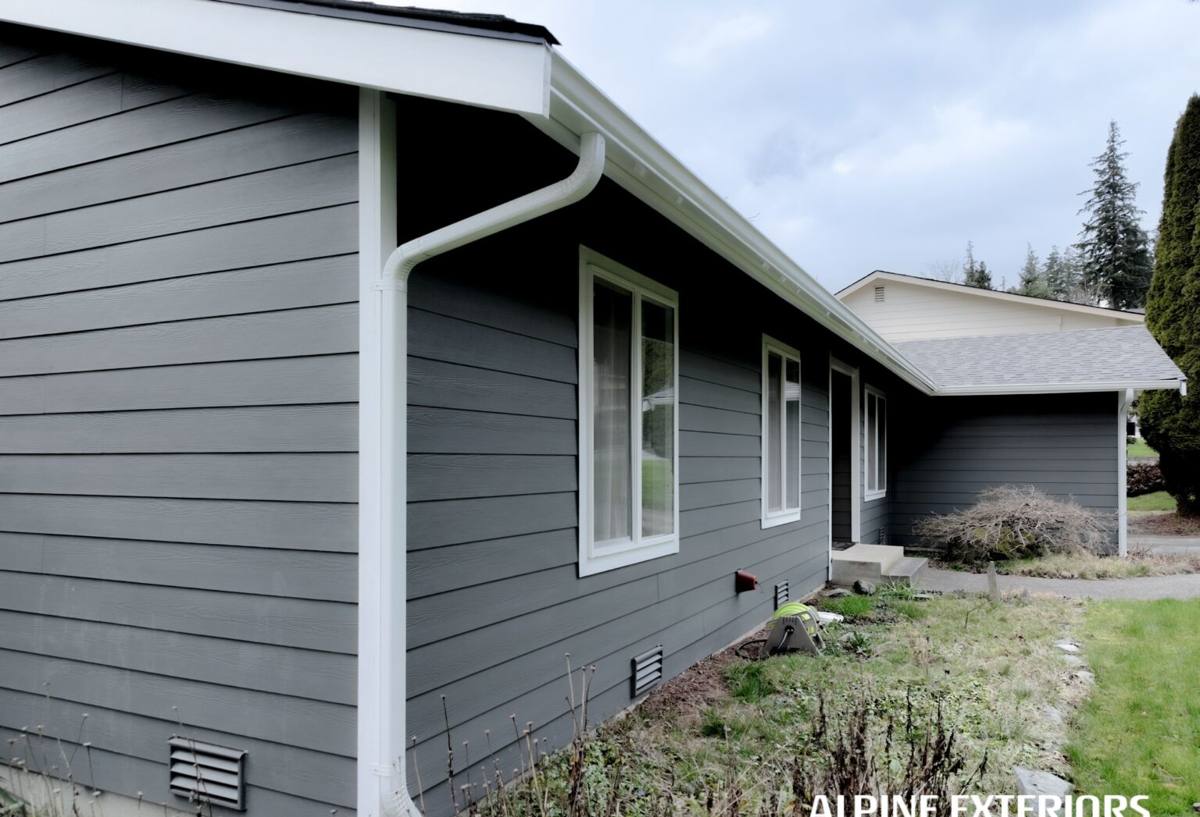
What the Nooksack Area's Climate Does to Siding
Marine-Influenced Air, Even This Far Inland
Being set back from open water doesn't mean Nooksack homes escape marine climate effects entirely. Pacific weather systems move through Whatcom County's low-lying valleys, and salt-tinged air travels further inland along river corridors than most homeowners assume. It's a slower, lower-grade version of what a shoreline property deals with, but over ten or twenty years it still accelerates wear on fasteners, trim hardware, and lower-quality finishes.
Driving Rain and Valley Humidity
Storms rolling in off the water arrive with wind behind them, and that wind pushes rain sideways into siding joints, window flashing, and roof-to-wall transitions rather than letting it run straight down and off. The river valley setting around Nooksack also holds humidity longer than more open, breezy sites; fog and damp air can sit over low-lying farmland well into the morning on cooler months, keeping siding surfaces wet longer than a more exposed location nearby.
A Long Moss and Mildew Season
Mature trees, irrigation, and the general moisture load of a river valley add up to a moss and mildew season that runs close to year-round on north-facing or tree-shaded walls. Any siding material that's even slightly porous, or that holds moisture against the wall rather than shedding it, turns into a growth surface fast in a setting like this.
Signs a Nooksack Home Needs Full Siding Replacement, Not Just Repair
Not every issue calls for tearing the whole exterior off a house. But a handful of signs point past a patch job and toward full replacement, especially once a home's siding is pushing two decades old:
- Soft or spongy panels in more than one or two isolated spots, rather than a single localized area
- Moss or dark staining that returns within weeks of cleaning, on more than one wall
- Visible warping, cupping, or buckling across multiple panels, not just one damaged board
- Paint that won't hold on wood-based or engineered wood siding despite repeated repainting
- Rot or staining found at multiple penetrations, such as around windows, hose bibs, or utility lines
- A documented history of water intrusion or interior staining on walls behind the siding
- Siding original to a home built more than 20-25 years ago, especially engineered wood or untreated wood products
When damage shows up in an isolated spot on an otherwise sound wall, a targeted repair can make sense. When it's spread across a wall, present on more than one elevation of the house, or paired with sheathing concerns underneath, replacement is usually the more honest recommendation, and it's the one we'll give even when a repair would be the easier sale.
Repair or Replace? What the Damage Usually Tells You
| What you're seeing | What it usually means |
|---|---|
| One or two soft boards near ground level | Often a localized moisture or clearance issue; repair may be reasonable if sheathing underneath is sound |
| Widespread cupping or warping across a wall | Points to a material or moisture problem affecting the whole wall; replacement is the more durable fix |
| Moss returning fast after cleaning, on multiple walls | Suggests the material itself is holding moisture rather than shedding it, a sign it's due for replacement |
| Rot found at tear-off in more than a couple of spots | Usually means the whole wall assembly needs attention, not just the siding surface |
| Home is 20+ years old with original siding | Even without visible damage yet, replacement planning is worth starting before problems force the timeline |
What a Correct Siding Replacement Actually Involves
Inspection Before Anything Is Quoted
We start by looking at the house itself: current siding condition wall by wall, any signs of trapped moisture, and how sun, shade, and tree cover affect different sides of the property. On a lot with mature trees or river-adjacent shade, that assessment often varies more from wall to wall than homeowners expect.
Full Tear-Off and Sheathing Check
Old siding comes off entirely so we can see the sheathing underneath before anything new goes up. Covering damaged sheathing with new siding just hides a problem that keeps getting worse behind the wall; finding and addressing it at this stage is non-negotiable, not an upsell.
Weather Barrier and Flashing Detail
Since most coastal-influenced siding failure traces back to water getting behind the cladding rather than through it, the house wrap, window flashing, and every wall penetration get careful attention. This is the step that's easiest to rush and hardest to inspect once new siding is up, so we treat it as a fixed part of the job rather than something that depends on the budget.
Installation to Manufacturer Spec
James Hardie's warranty depends on installation following their published specifications: correct fastener type and spacing, proper clearance above grade and roofline, and correct field-cutting and sealing at every joint. We install to that spec as the baseline on every Nooksack job, not as a premium add-on.
Final Walkthrough
We walk the finished job with the homeowner, cover the maintenance a Whatcom County property like this one actually needs, and confirm the work matches what was estimated before calling it done.
Why We Install Only James Hardie Fiber Cement
We standardized on one siding system after seeing, across jobs throughout Whatcom County, what genuinely holds up in sustained regional moisture and moss pressure versus what performs well on paper and struggles a few wet seasons into real use.
- Non-combustible core: Fiber cement doesn't feed a fire the way wood-based products can, which matters for both safety and insurance underwriting.
- Factory-applied ColorPlus finish: Baked on in a controlled factory process rather than field-applied, so it holds color and adhesion far longer under humidity and UV exposure than site-applied paint.
- Climate-engineered HZ product lines: Hardie's HZ5 formulation is built for regions with sustained moisture exposure and freeze-thaw cycling, a solid match for the Nooksack area's valley humidity and winter weather.
- Dimensional stability: Fiber cement doesn't swell, cup, or warp the way engineered wood siding can after repeated wetting and drying cycles.
- A strong transferable warranty: Hardie backs the product with one of the more robust warranty structures in the industry, provided installation follows their published specs.
We don't install LP SmartSide, vinyl siding, Cemplank, Allura, primed spruce, or cedar. Each has a place in the broader market, and homeowners elsewhere are satisfied with them. Our position is specific to this climate and to what we're willing to stand behind: given the moisture load a Nooksack property deals with year after year, we'd rather commit to one system fully than offer a cheaper option that quietly shifts long-term maintenance onto the homeowner.
What Affects the Cost of a Siding Replacement in Nooksack
| Factor | How it moves the estimate |
|---|---|
| Home size and number of stories | More square footage and taller walls mean more material and labor, plus added scaffolding or lift needs |
| Trim, window, and roofline detail | Homes with more architectural detail take longer to flash and finish correctly around every transition |
| Sheathing condition once old siding is off | Rot or soft sheathing found during tear-off adds repair work before new siding can go up |
| Tree cover and site access | Mature trees and tighter rural lots can add setup time and affect how the crew stages material |
| James Hardie product line and color | Lap siding, board-and-batten, and shingle profiles carry different material costs, as do custom ColorPlus colors |
We walk through these factors specifically during the estimate rather than handing over a number without explaining what's behind it.
Why It Matters to Hire a Crew That Already Works the Nooksack Area
We're based in Blaine and work throughout Whatcom County, including the Nooksack area, on a regular basis, not as an occasional detour between bigger jobs elsewhere. That regular presence shapes real decisions on the ground: which walls hold moisture longest given tree cover and orientation, where flashing deserves extra time, and which details are worth getting right the first time so a homeowner isn't dealing with a callback two winters later. It also means that if a warranty question or maintenance issue comes up years down the line, it's a call to a crew still working in this same part of the county, not one that's moved on somewhere else entirely.
If your Nooksack home's siding is showing its age, or you're just not sure whether a repair or a full replacement makes more sense, we're glad to come take a look. Reach out using the form below for a straightforward, no-pressure estimate.