 Blaine Window
 Why Nooksack-Area Homes Need Siding Built for the Coast
Homes in the Nooksack area, within Blaine's service reach in Whatcom County, deal with a climate that's harder on exterior siding than most homeowners realize until they're staring at a repaint every three years. Salt-tinged air off the water, wind-driven rain that hits walls sideways instead of straight down, and a wet season that stretches long enough to grow a healthy crop of moss on anything that stays damp — that combination wears out the wrong siding fast. It doesn't necessarily look dramatic. It shows up as caulk that cracks a season early, paint that chalks and fades ahead of schedule, and trim that goes soft at the corners before anyone notices water's been getting in.
Fiber cement siding, installed correctly, handles that combination about as well as any exterior product on the market. But "fiber cement" isn't one product — it's a category, and the brand, the installation detail, and the climate-specific product line matter as much as the material itself. This page is about what a correct fiber cement job looks like specifically for homes in this area, not a general rundown of what fiber cement is.
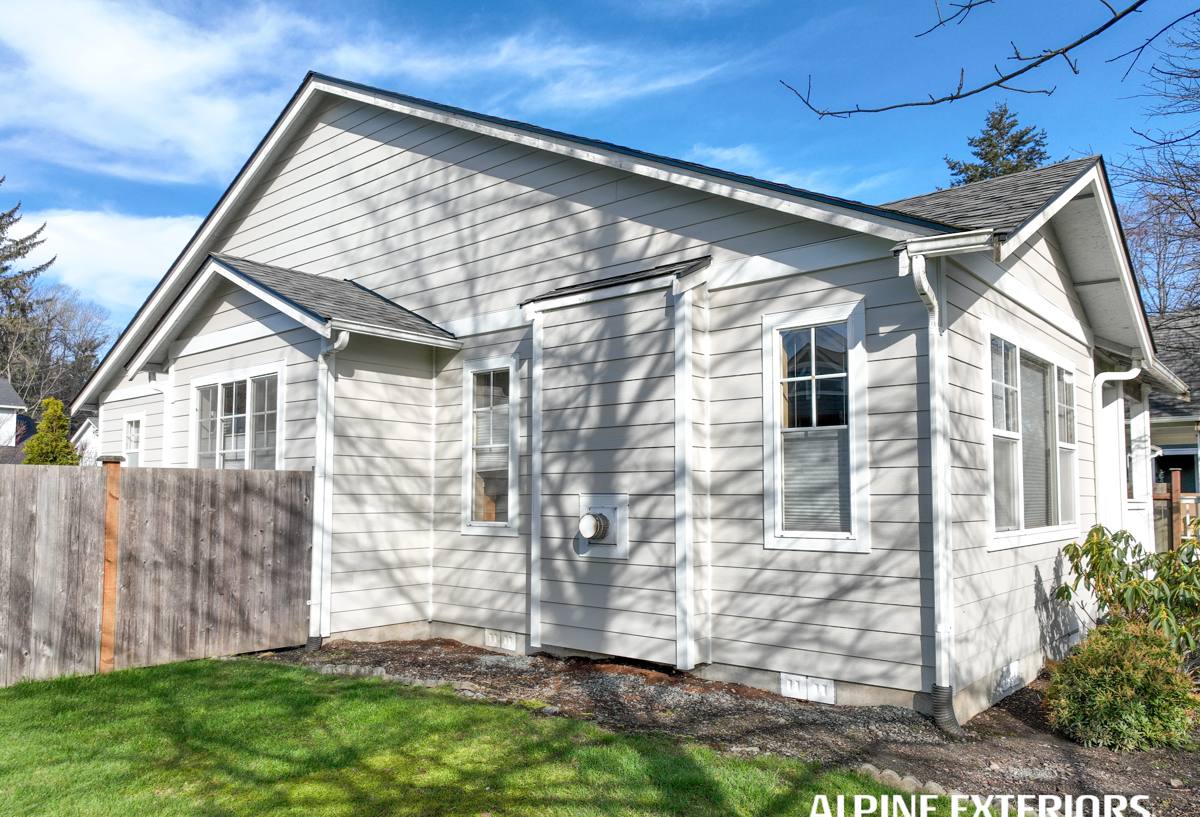
What "Correct" Fiber Cement Installation Actually Means Here
Water Has to Have Somewhere to Go
Fiber cement resists moisture far better than wood, but it isn't waterproof, and neither is the wall behind it. In a climate with regular driving rain, the water-resistive barrier behind the siding, the flashing above windows and doors, and the drainage path at the bottom of the wall all matter more than the siding panel itself. A rainscreen gap — a small air space between the back of the siding and the weather barrier — lets any water that does get past the surface drain and dry out instead of sitting against the sheathing. Skip that detail and you can install the best siding on the market and still get rot underneath it within a decade.
Fastening and Clearances Aren't Optional Details
James Hardie publishes specific fastener spacing, nailing patterns, and minimum clearances — siding-to-grade, siding-to-roofline, siding-to-deck — and those numbers exist for a reason. A clearance that's too tight traps moisture against the bottom edge of a board. A nailing pattern that's off can cause buckling as the material expands and contracts with temperature swings. None of this is unique to coastal Washington, but the consequences of getting it wrong show up faster here because the material spends more days per year wet than it does in a drier climate.
James Hardie vs. the Products We Don't Install
We install James Hardie fiber cement exclusively. Not because every other product is bad, but because after weighing how each one performs against this specific climate — long wet seasons, salt-influenced air, and driving rain — Hardie is the one we're willing to put our name behind and warranty.
| Siding Material | How It Handles Damp, Salt-Influenced Exposure | Maintenance Burden | Our Take |
|---|---|---|---|
| James Hardie Fiber Cement | Engineered HZ product lines for wet climates; non-combustible; factory ColorPlus finish resists moisture-driven fading | Low — occasional rinse, no repainting on schedule | What we install on every job |
| Vinyl Siding | Won't rot, but seams and J-channels let moisture behind the panels; can warp or crack in temperature swings | Low upfront, but trapped moisture problems are hidden until they're expensive | Moisture management concerns keep us from installing it |
| LP SmartSide (engineered wood) | Wood-based core is more moisture-sensitive than fiber cement; edge sealing and caulking has to be maintained closely | Moderate to high — depends heavily on upkeep discipline | Too installation- and maintenance-sensitive for this climate |
| Primed Cedar or Spruce Lap | Natural wood; attractive but absorbs moisture at end grain and needs a sound paint film at all times | High — repainting and caulk touch-ups on a regular cycle | Beautiful material, but not a fit for a marine-influenced climate long-term |
None of these are junk products used correctly in the right setting. But "the right setting" for several of them isn't a place that gets this much rain and this much moss pressure. Fiber cement's non-combustible, dimensionally stable core, paired with a factory-applied finish instead of a job-site paint job, is what holds up best against what this area throws at a wall.
Our Nooksack-Area Installation Process
Assessment and Tear-Off
We start by pulling the old siding and actually looking at what's behind it — sheathing condition, evidence of past water intrusion, existing flashing (or lack of it), and insulation condition. This is the step that gets skipped by crews trying to move fast, and it's the step that determines whether the new siding lasts fifteen years or fifty. Any soft or water-damaged sheathing gets replaced before anything new goes up; covering a problem with new siding doesn't solve it, it just hides it for a while.
Water Barrier and Flashing
We install a continuous water-resistive barrier, proper window and door flashing integrated with that barrier, and a rainscreen gap behind the siding. This is the layer that does the real work of keeping a wall dry in driving rain — the siding is the second line of defense, not the first.
Siding Installation and Finish Work
Panels or lap boards go up to Hardie's fastening specification, with correct clearances at grade, roofline, and trim. We use the manufacturer's recommended fasteners and caulk system rather than substituting whatever's cheapest, because a mismatched caulk or sealant is a common point of early failure. Trim, corners, and any transitions get detailed so water sheds away from the wall instead of pooling at a seam.
Walkthrough and Cleanup
Before we consider a job finished, we walk the exterior with the homeowner, point out anything worth knowing for future maintenance, and clear the site of debris and old material.
Moss, Salt Air, and Driving Rain: What Whatcom County Siding Has to Survive
Three climate factors do most of the damage to siding in this part of Whatcom County, and each one calls for a different response in how a job gets built.
- Moss and algae growth thrives anywhere siding stays damp and shaded, especially north-facing walls and areas under tree cover. A rainscreen gap that lets the wall dry between rain events, plus a factory finish that resists the moisture staining organic growth leaves behind, both matter more here than in a drier region.
- Salt-influenced air off the water accelerates corrosion on unprotected metal — fasteners, flashing, and hardware. We use corrosion-resistant fastener and flashing systems for exactly this reason; the wrong hardware can fail years before the siding around it does.
- Driving, wind-blown rain hits walls at an angle instead of falling straight down, which pushes water into laps, seams, and trim joints that would stay dry in a calmer climate. Correct lap overlap, sealant at critical joints, and flashing integration are what keep that water out.
None of this is exotic engineering. It's disciplined, unglamorous installation detail — the kind that's easy to shortcut and expensive to fix once it's covered up.
Signs Your Current Siding Is Already Losing That Fight
A lot of siding problems in this climate develop slowly enough that homeowners adjust to them without noticing. If you're seeing more than one or two of the items below, it's worth having someone take a real look rather than waiting for a visible failure.
- Paint that's peeling, bubbling, or chalking well ahead of when it should need attention
- Dark streaking or persistent moss and algae growth that comes back shortly after cleaning
- Caulk that's cracked, shrunk, or pulled away from trim and window edges
- Soft or spongy spots when you press on siding near the bottom of walls or below windows
- Visible gaps or warping at seams, corners, or board ends
- Rust staining bleeding from fasteners or trim hardware
- A musty smell or visible staining on interior walls that share an exterior wall with problem siding
Why a Crew That Already Works the Nooksack Area Matters
Fiber cement installation is forgiving of mediocre work in the short term — a poorly detailed job can look fine for a year or two before the moisture problems it created start showing up. A crew that already works this area knows which walls take the worst of the driving rain, understands how much clearance actually holds up against a real wet season instead of just meeting a minimum code number, and isn't guessing at how the local permitting and inspection process works. That familiarity doesn't show up as a line item on an estimate, but it shows up in whether the job is still performing well a decade later.
It also matters for something more basic: accountability. A crew that's local and plans to keep working in this area has every reason to do the job right the first time, because a callback isn't a distant inconvenience — it's next week's schedule.
Maintenance After Installation
One of the practical advantages of James Hardie's factory-applied ColorPlus finish is that it removes the repainting cycle that wears out homeowners with wood or field-painted siding. That doesn't mean zero maintenance — it means the maintenance that's left is manageable.
| Task | Why It Matters Here |
|---|---|
| Rinse siding annually, more often on shaded or north-facing walls | Reduces moss and algae buildup before it takes hold |
| Keep gutters and downspouts clear and directing water away from the foundation | Prevents splash-back and standing water at the base of walls |
| Check and refresh caulk at trim and window joints every few years | Driving rain finds any gap that's opened up over time |
| Trim back vegetation and tree cover touching the siding | Improves airflow and drying, which limits moss growth |
If you're weighing a siding replacement for a home in the Nooksack area or elsewhere near Blaine, we're glad to come take a look and talk through what your walls actually need — no pressure, no hard sell, just a straight answer. Use the form below to request a free estimate.