 Blaine Window
 What Nooksack's Climate Does to Siding Over Time
Nooksack sits inland from the water, but it shares the same wet, marine-influenced weather that shapes exterior work all across Whatcom County. Homes right on the water near Blaine take the brunt of direct salt air. Nooksack homes generally see less of that, but they trade it for something almost as hard on siding: long stretches of shaded, still, damp air. Tree cover, valley humidity, and slower drying times after rain add up to a longer moss and mildew season than you'd get in a drier inland climate.
Add in driving rain that comes sideways during winter storms, and you've got a combination that finds every weak point in a siding system - every gap in caulking, every spot where water can get behind a board and stay there instead of draining back out. Wood-based siding products are especially vulnerable to this pattern because they absorb moisture and hold onto it. Over a few winters, that's how you get soft trim, bubbling paint, and moss creeping up from the bottom courses.
None of this means Nooksack is a uniquely brutal climate. It means the siding on a Nooksack home needs to be a product and an installation that's actually engineered for sustained moisture exposure, not just rated for it on a spec sheet.
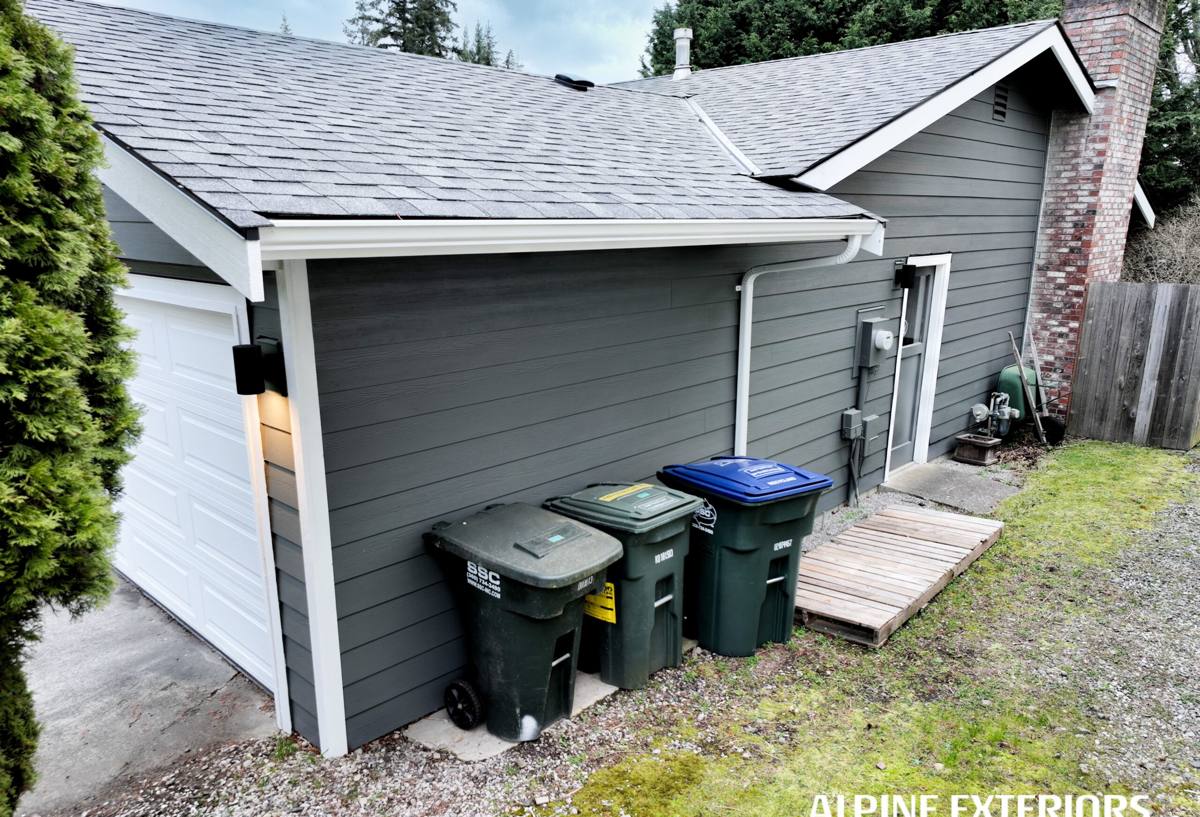
Why We Only Install Fiber Cement in This Area
We install James Hardie fiber cement siding exclusively. We don't install LP SmartSide, vinyl, Cemplank, Allura, primed spruce, or cedar, and the reasons come directly from what we see happen to those products in Whatcom County's climate over ten, fifteen, twenty years.
Engineered wood products like LP SmartSide use a wood strand core with a resin coating. That coating works as long as it stays fully intact, but any cut edge, fastener hole, or impact point is a place water can get in - and once it does, the wood core swells and doesn't recover. Vinyl doesn't rot, but it expands and contracts with temperature swings, can crack in cold snaps, and fades unevenly over the years, especially on south- and west-facing walls. Cedar and primed spruce are honest, attractive materials, but they need real maintenance - recoating, caulk inspection, moss treatment - on a schedule most homeowners don't keep up with once the "new house" feeling wears off.
Fiber cement is cement, sand, and cellulose fiber. It doesn't have a wood core to swell, and it doesn't have a plastic structure that degrades in UV light. It's dimensionally stable through wet and dry cycles, which matters enormously in a climate that swings between soaked and dry constantly.
| Factor | James Hardie Fiber Cement | Engineered Wood (LP SmartSide) | Vinyl | Cedar / Primed Spruce |
|---|---|---|---|---|
| Moisture behavior | Does not swell or rot; stable through wet cycles | Wood core can swell at cuts, holes, and damaged coating | Doesn't absorb water but can trap moisture behind it if installed poorly | Absorbs and releases moisture; prone to rot without upkeep |
| Moss / algae resistance | Factory finish resists staining; cleans up easily | Coating can stain and degrade under sustained moss growth | Doesn't feed moss but moss holds moisture against the surface | Moss anchors into grain and holds moisture against wood |
| Fire performance | Non-combustible | Combustible wood-based product | Combustible, can deform under heat | Combustible |
| Maintenance | Occasional wash; no recoating needed with ColorPlus finish | Coating maintenance and caulk inspection | Low, but cracked panels can't be spot-repaired invisibly | Recoating and moss treatment on a recurring schedule |
| Typical service life to spec | 30+ years, often longer with upkeep | Manufacturer-dependent, sensitive to install quality | 20-30 years, fading and brittleness increase over time | Highly dependent on maintenance discipline |
The James Hardie System We Put on Nooksack Homes
James Hardie makes climate-specific product lines, and for Pacific Northwest homes we spec the HZ5 line, engineered for regions that see prolonged moisture and freeze-thaw cycling. It's built and tested differently than the versions of Hardie siding sold in dry southwestern climates, which is part of why "James Hardie siding" isn't one single product - the region it's engineered for matters.
We install it with the ColorPlus factory finish whenever it fits the project, which bakes the color onto the board at the factory under controlled conditions instead of relying on field-applied paint. That finish holds color more evenly, resists fading, and comes with a separate finish warranty from Hardie's substrate warranty. For homeowners who want a specific custom color or are matching existing trim, we can install primed Hardie board for field painting instead - but ColorPlus is what we recommend for most Nooksack projects, because it removes an entire maintenance task from the homeowner's plate.
What a Correct Installation Actually Involves
The single biggest factor in how long any siding lasts isn't the product - it's the installation. Fiber cement performs exactly as well as the details underneath it, and in a wet climate, the details underneath are what determine whether water gets managed or trapped.
Water Management Behind the Boards
Before a single piece of siding goes up, the wall needs a properly lapped weather-resistant barrier, correctly integrated flashing at every window, door, and penetration, and a drainage plane that lets any moisture that does get behind the siding find its way back out instead of pooling. This is the part of the job nobody sees once it's finished, and it's also the part that decides whether you're dealing with a wall assembly failure ten years from now.
Clearances, Fastening, and Joints
Hardie's own installation instructions specify minimum clearances from grade, roof lines, decks, and other surfaces, along with specific fastener types, spacing, and penetration depth. Skipping these isn't a cosmetic shortcut - it's how you end up with wicking at the bottom edge, popped fasteners, or panels that don't perform the way the warranty assumes they will. Butt joints and trim intersections need to be caulked with a product rated for the movement and exposure involved, not whatever caulk happens to be in the truck that day.
Our Process for a Nooksack Siding Project
We start with an in-person inspection of the existing siding and the wall assembly underneath it wherever we can access it - not just a look at the outside condition, but a check for soft spots, existing moisture damage, and anything the old siding might be hiding. From there we walk the homeowner through what we found, what the scope of the job looks like, and where the money is actually going.
Once a project is underway, removing the old siding gives us a direct look at the sheathing and framing. Any rot or damage gets addressed before anything new goes up - installing new siding over a compromised wall doesn't fix the underlying problem, it just hides it again. We install or repair the weather barrier and flashing, then install the Hardie boards to spec, trim out windows, doors, and corners, and finish with a full walkthrough before we call the job done.
Problems We Commonly Find on Older Siding in This Area
A lot of our Nooksack calls start with a homeowner noticing something specific - a stain, a soft spot, a section that looks different from the rest - rather than a full siding failure. The patterns we see most often:
- Moss and algae staining concentrated on north-facing and shaded walls, where surfaces stay damp longest
- Soft or delaminating trim boards where caulk joints failed years earlier and were never resealed
- Swollen or bubbling panels on engineered wood siding near ground contact or under gutters that overflow
- Fastener corrosion or popped nails on older installations where the wrong fastener type was used
- Gaps at window and door trim where the original flashing was never properly integrated
None of these are unusual for the climate - they're the predictable result of moisture finding a way in and having nowhere to go. It's exactly the failure pattern fiber cement, installed correctly, is designed to resist.
Keeping New Siding Performing Like It Should
James Hardie siding with a ColorPlus finish is low-maintenance, not no-maintenance. A little attention once or twice a year goes a long way toward getting the full service life out of it in a climate like this one.
- Rinse siding with a garden hose once or twice a year to clear pollen, dust, and early moss growth before it takes hold
- Keep gutters clean and check that downspouts direct water away from the foundation, not down the wall
- Trim back vegetation and tree branches that keep siding shaded and damp longer than it needs to be
- Inspect caulk joints at trim and penetrations every year or two and have any cracked sections resealed
- Address any impact damage or chips promptly so the substrate underneath stays protected
Why It Matters Who You Hire for This
James Hardie siding is a forgiving product when it's installed correctly and an unforgiving one when it isn't. Two crews can install the same boards from the same batch and get very different results ten years out, because the difference lives in the flashing details, the fastening, and the clearances - the parts of the job that don't show up in a walk-around inspection right after completion.
A crew that regularly works in Nooksack and the surrounding Whatcom County towns has already seen how this climate treats siding that was installed to spec and siding that wasn't. That's not a marketing point - it changes what gets caulked, how flashing gets lapped, and where extra attention goes on a given wall, based on sun exposure, shade, and drainage on that specific lot.
What Drives the Cost of a Nooksack Siding Project
Every project is different, but the same handful of factors move the number most:
The condition of the wall underneath matters more than almost anything else - a straightforward re-side over sound sheathing costs less than a project where rot repair or sheathing replacement is needed first. The amount of trim detail, the number of windows and corners, and the home's overall size and story count all affect labor. Choosing ColorPlus factory-finished boards versus primed boards for field painting shifts cost between the siding purchase and the paint labor. And access - steep roof lines, tight lot lines, second-story work - affects how efficiently a crew can move.
We give straightforward, itemized estimates so homeowners can see where the cost is actually going, rather than a single lump number with no explanation behind it.
If you're weighing a siding project for a Nooksack home, we're happy to take a look and walk you through what we see - no pressure, no obligation. Use the form below to request a free estimate.