 Blaine Window
 Grandview's Climate Is Harder on Siding Than It Looks
Grandview sits close enough to the water that salt air is a daily fact of life, not an occasional nuisance. Add Whatcom County's driving winter rain — the kind that comes in sideways off Semiahmoo Bay and Boundary Bay rather than falling straight down — and you have two forces working against every exterior wall year-round. Then there's the long moss season: from late fall through spring, north-facing and shaded walls stay damp for weeks at a stretch, which is exactly the environment moss, algae, and mildew need to take hold.
None of this is dramatic on its own. It's the combination, repeated every year for decades, that separates siding that holds up from siding that quietly fails behind a good-looking surface. Salt air accelerates corrosion of fasteners and trim metal. Driving rain finds every gap in flashing and caulk that wouldn't matter in a drier climate. Moss and standing moisture hold water against the wall assembly longer than the material was ever designed to tolerate. A siding choice and installation approach that works fine in Spokane or Yakima is not automatically the right call two blocks from the water in Blaine.
Why We Install James Hardie and Nothing Else Here
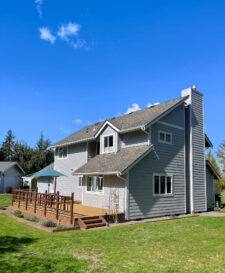
We're a James Hardie-only crew. We don't install LP SmartSide, vinyl, Cemplank, Allura, primed spruce, or cedar, and in a neighborhood like Grandview that's not a brand preference — it's a response to what the climate does to the alternatives.
Vinyl softens and warps under sustained UV and heat cycling, and its seams and J-channels give wind-driven rain more places to get behind the panel. Wood-based products, including engineered wood siding, depend on an intact factory coating to keep moisture out; once that coating is compromised by a scratch, a fastener hole, or years of damp shade, the wood substrate underneath can swell, delaminate, or rot from the inside where you can't see it until it's serious. Cedar looks great on day one but needs ongoing refinishing to hold up against salt air and moss, and that maintenance burden only grows every year the home sits this close to the water.
James Hardie fiber cement is non-combustible and doesn't have an organic wood component to rot. It's engineered specifically for wet regional climates through Hardie's HZ5 product line, which is formulated for higher-moisture, marine-influenced areas like ours. The ColorPlus factory finish is baked on under controlled conditions rather than applied on-site, which gives it a more consistent, longer-lasting bond than field-applied paint — a real advantage when the walls in question spend half the year damp.
What HZ5 Actually Changes
Hardie makes climate-specific formulations rather than one national product. HZ5 (used in wetter, more temperate regions including western Washington) is engineered with moisture and freeze-thaw cycling in mind, as opposed to the HZ10 formulation built for hot, dry, high-UV climates. Installing the correct HZ designation for our region isn't a marketing detail — it affects how the product handles the moisture load Grandview actually sees.
What a Correct Installation Involves
Fiber cement siding is only as good as the assembly behind it. In a high-moisture, salt-exposed neighborhood, the details most homeowners never see are the ones that determine whether the siding lasts 30-plus years or starts showing problems in year eight.
- Weather-resistive barrier (WRB): a continuous, properly lapped house wrap or building paper behind the siding, with all penetrations sealed — this is the home's real first line of defense, not the siding itself.
- Flashing at every penetration: windows, doors, hose bibs, light fixtures, and any other wall penetration need step flashing or properly integrated flashing tape so driving rain can't track behind the cladding.
- Correct clearances: Hardie specifies minimum clearances from grade, roofing, decks, and other abutting surfaces so water has somewhere to go instead of wicking into the bottom edge of the panel.
- Fastener spec and material: corrosion-resistant fasteners, placed and spaced to Hardie's published pattern — cutting corners here is where salt air does the most damage over time.
- Proper caulking and joint treatment: factory-primed cut edges sealed correctly, and joints treated per Hardie's installation guide rather than just caulked over and painted.
- Ventilation behind the cladding: allowing the wall assembly to dry between rain events, which matters most on shaded, moss-prone elevations.
Skipping or rushing any one of these doesn't show up on day one. It shows up three, five, or ten years later as staining, soft trim, or a panel that's failing from behind while the face still looks fine.
How We Approach a Grandview Project
1. On-Site Assessment
We walk the home and look specifically at moisture history — staining, soft spots, prior repairs, and which elevations get the most wind-driven rain and the least sun. In Grandview that's usually the north and west faces, which also tend to be the ones holding moss.
2. Removal and Substrate Check
Old siding comes off so we can actually see the sheathing and WRB underneath rather than installing over unknown conditions. Any damaged sheathing gets addressed before anything new goes up — new siding over a compromised wall just hides the problem for a few more years.
3. WRB and Flashing Installation
This is the step that determines long-term performance more than any other, and it's the one that's invisible once the job is done. We install and document the water-resistive barrier and flashing to Hardie's specifications before a single piece of siding goes on.
4. Hardie Installation to Spec
Panels, fasteners, clearances, and joint treatment go in per manufacturer specification — the same details listed above, done consistently across the whole house rather than just on the elevations that are easy to reach.
5. Final Walkthrough
We review the finished work with the homeowner, including care and maintenance expectations specific to a salt-air, high-moss environment.
Comparing Cladding Options for a Grandview Home
| Factor | James Hardie Fiber Cement | Vinyl | Wood / Engineered Wood |
|---|---|---|---|
| Moisture behavior | Doesn't rot; HZ5 formulated for wet climates | Doesn't rot, but seams/panels can let water track behind | Vulnerable once coating or seal is breached |
| Salt air / corrosion | Fiber cement body unaffected; use corrosion-resistant fasteners | Panel unaffected; hardware and fasteners still at risk | Coating breaks down faster near salt air |
| Moss and algae | ColorPlus finish resists staining better than field-applied paint | Can stain and hold moss in damp shaded areas | Prone to moisture retention and organic growth |
| Fire rating | Non-combustible | Combustible | Combustible |
| Maintenance | Periodic wash; repaint only if desired | Low, but degrades under UV/heat over decades | Regular refinishing required |
Cost Factors Homeowners Should Understand
We don't quote pricing without seeing the home, but the factors that move a Grandview project's cost up or down are consistent from house to house:
| Factor | Why It Matters |
|---|---|
| Wall condition underneath | Rot or moisture damage found during tear-off adds repair scope before new siding goes up |
| Number of stories / access | Multi-story and tight-lot homes take longer and require more setup |
| Trim and detail complexity | Dormers, bump-outs, and multiple roof lines add cutting, flashing, and labor time |
| Product line and profile | Lap siding, shingle-style panels, and board-and-batten carry different material costs |
| Color option | ColorPlus factory finishes vs. field-painted after installation affect both cost and long-term touch-up needs |
Living With Hardie Siding in Grandview's Climate
Correctly installed James Hardie siding is low-maintenance, not no-maintenance. A periodic gentle wash removes the salt residue and moss spores before they can take hold, especially on the shaded elevations that stay damp longest through Whatcom County's wet season. Keep gutters clear and grade sloped away from the foundation so wind-driven rain has somewhere to drain rather than sitting against the base of the wall. Trim back vegetation that's shading a wall and keeping it from drying out — that's often the single biggest factor in how much moss a given elevation collects.
If touch-up is ever needed at a cut edge or a repair, it's worth using Hardie-compatible primer and paint so the patched area weathers consistently with the ColorPlus finish around it rather than aging at a different rate.
Why It Matters That We Already Work in Grandview
A lot of what makes a siding job hold up here isn't in the product spec sheet — it's local knowledge. Knowing which elevations in this neighborhood take the worst of the wind-driven rain, which lots hold moisture longest into spring, and how salt air behaves on fasteners and trim over the years isn't something a crew that installs a handful of jobs a year in Whatcom County builds up quickly. A crew that's done this work in Grandview and the surrounding Blaine area repeatedly has already seen which shortcuts fail here and which installation details actually matter, rather than applying a generic approach and hoping it holds.
That local pattern recognition shows up in small decisions during the job — where to add extra flashing attention, which elevations warrant a closer look at the substrate before covering it back up, how to sequence the work around our wet-season weather windows. It's the difference between a technically correct installation and one that's actually correct for this specific piece of coastline.
Ready to Talk About Your Home
If you're weighing a siding replacement in Grandview, we're happy to walk the property, look at what your current siding is telling us, and give you an honest, no-pressure estimate for a correctly installed James Hardie system built for this exact climate. Fill out the form below and we'll be in touch.