 Blaine Window
 Why Decks in Custer Wear Out Faster Than Homeowners Expect
Custer sits close enough to the water and open farmland that decks here take a harder beating than the glossy composite ads suggest. Three things do most of the damage: salt-laden air moving in off the Strait, long stretches of driving rain that don't just fall straight down but get pushed sideways under railings and into seams, and a moss season that can run from October well into April. None of these are dramatic events — no single storm wrecks a deck. It's the slow, repeated exposure that gets into fasteners, framing, and ledger connections year after year until a deck that looked fine from the yard turns out to be structurally tired underneath.
We see the same failure pattern on a lot of Custer properties: the decking boards themselves are still walkable, but the framing, flashing, and hardware underneath have quietly given up. That's why a deck replacement here isn't just about picking new boards — it's about rebuilding the parts nobody sees so the next 20-plus years don't repeat the same problems.
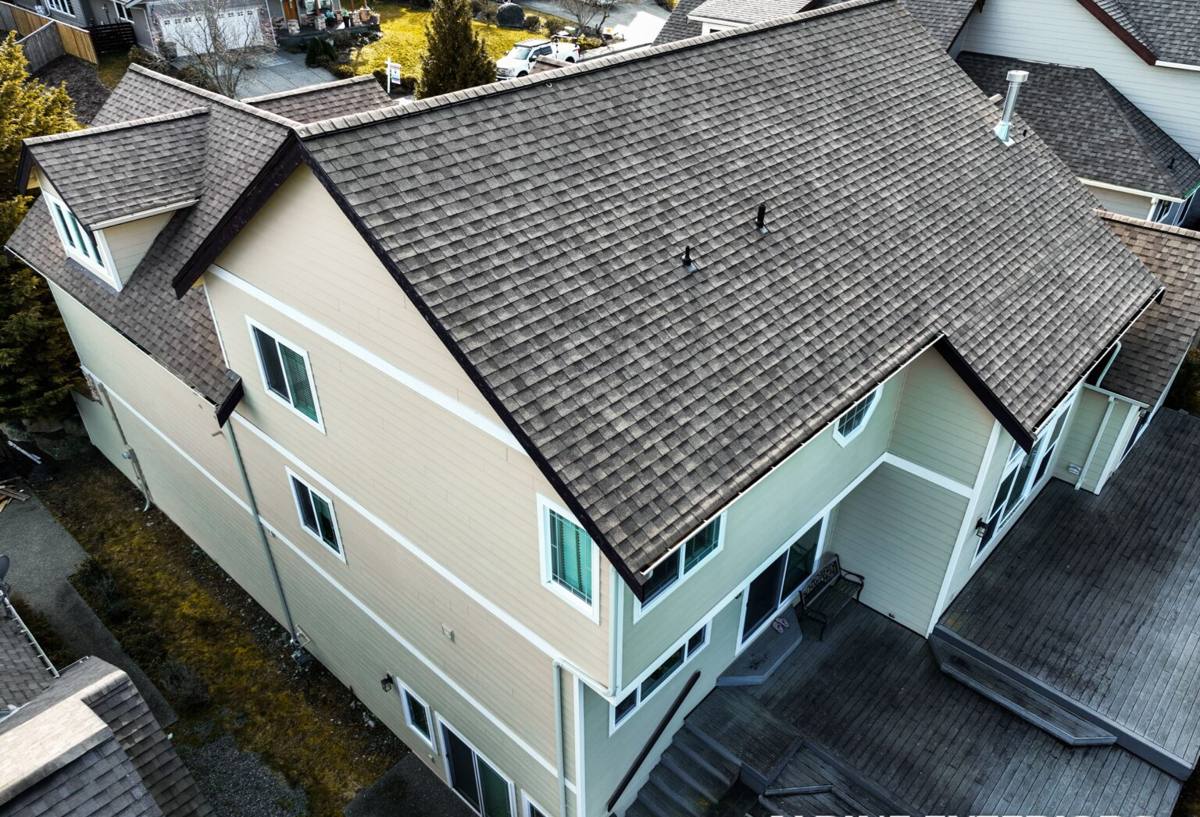
How Salt Air and Rain Actually Damage a Deck
Salt Air and Metal Hardware
Every deck depends on metal — joist hangers, structural screws, bolts, post bases — to hold the frame together. Standard zinc-coated hardware wasn't designed for coastal exposure, and in a salt-air environment like Custer's it corrodes faster than most homeowners realize. Corrosion doesn't announce itself; it happens under the decking, inside joist hangers, where you can't see it during a casual walk around the deck. By the time rust stains start showing through the boards, the hardware has often been compromised for a while.
Driving Rain and Hidden Rot
Rain that comes in at an angle finds its way into places vertical-fall rain never would — under railing caps, behind fascia boards, and especially at the ledger board where the deck attaches to the house. If that ledger connection wasn't flashed correctly when the deck was originally built, water has likely been getting behind it for years, slowly rotting the rim joist and sill area. This is the single most common structural failure point we find on older decks in this area, and it's almost always invisible until the deck starts to feel spongy or pulls slightly away from the house.
Moss, Algae, and Slip Risk
A long moss season means more than green boards. Moss and algae hold moisture directly against the decking surface for months at a time, which accelerates wood decay and, on composite or painted surfaces, creates a genuinely dangerous slip hazard on stairs and ramps. Decks with poor sun exposure or heavy tree cover — common on wooded Custer lots — are especially prone to this, and no amount of surface cleaning fixes it if the drainage and airflow underneath the deck were never addressed.
Signs a Deck Needs Replacement, Not Repair
Not every tired deck needs a full teardown. But there's a point where patching boards or sistering a joist is just delaying an expensive problem instead of solving it. Here's what we look for during an assessment:
- Soft, spongy, or bouncy sections in the decking or framing when you walk on them
- Rust streaking or stains coming through the boards near hardware locations
- A ledger board that shows gaps, dark staining, or separation from the house
- Posts or footings that have shifted, settled, or show visible rot at the base
- Railings that flex or wiggle noticeably when pushed
- Persistent moss or algae growth that returns within weeks of cleaning
- Fasteners that are rusted, backing out, or missing entirely
- A deck more than 20 years old that has never had the framing inspected
If you're seeing two or more of these, it's worth having someone look underneath before spending money on cosmetic fixes.
What a Correct Deck Replacement Actually Involves
A deck replacement done right is mostly about what's underneath the walking surface. The visible decking gets the attention, but the parts that determine whether the deck lasts are the ledger flashing, the framing layout, the footings, and the hardware. Here's what we treat as non-negotiable on every rebuild:
Ledger and Flashing
Where the deck meets the house is the single most important connection on the structure. We install proper flashing that directs water away from the rim joist and wall sheathing, rather than letting it pool at the connection point — this is the detail most responsible for hidden rot on older decks in wet climates like ours.
Footings and Posts
Footings need to sit below frost depth and bear on solid, undisturbed soil. On sites with drainage issues — common on lower-lying Custer lots — we pay close attention to how water moves around the footing locations so posts aren't sitting in standing water after every rain.
Framing and Joist Spacing
Joist spacing and beam sizing depend on the decking material you choose and the span involved. Composite decking, for example, often requires tighter joist spacing than wood to prevent flexing over time. We size the frame for the material going on top of it, not the other way around.
Fasteners and Hardware
Given the salt air here, we don't use standard mill-galvanized hardware on exposed framing. Hot-dip galvanized or stainless steel connectors and fasteners cost more up front, but they're the difference between hardware that's still sound in 15 years and hardware that's rusting through in five. This is one of the areas where cutting corners doesn't show up until it's a real problem.
Drainage and Airflow Underneath
A deck built low to the ground with poor airflow underneath will hold moisture and grow moss no matter how good the decking material is. Where grading allows, we build in enough clearance and slope the ground beneath the deck to shed water instead of trapping it.
Choosing a Decking Material for Custer's Climate
There's no single "best" decking material — there's a right choice for your budget, your maintenance appetite, and how exposed your deck is to weather. Here's how the common options actually compare in a coastal, high-rain climate:
| Material | Upfront Cost | Maintenance | Moisture Behavior | Typical Lifespan |
|---|---|---|---|---|
| Pressure-Treated Wood | Lowest | Annual cleaning, periodic staining/sealing | Prone to checking and splintering if not maintained; can rot at fastener points | 10–15 years |
| Cedar | Moderate | Regular sealing to maintain color and resist moisture | Naturally rot-resistant but still needs upkeep near salt air and standing moisture | 15–20 years |
| Composite | Higher | Occasional washing, no staining/sealing required | Doesn't rot, but can trap moss/algae on the surface if drainage underneath is poor | 25–30 years |
In our experience, composite makes the most sense for homeowners who want to skip the annual staining routine, especially on decks that get heavy moss exposure. Cedar remains a solid choice for those who prefer a natural wood look and are willing to keep up with sealing. Pressure-treated is the budget entry point, but in this climate it needs consistent maintenance to hit its full lifespan — skipped maintenance years show up fast as splitting and gray, weathered boards.
Permits and Code Considerations in Whatcom County
Most deck replacements — especially anything involving new footings, a raised structure, or guardrails over 30 inches — require a permit through Whatcom County. Guardrail height, baluster spacing, and stair rise/run all have code requirements that matter both for the inspection and for actual safety. We handle the permit application and coordinate the inspection as part of the job, so you're not left figuring out county requirements on your own. If your existing deck was built without a permit or before current code updates, a full replacement is often the moment to bring the structure up to current standards rather than repeating an outdated layout.
Our Deck Replacement Process
- On-site assessment — we inspect the framing, ledger connection, footings, and hardware, not just the surface boards, to determine what's actually driving the need for replacement.
- Written estimate — a clear breakdown of materials, structural work, and timeline, with honest trade-offs between decking options for your situation.
- Permit handling — we pull the necessary Whatcom County permits and schedule inspections so the project stays compliant.
- Demolition and disposal — old decking, framing, and any hidden rot are fully removed so we're building on solid material, not around a problem.
- Rebuild — footings, framing, flashing, and hardware go in first, sized correctly for your chosen decking material and local weather exposure.
- Decking and railing install — final surface, railings, and stairs installed to code, with attention to drainage and airflow underneath.
- Final walkthrough — we go over the finished deck with you and cover basic maintenance expectations for whatever material you chose.
We schedule around the wetter stretches of the year where possible, since framing and flashing work goes in better — and lasts longer — when it isn't rushed between rain systems.
Why a Crew That Already Works in Custer Matters
Deck problems here aren't generic — they're shaped by this specific stretch of Whatcom County: proximity to salt air, the amount of driving rain a given lot catches, tree cover and moss exposure, and how individual properties drain. A crew that's already replaced decks on similar lots in Custer isn't guessing at hardware grade or footing depth; they've seen what actually fails here and build around it from the start. That local pattern recognition is worth more than a generic install — it's the difference between a deck that needs attention again in eight years and one that doesn't.
If your deck is showing any of the warning signs above, or you're just ready to stop maintaining a structure that's past its prime, we're happy to take a look. Reach out for a free, no-pressure estimate — we'll walk the deck with you, tell you honestly what we find, and lay out real options before any work begins.