 Blaine Window
 Why Custer Decks Need to Be Built Differently
Custer sits close enough to the water and far enough into the Whatcom County countryside that decks here take a specific kind of beating. It's not one dramatic storm that wrecks a deck out this way — it's the slow, steady combination of salt-carrying wind off the Strait, months of driving rain, and a moss season that seems to start earlier every year. A deck built to a generic spec, or installed by a crew that mostly works drier inland areas, tends to show its age fast: soft spots in the frame, green film on the boards by January, fasteners that back out, railings that go soft at the post base. Composite decking done right handles all of that. Composite decking done wrong just hides the problems longer before they show up.
We install composite decking in Custer regularly, not as a side trip from a job somewhere else. That matters more than it sounds like it should, and we'll get into why later in this page. First, it's worth being honest about what this climate actually does to a deck, because that's what should drive every decision about materials and installation — not just the color of the board.
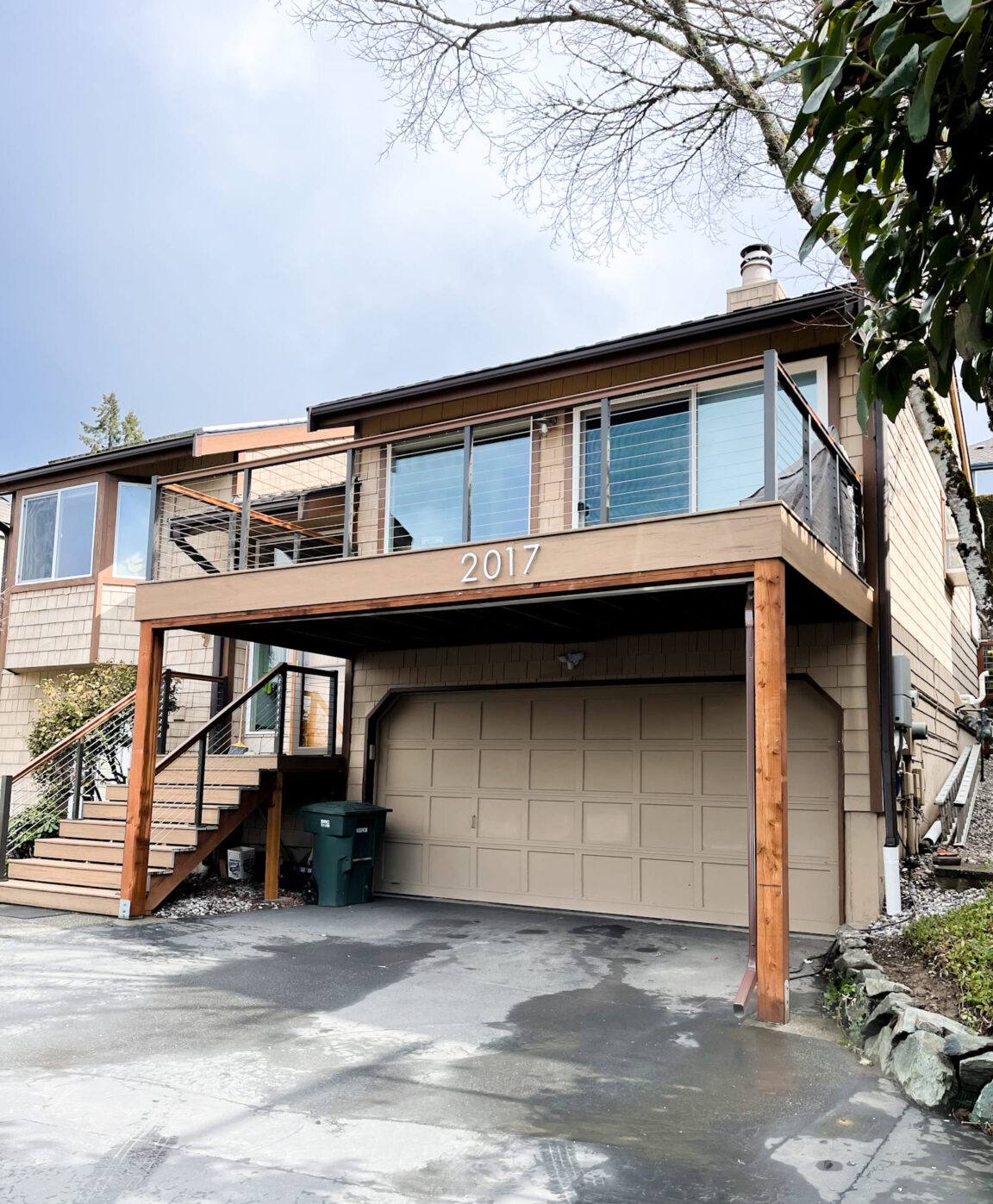
What Salt Air, Rain, and Moss Actually Do to a Deck
Three things work against decks in this part of Whatcom County, and they don't act alone — they compound each other.
Salt Air
Even a few miles inland, air moving off the Strait of Georgia carries fine salt that settles on every exterior surface. On a deck, that means accelerated corrosion on any exposed fastener, hinge, or bracket that isn't rated for coastal exposure. Standard zinc-coated screws and brackets will rust and stain long before the boards themselves show any wear.
Driving Rain
This isn't a light-drizzle climate for much of the year. Rain here often comes sideways, which pushes water into joints, under railings, and along the edges of boards that a calmer climate would keep mostly dry. Any gap in flashing, any spot where water can pool instead of shed, becomes a slow-motion problem — rot in the framing underneath, staining, or a soft feel in the boards over a few seasons.
Moss and Organic Growth
Shade, moisture, and mild temperatures are exactly what moss and algae want. A deck that doesn't get much direct sun, or one that's tucked under trees, will grow a green film faster here than almost anywhere else in the state. That film isn't just cosmetic — it holds moisture against the board surface and makes the deck slick and genuinely dangerous underfoot when wet.
None of this means composite decking is a bad fit for Custer — it's actually one of the better options for this exact combination of problems. But "composite" isn't one product, and not every composite board or installation method handles these three stresses equally well.
Choosing a Composite Board That Actually Holds Up Here
"Composite decking" covers a range of products with real differences in how they perform in wet, mossy, salt-air conditions. The two biggest distinctions we walk homeowners through are capped versus uncapped composite, and how the board's surface texture handles algae and moisture.
Capped vs. Uncapped Composite
Capped composite boards have a polymer shell fully wrapped around a wood-plastic core. That shell is what resists moisture absorption, staining, and fading — it's the reason capped composite has largely replaced older uncapped composite products in coastal and high-rain climates. Uncapped composite, or composite with only a partial cap, absorbs more moisture at the surface over time, which in a climate like Custer's means faster moss and mildew growth and a shorter realistic lifespan before the surface starts to look tired.
Surface Texture and Color
Deeply grained, textured surfaces look great in a showroom but can hold more moisture and organic debris in a shaded, rain-heavy yard than a smoother, more uniform surface finish. Darker boards also show green moss film faster than lighter or variegated colors, simply because of contrast — the moss isn't necessarily growing faster, it's just more visible sooner. We factor this into the color and texture conversation for any deck that's going in a shaded or low-sun spot, which describes a fair number of yards in and around Custer.
| Factor | Capped Composite | Uncapped / Partial-Cap Composite |
|---|---|---|
| Moisture absorption | Low — polymer shell blocks most water contact with the core | Higher — core material can absorb moisture at cut edges and surface |
| Moss/algae resistance | Better — smoother, sealed surface is harder for growth to grip | Weaker — porous surface holds moisture longer |
| Fading/staining over time | Slower, more consistent color retention | More noticeable fading and staining within a few seasons |
| Upfront material cost | Higher | Lower |
| Best fit for this climate | Strong fit for shaded, rainy, or near-water lots | Better suited to drier, sunnier sites |
We don't push one brand over another — most reputable composite manufacturers now make a capped product line, and the right choice often comes down to budget, the specific spot on your property, and how much sun the deck actually gets. What we won't do is install a board we know is a poor match for a shaded, rain-exposed Custer lot just because it's the cheaper option on the shelf. That's a conversation we'd rather have honestly up front than one we have to have again in three years.
What a Correct Installation Involves Underneath the Boards
The composite boards get all the attention, but most deck failures in this climate start below them — in the framing, the fasteners, and the drainage path water takes once it hits the surface.
Framing and Substructure
Composite decking is heavier than wood decking, and it doesn't flex the same way, so joist spacing and beam sizing need to match the manufacturer's spec for the specific board being installed — not just whatever spacing the old wood deck used. We also treat or protect any framing lumber that's exposed to splash-back or standing water, since a composite deck surface can easily outlast an underbuilt or under-protected frame.
Drainage and Airflow
Water needs somewhere to go, both across the surface and underneath it. That means correct board spacing for expansion and drainage, ledger flashing that actually sheds water away from the house rather than into the rim joist, and enough clearance underneath the deck for air to move and framing to dry out between rain events. A deck built tight to grade with no airflow underneath is one of the more common problems we find when we're asked to look at an older deck in this area.
Fasteners and Hardware
Given the salt air, we use fasteners and structural hardware rated for coastal or high-corrosion environments — stainless steel or coated hardware built to hold up outdoors near saltwater, not standard interior-grade screws. Hidden fastener clip systems, where the composite board allows for it, also reduce the number of exposed metal points on the deck surface, which cuts down on both corrosion and the surface staining that rusting screws eventually cause.
Our Process for Custer Composite Decking Projects
- On-site assessment — we look at sun exposure, drainage slope, existing framing condition if it's a tear-off, and how the deck ties into the house.
- Board and hardware selection — matched to that specific site, not a default catalog pick, based on shade, rain exposure, and your budget.
- Framing and structural work — repaired or built new to the load and spacing spec the composite manufacturer requires.
- Flashing and drainage detailing — ledger, joists, and any transitions against the house sealed and sloped correctly before a single board goes down.
- Composite installation — proper gapping, fastening, and edge treatment, including cut-edge sealing where the manufacturer calls for it.
- Final walkthrough — we go over the maintenance a composite deck actually needs in this climate before we consider the job done.
Maintenance This Climate Actually Requires
Composite decking is genuinely low-maintenance compared to wood, but "low-maintenance" doesn't mean "no maintenance" — especially with Custer's moss season working against you. A short seasonal routine keeps a composite deck looking and performing the way it should for the long haul.
- Sweep debris and standing leaves off the deck regularly through fall — trapped organic matter is what feeds moss and algae growth.
- Rinse the deck surface with a garden hose every few weeks during the wet months, more often in shaded areas.
- Use a soft-bristle brush and a cleaner rated for composite decking on any moss film — avoid pressure washers on the highest settings, which can damage the board's cap layer.
- Check gaps between boards each fall and clear out compacted debris so water can keep draining properly.
- Inspect railing posts and fastener points once a year for any early staining or looseness, since that's usually the first visible sign of a hardware issue underneath.
- Trim back overhanging branches or brush where practical to get more sun and airflow onto shaded sections of the deck.
Why a Crew That Already Works Custer Matters
A lot of what separates a composite deck that looks good in year one from one that still looks good in year ten comes down to decisions made before the first board is installed — framing spec, drainage detailing, fastener choice, board selection for the actual sun and shade conditions on that specific lot. Those are exactly the decisions that go wrong when a crew is used to building decks in a different climate zone and treats a Custer yard the same as a dry, sunny lot on the other side of the mountains.
Blaine Window Co works Whatcom County properties regularly, which means we're not guessing at how a given site will drain in January or how much moss pressure a shaded north-facing deck will see by year two. We've seen what holds up out here and what doesn't, and we build accordingly rather than defaulting to whatever spec sheet came with the boards.
What Composite Decking Typically Costs to Get Right
Every deck is different, and final pricing depends on size, framing condition, board selection, and site access — we won't quote a number without seeing the job. But it's fair to say composite decking generally costs more upfront than pressure-treated wood and less than premium hardwoods like ipe, with the gap partly offset over time by lower maintenance costs and a longer realistic service life in a wet climate like this one.
| Cost Factor | What Drives It |
|---|---|
| Deck size and shape | Square footage, number of angles, stairs, and railing runs |
| Framing condition | New build vs. tear-off and repair of existing structure |
| Board tier | Uncapped/partial-cap vs. fully capped composite, plus color and texture |
| Hardware and fasteners | Coastal-rated hardware and hidden fastener systems cost more than standard-grade options |
| Site access and drainage work | Sloped lots, poor existing drainage, or difficult access can add labor time |
If you're weighing a new composite deck or a rebuild of an aging one in Custer, we're glad to take a look and give you a straightforward, no-pressure estimate — including an honest read on what your specific site needs, not just a generic quote. Use the form below to get started.