 Blaine Window
 Siding Repair in Cherry Point: A Shoreline Stretch of Whatcom County
Cherry Point sits along the water on the Whatcom County shoreline near Blaine, and homes out here take a different kind of weathering than houses set further inland. Being this close to open water means more sustained exposure to salt-laden air, more direct wind off the strait, and a wetter, mossier stretch of the calendar than towns just a few miles inland see. Siding on a Cherry Point home is doing more work than siding on an average Whatcom County house, and when it starts to fail, it usually fails in ways that are specific to that exposure.
We're a Whatcom County exterior contractor, based near Blaine, and Cherry Point is regular territory for our crew. This page is about one job specifically: repairing siding on homes in this area, correctly, rather than papering over a symptom that will just resurface in a year or two. That means understanding what the local climate actually does to a wall, telling cosmetic wear apart from a real repair-worthy problem, and knowing when a patch is the right call and when it isn't.
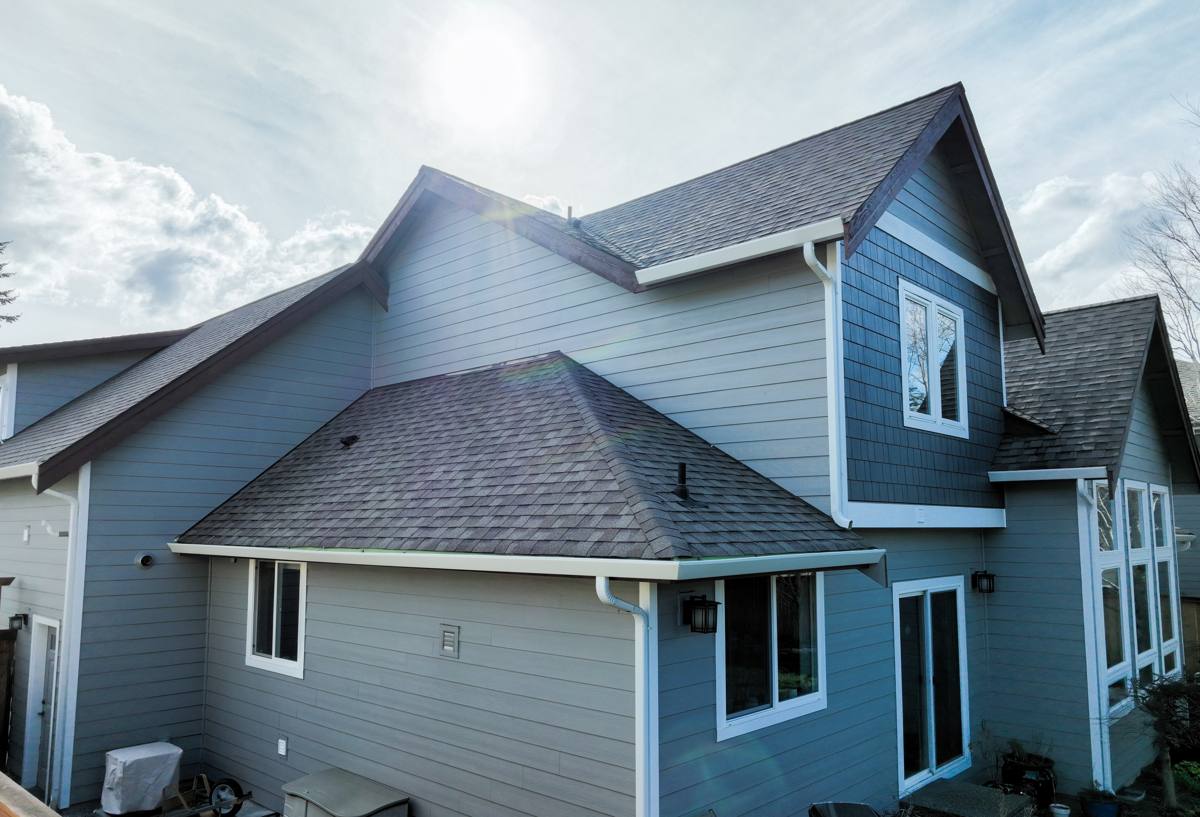
What Cherry Point's Climate Does to Siding
Salt Air Off the Water
Homes this close to the shoreline take on a steadier dose of salt-laden air than towns set back from the water. Salt accelerates corrosion in fasteners, flashing, and any exposed metal trim, and it breaks down lower-quality finishes faster than a drier, more inland climate ever would. On a repair, that means old fasteners and hardware are often more compromised than they look from the ground, and a patch that reuses corroded hardware tends to fail again on a similar timeline.
Driving Rain
Storms coming off the water rarely drop rain straight down. Wind pushes it sideways into wall assemblies, into window and door flashing, and into any seam or joint that isn't sealed the way it should be. That sideways load finds gaps a careless repair would leave behind, and it's a big part of why a damaged section of siding in Cherry Point often has more moisture behind it than the visible damage suggests.
A Long Moss Season
Mild temperatures and near-constant moisture add up to a moss and mildew season that runs long here, especially on shaded or north-facing walls. Moss holds moisture against a wall surface for extended stretches, and any siding with even a little surface porosity becomes a growth surface over time. On repair calls, we regularly find the worst deterioration on the same walls where moss has been established longest.
Cosmetic Wear vs. Repair-Worthy Damage
Not every mark on a wall means the same thing, and telling the difference correctly is the first real job of a repair estimate.
| Symptom | Usually Cosmetic | Often Repair-Worthy |
|---|---|---|
| Surface staining or mild discoloration | Yes — cleanable, especially away from ground level | Only if staining returns quickly after cleaning |
| Moss or algae on shaded walls | Sometimes — surface growth only | Often — if the surface underneath stays damp |
| Hairline cracking at a butt joint | Rarely | Usually — an entry point for wind-driven moisture |
| Soft or spongy board | No | Yes — moisture has already gotten behind the surface |
| Rust streaking near fasteners | Cosmetic if isolated and shallow | Can indicate corroded fasteners losing holding strength |
| Gap or separation at trim or corner boards | No | Yes — a common path for water behind the siding |
Cosmetic issues can usually wait for routine cleaning or maintenance. Anything involving soft material, a widening gap, or hardware that's visibly corroding shouldn't be deferred, since those are the symptoms that get more expensive to fix the longer they sit.
How We Diagnose a Repair Before Recommending a Scope
A repair estimate that's actually useful starts with a real inspection, not a guess from the driveway. On a Cherry Point property, that typically includes:
- Probing the damaged area and the boards around it for soft spots, since moisture rarely stops exactly at the visible mark
- Checking fasteners and any exposed hardware near the damage for corrosion, particularly on walls with the most direct water exposure
- Inspecting the house wrap and flashing behind the affected section once siding is pulled back, since a repair that skips this step often just reseals the same problem
- Looking at butt joints, trim transitions, and corner boards nearby for early separation that hasn't turned into visible damage yet
- Assessing how much sun and airflow the affected wall gets, since shaded, slow-drying walls are more likely to have related damage nearby
- Confirming what siding is currently on the wall and whether a color or profile match is realistically available
We walk through what we find honestly — what needs fixing now, what can be watched, and what's purely cosmetic — before putting together a scope of work.
Repair vs. Full Replacement: How That Call Gets Made
Homeowners often assume any siding damage means a full re-side, or the opposite — that a patch will always be the cheaper, equally good option. Neither assumption holds up consistently. The honest factors that actually drive this decision:
- How far the moisture has traveled. Damage limited to a section or two, with dry framing and house wrap behind it, is usually a strong repair candidate.
- Age and condition of the rest of the siding. Siding nearing the end of its practical life may only justify a repair as a short-term measure before replacement becomes the more sensible spend.
- Whether the original installation was done to spec. Siding installed without a proper rain screen gap, correct flashing, or the right fasteners tends to develop the same failure again nearby, even after a repair.
- Whether a color and profile match is realistically available. Older ColorPlus colors and some discontinued profiles can be hard to match exactly, which affects whether a visible repair or a broader re-side makes more sense.
We'll give a straight answer on which category a given repair falls into, including when full replacement is genuinely the better long-term option, rather than defaulting to whichever job is bigger.
What a Correct Siding Repair Involves
Matching Color and Profile
Hardie's ColorPlus finish is factory-applied and holds up for years, but older colors and some discontinued profiles aren't always available for an exact match. We'll tell you upfront if a perfect match isn't realistic so that decision is made with full information before work starts, not after.
Restoring the Moisture Barrier and Flashing
Once siding comes off around the damaged area, the house wrap and flashing underneath need to go back correctly — properly lapped, sealed at every penetration, and tied into the surrounding wall assembly. This is the step a rushed repair skips most often, and it's usually why a "fixed" section fails again within a season or two.
Fasteners and Hardware
Any fastener touched during a repair gets replaced with corrosion-resistant hardware suited to a shoreline environment, not a like-for-like swap with whatever was used originally. Reusing compromised fasteners in a salt-air location is one of the most common reasons a repair doesn't hold.
Fixing the Cause, Not Just the Symptom
A soft board or a stained section is a symptom. A failed seal at a butt joint, a gap at a corner board, or moisture sitting against a wall that never gets direct sun is usually the cause. A repair that replaces the visible damage without correcting what let moisture in tends to fail again in the same spot.
Why We Only Repair and Install James Hardie Fiber Cement
We install and repair James Hardie fiber cement siding exclusively. We won't install or patch in LP SmartSide, vinyl siding, Cemplank, Allura, primed spruce, or cedar. That's a professional standard, not a sales pitch, and it comes from what we've found on repair calls and tear-offs in shoreline locations like Cherry Point, where salt air and driving rain expose every weak point in a siding system faster than they would inland.
- Non-combustible core: Fiber cement doesn't feed a fire the way wood-based siding can, which matters for both safety and insurance.
- Factory-applied ColorPlus finish: Baked on under controlled conditions rather than brushed on in the field, so it holds its finish longer against fading and moisture.
- Climate-engineered HZ5 formulation: Built for regions with sustained moisture and freeze-thaw cycling, which describes shoreline Whatcom County well.
- Dimensional stability: Fiber cement doesn't swell, cup, or warp the way engineered wood can after repeated wet-dry cycling off the water.
- Strong transferable warranty: Provided the installation and any repairs follow spec, Hardie backs the product with one of the stronger warranty structures in the industry.
Other siding products have a place in the market and homeowners who are happy with them. In a shoreline spot like Cherry Point, though, we'd rather stand fully behind one system than patch together repairs on a product we don't install, using materials that shift maintenance risk back onto the homeowner.
Cost Factors for Cherry Point Siding Repair
| Factor | What It Affects | Shoreline Consideration |
|---|---|---|
| Size of the damaged area | Labor and material for the patch itself | Hidden moisture damage nearby can widen the actual scope |
| Color and profile match | Whether an exact match is available or a broader section needs redoing | Salt air and sun exposure fade siding at different rates by wall orientation |
| Condition behind the siding | House wrap, flashing, and sheathing repair if moisture got through | More likely on walls facing prevailing wind and rain off the water |
| Hardware replacement | Fastener and trim hardware upgrades during the repair | Corrosion-resistant hardware is worth the added cost this close to the shoreline |
These are general drivers, not a quote. Every Cherry Point property sits at a slightly different distance from the water and under different tree cover, so we inspect the actual damage before putting a number on the work. What looks like a small patch from the ground sometimes turns out to need more once the old siding comes off, and we'd rather tell you that honestly than surprise you mid-project.
Why a Crew That Already Works Cherry Point Matters
A contractor who mostly repairs siding on inland properties can still do competent work here, but a shoreline repair in Cherry Point has variables that come up more often on this stretch of coastline than elsewhere in Whatcom County — corrosion patterns tied to steady salt exposure, wind-driven rain that finds gaps a calmer inland wall wouldn't have to deal with, and moss growth that takes hold earlier on shaded, slow-drying walls. Working this area regularly means we already know which walls tend to hide the worst damage, what fastener grade actually holds up this close to the water, and how a repair needs to be detailed differently than it would a few miles inland. That familiarity leads to a more accurate first estimate, with less back-and-forth once the old siding is off and we can see what's actually going on underneath.
Get a Free, No-Pressure Estimate
If siding on your Cherry Point home has a soft spot, a stained section, or damage you're not sure is cosmetic or serious, we're glad to take a look and give you a straightforward, honest assessment. Reach out using the form below to schedule a free estimate — no pressure, no upsell script.