 Blaine Window
 Why Birch Point's Location Puts Extra Stress on a Roof
Birch Point sits out on the water toward Semiahmoo Bay, and that location shapes what a roof out here has to deal with. Homes get a steady dose of salt-laden air coming off the water, wind-driven rain that works its way under loose or aging flashing, and a wet season in Whatcom County that runs long enough for moss and algae to get a real foothold on anything that stays damp. None of that is unusual for one particular house — it's the baseline for waterfront and near-waterfront properties all along this part of Blaine, and it's why we think about a Birch Point roof differently than one going on a sheltered, inland lot.
Asphalt shingles can hold up fine in drier, more protected settings, but in a salt-air, high-moisture environment they're working against their own design. Granule loss speeds up, moss gets a grip in shaded valleys and north-facing slopes, and the effective lifespan of the roof shrinks compared to the same product installed somewhere calmer. Metal roofing, done correctly, is built to handle exactly the conditions that wear a shingle roof down early — which is why we get asked about it so often out here.
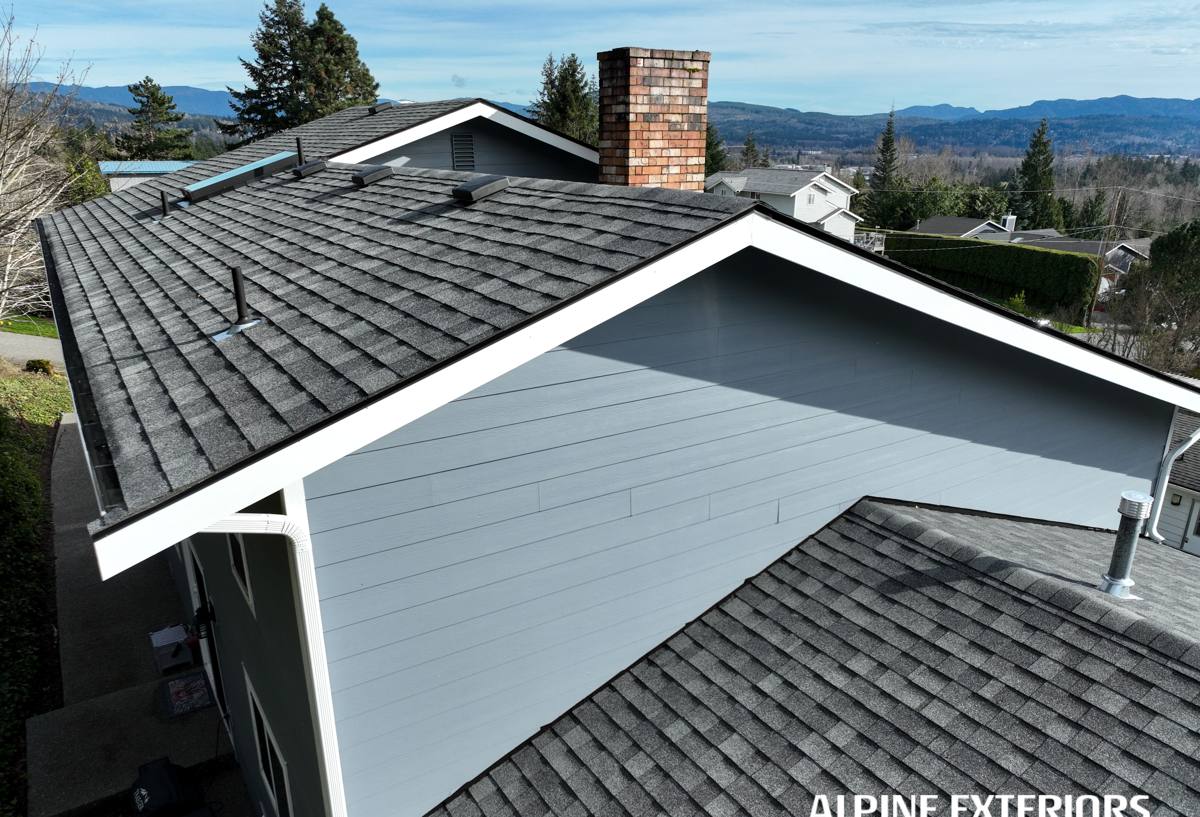
Why Metal Roofing Makes Sense for This Stretch of Whatcom County
Standing Seam vs. Exposed-Fastener Panels
Not all metal roofing is the same product wearing different colors. Standing seam panels use hidden clips and interlocking seams with no exposed screws on the field of the roof — the panels can expand and contract with temperature swings without stressing a fastener. Exposed-fastener panels (sometimes called corrugated or R-panel) are less expensive up front but rely on screws with rubber washers driven through the panel face. Those washers do their job for years, but they're also the first thing to fail as they age, and a failed washer in a salt-air climate is a slow, hidden leak point rather than an obvious one. For a home exposed to this much weather, we lean toward standing seam whenever the budget allows it, and we're upfront with clients about the trade-off when it doesn't.
Corrosion Resistance in a Coastal Environment
Salt air accelerates corrosion on anything with exposed steel — fasteners, cut edges, scratched coatings. That's a maintenance and longevity issue, not a cosmetic one. It's why panel material and coating matter more here than they would twenty miles inland, and why we pay close attention to how cut edges are treated and how fasteners are specified on every Birch Point job, not just which panel profile a homeowner likes the look of.
What a Correct Metal Roof Installation Involves Here
Underlayment and Moisture Barrier
The panels get the attention, but the underlayment is what protects the house if wind ever drives rain up under a seam or through a fastener. In this climate we treat a synthetic, high-temp underlayment as the standard, with self-adhered ice-and-water membrane at the eaves, valleys, and any roof-to-wall transition — the spots where wind-driven rain actually gets pushed uphill instead of running off. Skipping or skimping on this layer is one of the most common shortcuts we see on older reroofs, and it's invisible until the day it isn't.
Flashing and Fastener Details
Most metal roof leaks don't happen in the middle of a panel — they happen at penetrations, valleys, and edges where two roof planes or a roof and a wall meet. Correct step flashing, properly lapped valley metal, and fasteners matched to the panel material (mixing incompatible metals causes galvanic corrosion) are what separate a roof that holds up in coastal wind from one that starts leaking in year three. This is detail work, and it's where experience with this specific environment shows up most.
Ventilation
A metal roof that traps moist attic air underneath it is fighting itself. Proper intake and exhaust ventilation keeps condensation from forming on the underside of the panels and keeps the attic from becoming a second moisture source working against the roof from the inside. We check existing ventilation on every reroof rather than assuming what's there is adequate.
Moss, Debris, and the Long-Term Maintenance Picture
Metal roofing resists moss far better than shingles because there's less texture for spores and organic debris to cling to, but "resists" isn't "immune." Shaded valleys, areas under overhanging trees, and spots where fir needles and leaves collect can still grow moss over time, and that buildup holds moisture against the panel longer than the roof was designed for. A little seasonal attention keeps a metal roof performing the way it should for decades instead of just years.
- Clear needles, leaves, and debris from valleys and behind chimneys or vents at least once or twice a year
- Keep gutters and downspouts flowing freely so water isn't backing up under the eave edge
- Trim back branches that keep a section of roof shaded and damp longer than the rest
- Rinse visible moss or algae growth with plain water and a soft approach — avoid pressure washing, which can force water under seams or strip coatings
- Do a visual check after major windstorms for lifted flashing or loosened fasteners rather than waiting for a visible leak
Choosing the Right Panel and Finish
There's no single "best" metal roof — the right choice depends on budget, how long you plan to stay in the house, and how much you want to think about maintenance later. Here's how the common options generally compare for a coastal Whatcom County home:
| Option | Upfront Cost | Coastal Durability | Maintenance |
|---|---|---|---|
| Standing seam, steel | Higher | Strong — hidden fasteners, fewer failure points | Low |
| Standing seam, aluminum | Highest | Excellent — naturally corrosion-resistant, good for direct salt exposure | Low |
| Exposed-fastener steel panel | Lower | Fair — depends on fastener washer life | Moderate; washers need periodic checks |
| Standard asphalt shingle (for comparison) | Lowest | Weakest in salt air and moss-prone shade | Higher; more frequent moss and granule issues |
Broad, honest ranges only — every roof's cost depends on size, pitch, tear-off scope, and detail work, so we won't quote a number without seeing the actual roof. As a general sense of scale, metal roofing typically runs meaningfully higher per square foot than asphalt shingles, with aluminum standing seam at the top of that range and exposed-fastener steel closer to the bottom. What we can promise is a written estimate that breaks down exactly what's driving the price, not a vague lump sum.
Signs Your Current Roof Is Telling You It's Time
Homeowners often wait for an obvious leak, but a roof usually gives warning signs well before water shows up inside. Granule buildup in gutters, curling or cracked shingles, rusted or lifted flashing around chimneys and vents, and daylight visible through the attic roof deck are all signals worth a look. On an existing metal roof, watch for chalking or fading paint, rust starting at cut edges or fastener heads, and any panel that's come loose at a seam after a windstorm. Catching these early is almost always cheaper than waiting for interior damage.
Our Process for a Birch Point Metal Roof
- On-site inspection — we look at the existing roof deck, ventilation, flashing points, and any moisture or moss issues before recommending anything
- Honest options and a written estimate — panel type, finish, and underlayment choices laid out with real trade-offs, not just a single package
- Tear-off and deck check — old roofing removed and the deck inspected for rot or soft spots before anything new goes down, since covering a bad deck just hides the problem
- Underlayment and flashing installation — ice-and-water membrane at eaves, valleys, and wall transitions, with flashing detailed for this climate specifically
- Panel installation — correct fastener spacing, seam alignment, and edge treatment appropriate to the panel type and coastal exposure
- Final walkthrough — we go over the finished roof with you, including what maintenance to expect and when
Why a Crew That Already Works Birch Point Matters
A roofing crew that's spent time on this stretch of Whatcom County coastline isn't guessing about how salt air, wind direction, and moss season interact with a roof — they've seen it play out on homes with the same exposure as yours. That shows up in small decisions: which fastener to spec, how much ice-and-water membrane to use at a valley, whether a given panel finish is worth the extra cost for a home this close to the water. It also means a crew that isn't learning the local weather patterns on your dime, and one that's still around locally if a question comes up after the job is done.
If you're weighing options for a Birch Point roof — whether it's a straightforward reroof or you're still deciding between metal and another material — we're glad to take a look and walk through what we'd actually recommend for your specific house. Reach out for a free, no-pressure estimate using the form below.