 Blaine Window
 Deck Replacement in Bellingham: Built for a Wet, Salt-Tinged Climate
Bellingham sits on the shore of Bellingham Bay, roughly twenty minutes south of Blaine, and it shares the same marine climate that shapes this whole stretch of Whatcom County: salt-tinged air off the water, long stretches of driving rain, and a moss season that can run most of the year on shaded surfaces. A deck takes more of that weather, more directly, than almost any other part of a house. It sits low to the ground, it's mostly horizontal surface that can't shed water the way a wall or a roof pitch does, and it's usually built from wood or wood-based products that were never meant to sit in standing moisture indefinitely.
We handle windows and decks for homes throughout Whatcom County, and deck replacement in Bellingham specifically comes with its own set of considerations tied to the bay, the tree cover common on a lot of lots in town, and the amount of rain this part of the county sees over a typical year. This page covers what actually goes wrong with decks here, what a correct replacement involves, and how our process works from the first look to a finished deck.
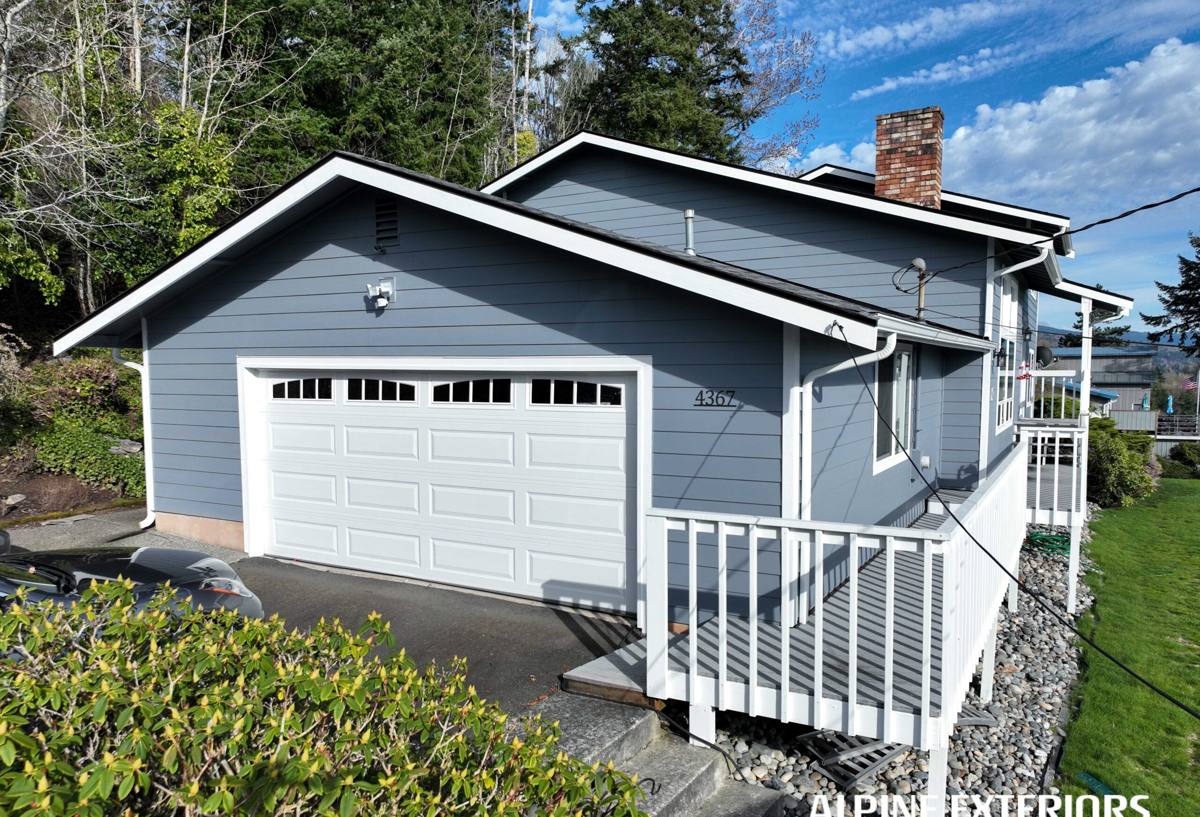
What Bellingham's Marine Climate Does to a Deck
Salt Air Off the Bay
Bellingham Bay puts a steady amount of salt-laden air into the atmosphere across town, not just on waterfront lots. That salt accelerates corrosion on fasteners, joist hangers, and any exposed metal hardware holding a deck's frame together — the parts of a deck that don't get seen or maintained the way the visible decking boards do. A deck framed with standard hardware in a dry inland climate will often outlast the same hardware here by years, simply because the corrosion pressure is so much lower.
Driving Rain and Standing Moisture
Storms moving through Whatcom County regularly bring sideways-driven rain, and a deck's horizontal surface catches and holds more of that moisture than a vertical wall ever would. Water that pools on decking boards, collects in the ledger board connection, or sits against framing that can't dry out is what actually rots a deck from the inside, usually well before the surface boards show obvious damage. That's also the mechanism behind most of the serious deck failures we get called out to look at — moisture sitting somewhere it was never designed to sit.
A Long Moss Season
Mild temperatures and near-constant moisture give moss and algae a growing season that can stretch across most of the year on shaded decks, especially those under tree cover, which describes a lot of Bellingham lots. Moss holds moisture against the decking surface, and beyond the obvious slip hazard, that trapped moisture is exactly the condition that accelerates rot in wood decking and staining on lower-grade composite products.
Signs Your Bellingham Deck Needs Replacing, Not Just Repairing
Not every deck problem calls for a full replacement — sometimes a board swap or a hardware upgrade solves it. But there's a point where patching a deck stops making sense, either because the framing itself is compromised or because the cost of doing it right piecemeal starts to approach the cost of starting over. Signs worth taking seriously:
- Soft, spongy, or springy boards anywhere on the deck surface, not just at the edges
- Visible rot, splitting, or crumbling wood at the ledger board where the deck attaches to the house
- Rust staining or corroded, loose fasteners and joist hangers
- Wobble or movement in the railing or posts when pushed
- Gaps opening up between decking boards well beyond normal seasonal movement
- Persistent moss or dark staining that returns quickly after cleaning
- A deck more than 20-25 years old that has never had its framing inspected
Any one of these on its own might just need attention. Several together, especially anything involving the ledger board or main support posts, usually means the deck's structure has been compromised and a repair would just be patching a symptom rather than fixing the cause.
What a Correct Deck Replacement Involves
Ledger Board Attachment and Flashing
The ledger board — the piece that attaches the deck to the house — is where most serious deck failures start, and it's also the connection point most exposed to the kind of wind-driven rain Bellingham gets regularly. A correct ledger attachment uses flashing integrated with the house's existing siding or sheathing, so water sheds away from the connection instead of tracking behind it and rotting both the ledger and the wall framing behind it. This is also the single detail we see skipped or done poorly most often on decks that come to us for full replacement rather than repair.
Framing, Footings, and Fasteners
Deck framing has to account for local frost depth and soil conditions, with footings sized and set correctly, and every fastener and joist hanger exposed to Whatcom County's damp, salt-tinged air needs to be corrosion-resistant hardware — stainless steel or heavy hot-dip galvanized, not a lighter coating that looks fine on day one and starts rusting within a couple of wet seasons. We also frame to current code span tables rather than whatever the original deck happened to use, since older decks in this area were sometimes built lighter than today's standards call for.
Drainage and Airflow Underneath
A deck that can't breathe underneath stays wet longer after every rain, which speeds up rot regardless of what decking material sits on top. Correct spacing between boards, grading that moves water away from posts and footings rather than pooling against them, and keeping vegetation and debris from blocking airflow under a low deck all matter more here than they would in a drier climate, where a deck has more time to dry out between storms.
Choosing a Decking Material for Bellingham's Climate
The decking material — the boards you actually walk on — is a separate decision from the framing underneath, and it's worth thinking through honestly rather than just picking the cheapest option. Each choice below has real trade-offs in a climate that stays wet and shaded for a large part of the year.
| Material | Upfront Cost | Maintenance | How It Handles Bellingham's Climate |
|---|---|---|---|
| Pressure-Treated Wood | Lowest | Regular cleaning, sealing, and re-staining | Prone to splintering, warping, and moss growth if maintenance lapses |
| Cedar | Moderate | Periodic sealing to hold color and resist moisture | Naturally moisture-resistant but still needs upkeep to avoid graying and softening |
| Capped Composite / PVC | Highest | Occasional washing, no sealing or staining | Resists moisture absorption and moss staining far better than wood over the long run |
We'll walk through these trade-offs against your budget and how much upkeep you actually want to take on, rather than pushing one option as the only right answer. A well-built deck in the wrong material still needs more attention than most homeowners expect in this climate; the framing quality underneath matters at least as much as which boards go on top.
Our Deck Replacement Process
- On-site assessment: we look at the existing deck's framing, ledger connection, and footings, not just the surface boards, to determine what's actually driving the need for replacement.
- Honest scope and options: we walk through decking material choices, railing options, and any structural changes, with a clear range for the work involved.
- Permitting: we handle the permit application and any required inspections through the City of Bellingham's process for the scope of work.
- Demolition and disposal: the old deck comes down and old material gets hauled off, with attention to protecting the areas around the work site.
- Framing and ledger work: new footings, framing, and ledger flashing go in to current code and correct detailing for this climate before any decking is installed.
- Decking, railing, and finish work: boards, railing, stairs, and trim go in, followed by a final walkthrough with you.
Every step in that sequence matters more in a wet climate than a dry one, because a shortcut anywhere along the way tends to show up as a problem within a few wet seasons rather than staying hidden for decades.
Permits and Local Code Considerations
Most deck replacement work in Bellingham that involves new framing, a raised deck, or work attached to the house requires a building permit through the City of Bellingham, and decks built to current code also have to meet guardrail height and baluster spacing requirements once a deck reaches a certain height off the ground. Skipping the permit step might seem like it saves time, but it can create real problems later — at resale, with insurance, or simply because unpermitted structural work never gets the inspection that catches a framing mistake before it becomes a safety issue. We handle the permit process as a standard part of a full deck replacement rather than treating it as an optional extra.
Why a Local Crew That Already Works Bellingham Matters
A crew that works this stretch of Whatcom County regularly has already seen how Bellingham's salt air, driving rain, and moss actually behave on real decks over a full year, not just how a product performs on a spec sheet. That experience shapes decisions on install day — which hardware grade is worth the extra cost, how much drainage clearance a low deck actually needs on a shaded lot, and where the ledger connection needs extra attention because of how a particular house is sided. Bellingham's mix of bay-adjacent exposure and heavily treed residential lots isn't identical to more open or more sheltered parts of the county, and a crew that's used to building here plans for it instead of applying a generic approach everywhere.
Get a Free, No-Pressure Estimate
If your Bellingham deck is showing soft spots, rot, rust, or just years of wear from this climate, we're glad to come take an honest look and tell you straight whether it needs repair or full replacement. Reach out using the form below to schedule a free, no-pressure estimate.