 Blaine Window
 Sandy Point's Coastal Climate Is Hard on Siding
Sandy Point sits close to open water in Whatcom County, and that exposure changes what a siding job needs to hold up to compared with homes a few miles inland in Blaine. Three things do most of the damage over time: salt-laden air, wind-driven rain, and a moss season that runs longer here than in most of the state.
Salt air is corrosive. It works on exposed fasteners, breaks down cheap or thin coatings faster than a manufacturer's warranty assumes, and speeds up chalking and fading on anything not built to handle it. Wind off open water also changes how rain behaves against a wall. It doesn't just fall straight down — it gets pushed sideways and upward, forcing moisture into laps, trim joints, and gaps that a less-exposed installation might get away with for years. And because this stretch of the Salish Sea coast stays mild and damp for long stretches of the year, moss and algae get a growing season that barely stops on shaded or north-facing walls, holding moisture against the siding and the wall assembly behind it far longer than a drier climate would allow.
None of that means siding here is doomed to fail early. It means the margin for error in material choice and installation detail is smaller, and cutting corners shows up sooner than it would on a home set back from the water.
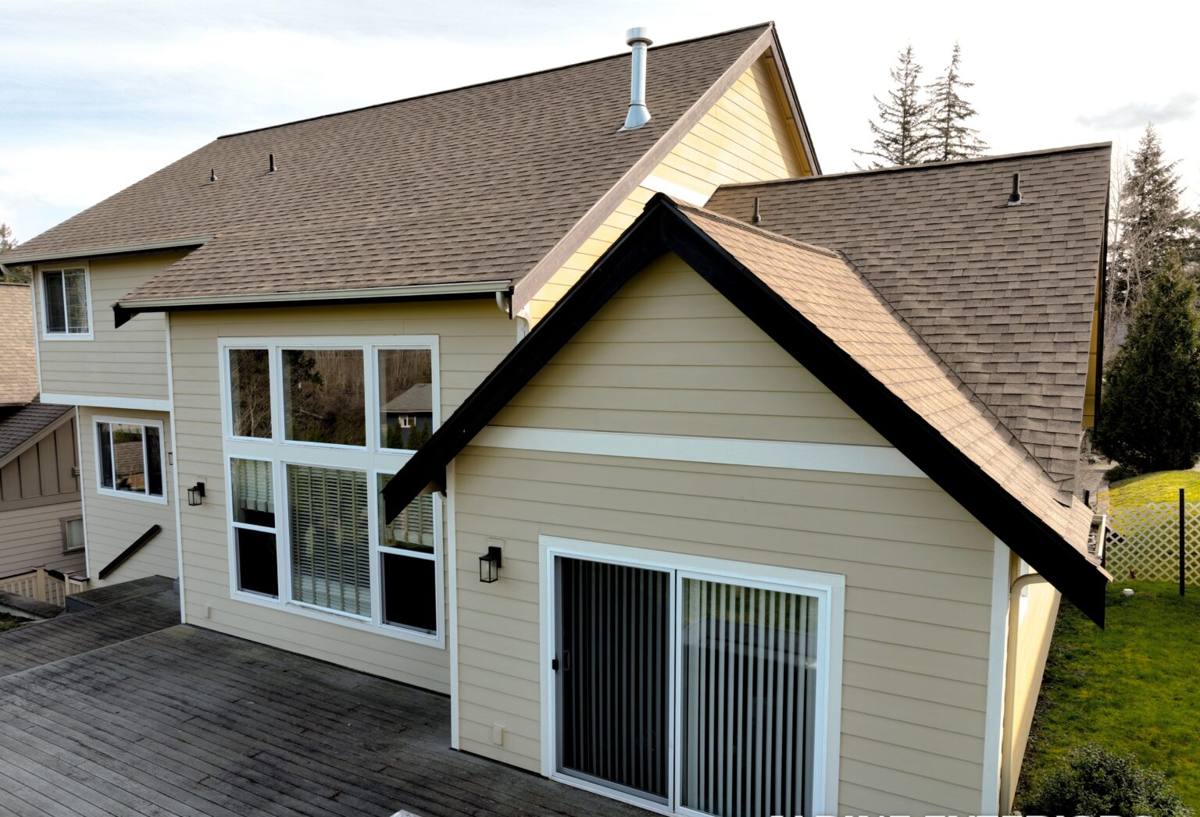
Warning Signs Replacement Makes More Sense Than Repair
Not every siding problem calls for a full tear-off. But on a home this exposed, patching the same spot repeatedly usually costs more over time than replacing the whole wall once, correctly. Signs it's time to talk replacement instead of another repair:
- Soft or spongy spots when you press on the siding, especially near the bottom courses or around window trim
- Paint that's bubbling, peeling, or won't hold no matter how often it's redone
- Dark staining or streaking at seams and butt joints, which usually means water is getting behind the siding, not just sitting on top of it
- Moss or algae that returns within a season or two of cleaning
- Cupping, warping, or visible gaps opening up at panel joints
- Siding that's pulling away from nail heads or fasteners that have rusted and stained the face of the panel
If you're seeing more than one of these, especially on the sides of the house that face the water or prevailing wind, the wall assembly underneath has likely already taken on some moisture. A proper replacement is the chance to find and fix that before it becomes a bigger repair.
Why We Only Install James Hardie Fiber Cement Siding
We install James Hardie fiber cement siding and nothing else — no vinyl, no cedar or primed wood, no LP SmartSide or other engineered wood panel. That's a standard we hold across every job, not just ones on the water, but it matters even more on a home exposed to salt air and driving rain.
Fiber cement is dimensionally stable in a way wood products aren't — it doesn't swell, cup, or warp with repeated wet-dry cycles the way wood-based siding can. It's non-combustible, which matters given how many homes in this area sit close to trees and brush. James Hardie's HZ5 product line is engineered specifically for climates like this one, with formulations built to resist moisture damage in wetter, more humid conditions rather than a one-size-fits-all product. The factory-applied ColorPlus finish is baked on under controlled conditions and backed by its own finish warranty, which holds up better against salt air and UV exposure than a field-applied paint job, and it stretches out the years between repaints. On top of the product itself, James Hardie backs installations with a strong, transferable warranty — useful if you ever sell the home.
We're not going to tell you every other siding product is junk. Vinyl, cedar, and engineered wood all have real uses and real advantages in the right setting. But for a home taking on this much salt air, wind, and moisture, we've made the call that fiber cement done right is what we're willing to put our name behind.
What a Correct Installation Actually Involves
The siding itself is only part of the system. Most siding failures we get called out to inspect trace back to what's underneath it, not the panels themselves.
Weather-Resistive Barrier and Drainage
A correctly installed weather-resistive barrier gives any water that gets past the siding a way to drain back out instead of sitting against the sheathing. On a wind-exposed wall, this layer is doing real work, not just satisfying a code minimum.
Flashing and Penetration Details
Windows, doors, hose bibs, vents, and light fixtures are where water finds its way in. Every one of those penetrations needs proper flashing and sealant, installed so water sheds outward and down rather than pooling or being driven in sideways by wind.
Fastening to Manufacturer Spec
James Hardie publishes specific fastening patterns, gaps, and clearances for a reason — following them is what keeps the warranty valid and what keeps panels performing the way they're engineered to. Corner-cutting on fastener spacing or nailing height is one of the most common causes of early siding problems we see on re-inspections.
Comparing Siding Options for a Home Like Yours
Here's an honest, general comparison of how the common siding materials tend to perform in a coastal, high-moisture climate like Sandy Point's. This isn't about which is "best" in every situation — it's about trade-offs, which is why we've standardized on one option.
| Material | Salt Air / Moisture Resistance | Maintenance | Typical Lifespan | Fire Resistance |
|---|---|---|---|---|
| Vinyl | Doesn't corrode, but can warp or crack in wind and impact; seams are a moisture entry point | Low, but color fades and can't be repainted easily | Moderate, varies widely by product grade | Combustible |
| Cedar / Primed Wood | Attractive but absorbs moisture; needs a well-maintained finish to hold up near salt air | High — regular painting or staining required | Shorter without diligent upkeep | Combustible |
| Engineered Wood (e.g. LP SmartSide) | Treated to resist moisture, but edges and cut ends are vulnerable if not sealed correctly | Moderate — finish maintenance still needed over time | Moderate | Combustible |
| James Hardie Fiber Cement | Engineered for moisture and climate exposure (HZ5); dimensionally stable | Low — factory finish, no swelling or rot | Long, with a strong transferable warranty | Non-combustible |
Our Siding Replacement Process
Every job follows the same sequence, whether it's one wall or the whole house:
- Inspect the existing siding and, once it's off, the sheathing underneath for rot or hidden moisture damage
- Remove old siding and trim, and repair or replace any damaged sheathing before anything new goes on
- Install a new weather-resistive barrier with proper overlaps and drainage
- Flash all windows, doors, and penetrations before siding installation begins
- Install James Hardie siding and trim to manufacturer fastening specifications
- Caulk and finish per ColorPlus or paint-grade requirements, depending on the product selected
- Final walkthrough so you can see the completed work and ask questions before we call it done
We don't skip the sheathing inspection step to save time, even when the old siding looks fine from the outside. On a home this close to the water, what's underneath is usually the more important story.
Why Local Experience in Sandy Point Specifically Matters
A crew that's worked in Sandy Point before already understands how wind and rain move across a waterfront lot, which walls take the worst of it, and where extra flashing attention pays off versus where it's overkill. That's not something you can fully plan for from a spec sheet — it comes from having done the work here before.
If your property is part of a community with its own design or exterior guidelines, we're used to working within those requirements rather than treating them as an afterthought. And on tighter waterfront lots, knowing how to stage material delivery, tear-off, and disposal without disrupting neighbors or blocking access matters just as much as the installation itself.
Keeping Your New Siding Looking Right
New siding is a long-term investment, and a little upkeep keeps it performing the way it's designed to, especially in this climate:
- Rinse siding annually to keep salt residue and organic buildup from settling in, especially on walls facing the water
- Keep gutters clear so overflow isn't running down the face of the siding
- Trim back vegetation and tree cover on shaded walls to slow moss regrowth
- Check caulking at trim, windows, and penetrations once a year and touch up before winter storms
- Make sure attic and crawlspace ventilation is working — trapped interior moisture can undermine even correctly installed siding from the inside
If you're weighing a siding replacement for a home in Sandy Point, we're happy to take a look and walk you through what we're seeing and why. Reach out for a free, no-pressure estimate using the form below.