 Blaine Window
 Why Point Roberts Is a Hard Place to Get Siding Wrong
Point Roberts sits on its own little peninsula jutting into Boundary Bay and the Strait of Georgia, which means almost every home there takes weather from three sides instead of one. That geography is part of what makes the community special, and it's exactly what wears out exterior siding faster than it would a few miles inland. Salt-laden air blows off the water and settles into every seam, joint, and fastener head. Driving rain off the Strait doesn't just wet a wall — it drives horizontally into laps and trim under wind pressure that inland siding never has to deal with.
Add in a moss season that can run from fall through spring in this part of Whatcom County, and you've got a wall assembly that needs to shed water fast, resist salt corrosion, and not give algae and moss anything to grab onto. A lot of siding products can handle one of those conditions. Very few handle all three well, year after year, without babysitting.
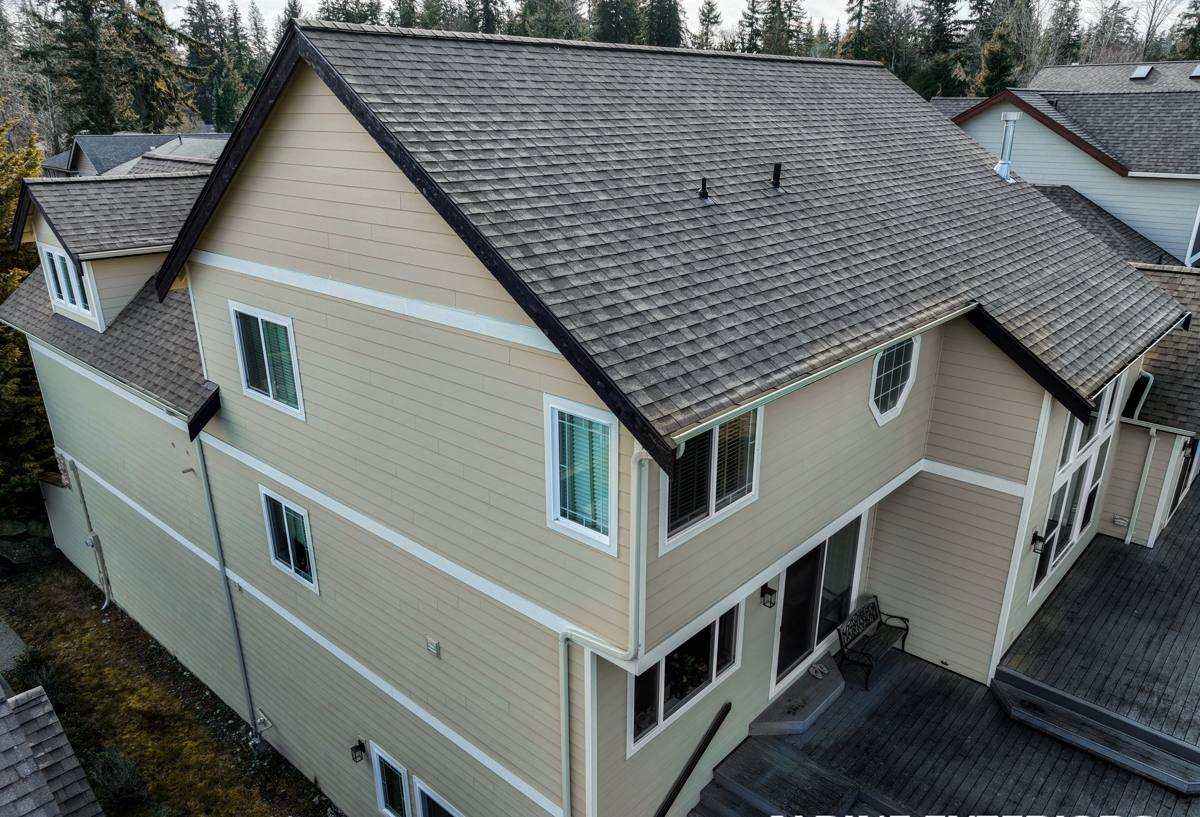
What Siding Actually Needs to Survive Here
Salt Air and Fastener Corrosion
Salt exposure is hardest on metal — nail heads, flashing, and trim fasteners corrode faster near saltwater than almost anywhere else in the county. Once a fastener starts rusting, it weeps stain down the face of the siding and eventually loses its grip. The fix isn't complicated, but it has to be done on purpose: corrosion-resistant fasteners rated for coastal exposure, correct fastener placement per the manufacturer's instructions, and trim details that don't leave metal exposed to standing moisture.
Moss and the Shaded-Wall Problem
North- and west-facing walls in Point Roberts, especially anything shaded by trees or a neighboring structure, stay damp longer after every rain. That's where moss and algae take hold first. A factory-cured, painted finish that doesn't have to be re-sealed every couple of years holds up far better here than a field-finished or unfinished product, because there's no bare substrate underneath waiting to soak up moisture the moment a coating wears thin.
The Point Roberts Logistics Factor
Point Roberts is a U.S. exclave — the only way to drive there is through Canada, crossing two international borders to move a few miles within Whatcom County. That's not a trivia fact, it's a real scheduling and logistics issue for any siding project. Material deliveries, dumpster and debris removal, and crew scheduling all have to account for border crossing times and customs paperwork for commercial vehicles and job materials. A crew that hasn't done the drive before will underestimate the day, show up with the wrong paperwork, or push deliveries to the point where a job sits half-finished and exposed to weather longer than it should.
Permits still run through Whatcom County regardless of the border logistics, and the county's exterior work requirements don't change because a property happens to be on the peninsula. Working here regularly means already knowing that process instead of learning it on the homeowner's timeline.
What a Correct Fiber Cement Installation Involves
Tear-Off and Sheathing Inspection
Old siding comes off, and the sheathing underneath gets inspected before anything new goes up. In a marine climate, hidden moisture damage behind old siding is common enough that we treat this step as non-negotiable — covering up rot or soft sheathing with new siding just delays a much bigger repair.
Water Management Behind the Siding
A weather-resistive barrier and, where the wall assembly calls for it, a drainage plane go on before a single piece of siding is hung. This is the layer that actually keeps driving rain out of the wall cavity — the siding itself is the first line of defense, not the only one. Flashing at windows, doors, and every horizontal trim transition gets lapped correctly so water sheds down and out, never into the wall.
Fastening and Finish
Panels and lap siding get fastened per the manufacturer's climate-specific instructions — correct nail type, spacing, and depth, with joints and butt seams sealed the way the system is engineered to be sealed. Corners, trim, and caulking are finished last, using sealants rated for exterior, coastal exposure rather than whatever's cheapest at the hardware store.
Why We Install Only James Hardie
We don't offer vinyl, LP SmartSide, Cemplank, Allura, or unfinished wood siding, and that's a deliberate standard, not a supply limitation. James Hardie's fiber cement is non-combustible, dimensionally stable in wet-dry cycling, and available in an HZ5 formulation specifically engineered for colder, wetter climates like ours — as opposed to the HZ10 line built for hot, dry regions. That distinction matters more in Point Roberts than almost anywhere else we work.
Hardie's ColorPlus finish is baked on at the factory under controlled conditions, which gives it better fade and moisture resistance than a field-applied paint job, and it comes with its own finish warranty separate from the product warranty. For a home taking on salt air and year-round dampness, a factory finish that isn't relying on a painter's timing and weather window on installation day is a real advantage, not a marketing detail.
James Hardie vs. Other Siding Options for This Climate
| Factor | James Hardie Fiber Cement | Vinyl | Engineered Wood (LP-type) |
|---|---|---|---|
| Salt air / corrosion resistance | Strong — inert cement composite, factory finish | Moderate — can chalk and become brittle over time | Moderate — depends on coating integrity |
| Moisture and moss resistance | Strong when installed with proper drainage detailing | Good at shedding water, poor at breathable wall assemblies | Vulnerable if edges or coating are compromised |
| Fire resistance | Non-combustible | Combustible | Combustible |
| Finish durability | Factory ColorPlus finish, separate warranty | Color molded in, can fade | Field or factory coating varies by product |
Signs Your Point Roberts Home Needs New Siding
Coastal wear on siding is often gradual, so homeowners tend to notice it late. Watch for:
- Dark streaking or green-black growth on north-facing or shaded walls that comes back within weeks of cleaning
- Rust stains bleeding down from nail heads or trim fasteners
- Soft or spongy spots when you press on siding near the bottom courses or around window trim
- Paint or finish that's chalking, peeling, or visibly different in sheen from panel to panel
- Gaps opening up at seams, corners, or where trim meets siding
- A musty smell or visible staining on interior walls that back up to exterior siding
Cost Factors for a Point Roberts Siding Project
| Factor | Why It Affects Cost |
|---|---|
| Home size and wall complexity | More corners, gables, and trim transitions mean more cutting, flashing, and labor time |
| Condition of existing sheathing | Hidden moisture damage found during tear-off adds repair scope before new siding goes on |
| Siding profile and trim package | Lap width, shingle-style panels, and trim detailing all price differently |
| Color and finish selection | Factory ColorPlus finishes vs. field-painted options affect material cost and long-term maintenance |
| Site access and logistics | Delivery scheduling and border-crossing logistics for materials and equipment factor into project timeline |
Our Process, Start to Finish
We start with an on-site look at the home, not a phone estimate — coastal wear and hidden moisture issues don't show up in a photo. From there we walk through siding options, explain what HZ5 James Hardie profile and color combination fits the home, and put together a written scope before any work starts. We handle the Whatcom County permit process, plan material delivery and crew scheduling around the realities of getting to Point Roberts, and keep the homeowner in the loop if weather or border logistics shift the timeline. When the job's done, we walk the exterior with the homeowner before calling it finished.
Living With Hardie Siding in a Marine Climate
Correctly installed Hardie siding isn't maintenance-free, but it's low-maintenance compared to the alternatives. A rinse-down once or twice a year knocks back the moss and salt residue before it stains. Gutters and downspouts need to stay clear so water isn't sheeting down the wall face longer than it should. Beyond that, an occasional look at caulking around windows and trim — the first thing to age in salt air — catches small issues before they become water intrusion problems.
If your Point Roberts home is due for new siding, or you're just trying to figure out whether what's on the walls now is holding up the way it should, we're happy to take a look. There's a free, no-pressure estimate available through the form below — no obligation either way.