 Blaine Window
 Why Ferndale Siding Takes a Beating
Ferndale sits close enough to saltwater and the open flats of Whatcom County that homes here deal with a combination of stresses most inland siding never has to handle. Salt-laden air off the Strait works into seams and fastener heads year-round. Wind-driven rain off Bellingham Bay doesn't fall straight down — it gets pushed sideways into wall assemblies, which means siding here has to shed water horizontally, not just vertically. And the long gray stretch from fall through spring gives moss, algae, and mildew months of damp, shaded conditions to take hold on north-facing walls, under eaves, and anywhere airflow is limited.
None of that is dramatic on its own. The problem is cumulative. A siding product or installation detail that would hold up fine in a drier climate can fail slowly and quietly here — trapped moisture behind the cladding, swelling at cut edges, paint that chalks and peels years early, moss that holds water against the wall instead of letting it run off. By the time it's visible from the street, the damage is often already in the sheathing.
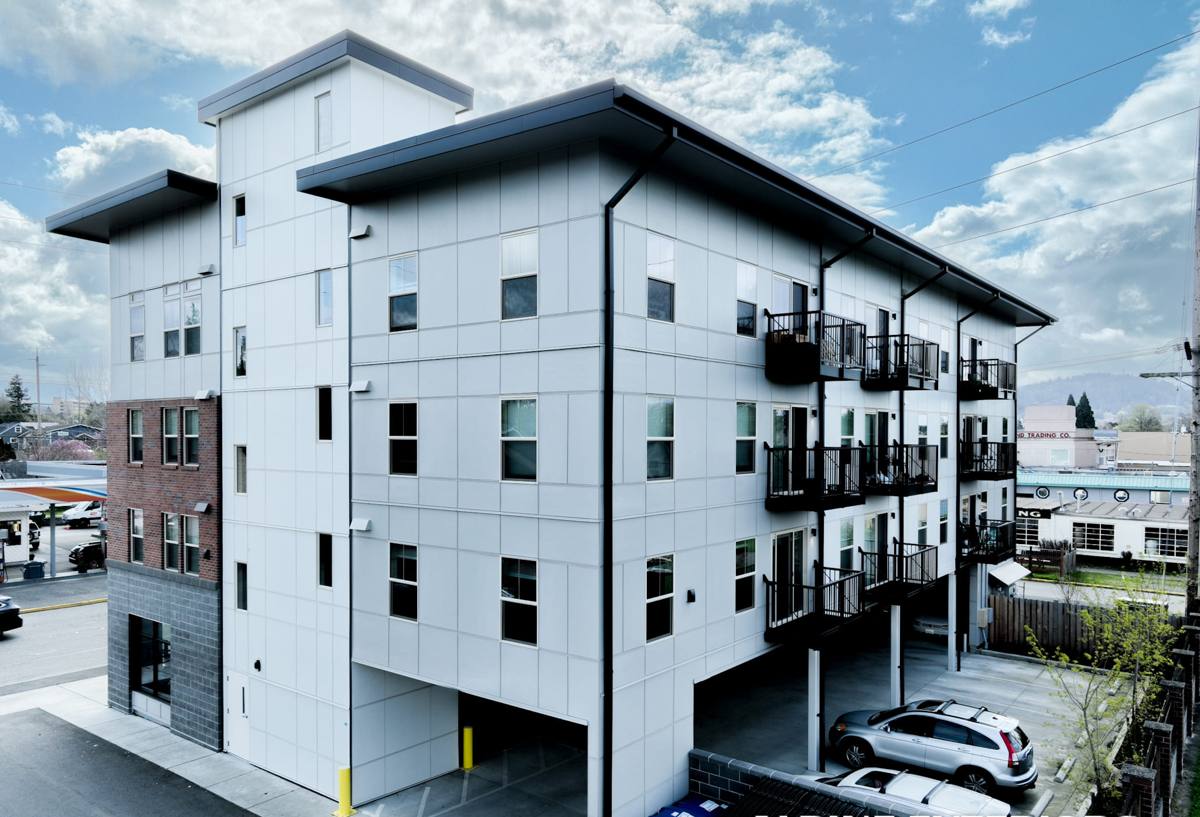
What Ferndale Homes Actually Need From Their Siding
Given that climate, a siding system for a Ferndale home has three jobs to do well, not just one:
- Shed water sideways. Laps, flashing, and joints need to handle wind-driven rain, not just gravity-fed runoff.
- Resist moisture without swelling or rotting. Whatever the material, it needs to tolerate repeated wet-dry cycling for decades without losing dimensional stability.
- Stay clean-able and inhospitable to moss. A dense, factory-finished surface sheds algae and moss growth far more easily than a porous or textured one, and it holds up to the occasional wash-down without damage.
Every siding decision on a home in this area — the material, the house wrap, the flashing details, the gap spacing — should be judged against those three requirements first, and appearance second.
What Correct Siding Installation Actually Involves
Most siding problems we get called out to inspect in Whatcom County aren't material failures — they're installation shortcuts. The material can only perform as well as the assembly behind it. A correct siding installation includes:
Water-Resistive Barrier and Flashing
A continuous, properly lapped weather-resistive barrier goes on before any siding, with flashing integrated at every window, door, deck ledger, and roof-to-wall transition — installed shingle-style so water is always directed outward and down, never trapped behind the cladding.
Drainage Space
Rainscreen furring or a drainage mat behind the siding gives bulk water a path to escape and lets the wall assembly dry out between storms — critical in a climate where "between storms" can be a short window.
Fastening and Gapping to Spec
Fastener type, spacing, and placement, along with butt-joint and clearance gaps, all follow the manufacturer's published installation manual. Skipping this is the single most common cause of early siding failure, and it's also the most common reason a manufacturer warranty gets denied.
Clearances
Proper gaps from grade, roof lines, decks, and other transitions keep the bottom edge of the siding from sitting in standing water or splashback — a detail that matters more here than in drier regions.
Signs a Ferndale Home Needs New Siding
| What You're Seeing | What It Usually Means |
|---|---|
| Soft or spongy spots when pressed | Moisture has reached the substrate — often past the point of a surface fix |
| Persistent moss or dark streaking, even after cleaning | The surface is porous or the drainage path behind it is compromised |
| Peeling, bubbling, or chalking paint | Moisture is moving through the material from behind, not just weathering on the surface |
| Visible warping, cupping, or gaps opening at joints | Dimensional instability — common with wood-based and some engineered products |
| Rising energy bills with no other explanation | Compromised siding and wrap can be letting conditioned air escape |
Quick Self-Check
- Walk the north and shaded sides of the house — is moss or algae established, not just surface dirt?
- Press gently at the bottom few feet of wall near grade — any give?
- Check under eaves and around window trim for staining or bubbling paint.
- Look at butt joints and corners — are gaps opening or caulk failing?
- Note any interior drywall staining or musty smell on exterior-facing walls.
One or two of these on their own aren't an emergency. Several together, especially combined with the home's age, usually mean it's time for a proper inspection rather than another round of caulk and paint.
Why We Install Only James Hardie Fiber Cement
We standardized on James Hardie fiber cement siding and stopped installing vinyl, LP SmartSide, and other wood-based or engineered-wood products, because of exactly the conditions described above. That's not a knock on every use case for those products — vinyl is inexpensive and low-maintenance in the right climate, and engineered wood siding has its place. It's a judgment call about what actually holds up, unmaintained, through a Whatcom County wet season after wet season.
Fiber cement is non-combustible and dimensionally stable — it doesn't swell, cup, or absorb water the way wood-based products can at cut edges and exposed joints. James Hardie's ColorPlus factory finish is baked on under controlled conditions, which gives it better fade and moisture resistance than field-applied paint, and it holds up to the algae and moss pressure that's constant on shaded Ferndale walls far better than porous or textured surfaces. Hardie also engineers specific product lines (HZ5, HZ10) for regional climate zones, so the material itself is matched to the moisture and temperature swings of the Pacific Northwest rather than a one-size-fits-all spec. Backed by a strong transferable warranty, it's the product we're comfortable putting our name behind for a 30-plus-year install in this climate.
Our Installation Process in Ferndale
- On-site assessment. We inspect existing siding, sheathing, and any moisture damage before quoting anything — you get an honest read on what's actually needed.
- Tear-off and substrate check. Old siding comes off and we inspect the sheathing underneath for rot or soft spots, addressing any repairs before new material goes on.
- Weather-resistive barrier and flashing. Installed continuous and correctly lapped, with flashing detailed at every penetration and transition.
- Drainage plane. Rainscreen furring installed to give the wall assembly a way to drain and dry.
- Hardie installation to manufacturer spec. Fastening, gapping, and joint treatment follow the published installation manual — this is what keeps the warranty valid and the wall performing for decades.
- Trim, caulking, and final detail work. Careful attention at windows, corners, and transitions, since these are the spots that fail first when rushed.
- Final walkthrough. We go over the finished work with you and explain basic care going forward.
What Affects the Cost of a Siding Installation
| Factor | Why It Matters |
|---|---|
| Home size and wall complexity | More corners, dormers, and trim detail mean more labor and material cuts |
| Condition of existing sheathing | Rot or moisture damage found during tear-off adds repair scope |
| Siding profile and accessories | Lap width, trim boards, and accent details affect material cost |
| Access and site conditions | Steep lots, tight setbacks, or landscaping can add labor time |
| Existing drainage plane | Whether a rainscreen system needs to be added or is already in place |
We give a firm, itemized quote after the on-site assessment — not a phone estimate — because the sheathing condition and site details genuinely change the scope on older Ferndale homes.
Living With Hardie Siding Through Moss Season
Correctly installed Hardie siding is close to maintenance-free, but a little seasonal attention keeps it looking that way. A gentle rinse once or twice a year — especially on shaded, north-facing walls — keeps moss and algae from getting established in the first place. Keep gutters clear so overflow isn't running down the wall face, and trim back vegetation that holds moisture against the siding. None of this is heavy maintenance; it's closer to what you'd already be doing for the rest of the exterior.
Why Local Experience Matters
Installation manuals don't tell you how a specific wall on a specific lot catches wind-driven rain off the bay, or which north-facing elevations in this area need extra attention to airflow and drainage. That comes from having installed and later inspected siding on homes throughout Whatcom County long enough to see which details actually hold up here and which ones look fine on day one and fail in year five. A crew that only occasionally works this coastline is learning those lessons on your house. A crew that works Ferndale regularly already knows them.
If your Ferndale home's siding is showing its age, or you're planning ahead of a remodel, we're happy to take a look and give you a straight, no-pressure assessment. Fill out the form below to schedule a free estimate.