 Blaine Window
 Why Grandview Roofs Age Differently Than Roofs Inland
Grandview sits close enough to the water and to the open exposure around Blaine that roofs here take a different kind of beating than a roof twenty miles inland in Whatcom County. It isn't one dramatic event that wears a roof out — it's the combination working on it every week of the year. Salt-laden air corrodes exposed metal fasteners and flashing faster than dry inland air does. Driving rain, often pushed sideways by wind off the water, finds any weak lap or under-driven nail and works it loose over a few seasons. And the long stretch of damp, low-sun months from fall through spring gives moss and algae months of undisturbed growing time on north-facing and shaded slopes.
None of that means a roof here can't last a normal service life. It means the installation has to account for those conditions from the start, rather than relying on a standard build-out that was designed for a drier, calmer climate. That's the difference between a roof that needs attention in year six and one that's still solid at year twenty.
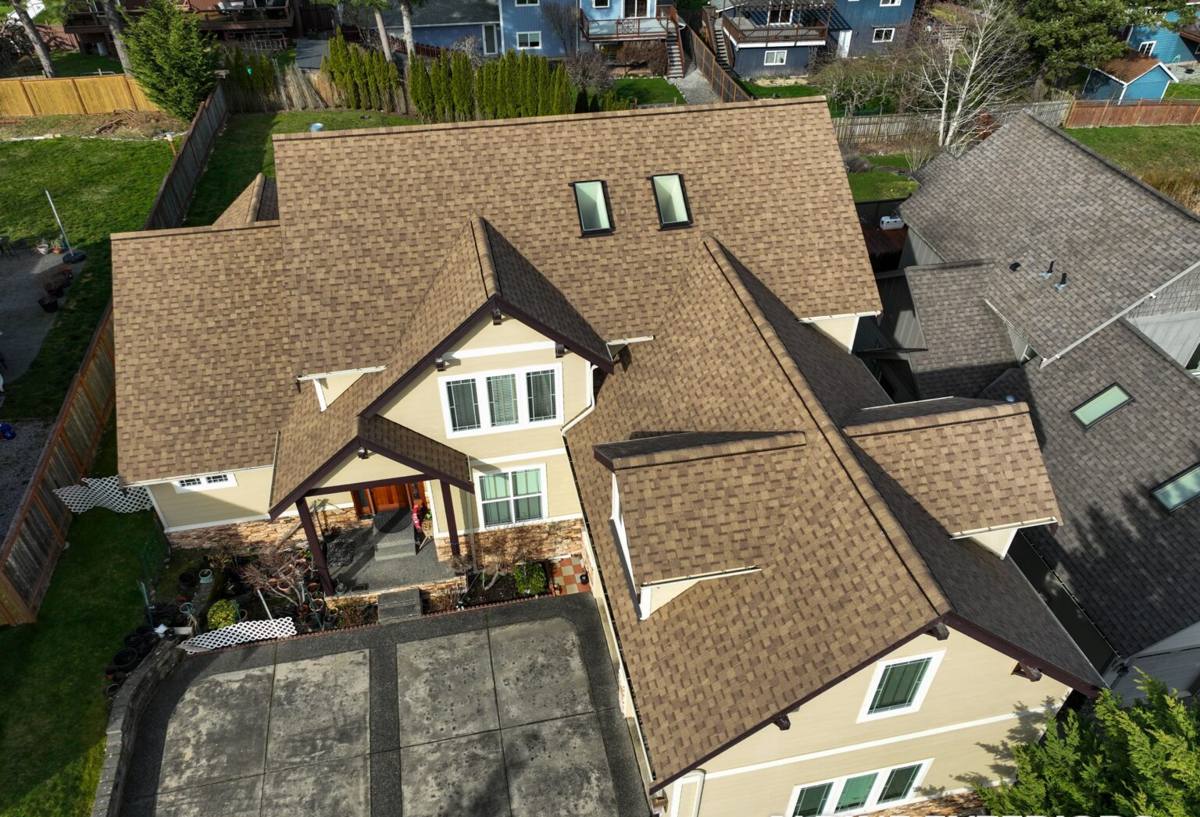
What a Correct New Roof Installation Actually Involves
A new roof is more than shingles going down over what was already there. Done right, a full installation includes several layers most homeowners never see, and each one matters more in a coastal, high-rainfall area than it would somewhere drier.
Tear-off and deck inspection
We remove the old roofing down to the deck rather than layering over it. That's the only way to actually see the condition of the sheathing underneath — soft spots, old water staining, or rot that's been hidden under the previous roof for years. Any damaged decking gets replaced before anything new goes on top of it.
Underlayment
In a climate that sees sustained rain and wind-driven moisture, the underlayment is doing real work, not just serving as a backup. We use synthetic or self-adhering underlayment at eaves, valleys, and other vulnerable points so that if wind-driven rain gets past the primary roofing surface, it doesn't reach the deck.
Flashing
Flashing around chimneys, vents, skylights, and roof-to-wall transitions is where most leaks actually start — not in the field of the roof itself. We use corrosion-resistant flashing material and proper step-and-counter-flashing techniques, since standard galvanized flashing degrades faster in salt air than it would further from the coast.
Ventilation
Balanced intake and exhaust ventilation keeps the attic space at a consistent temperature and moisture level. Skip this and you get condensation building up on the underside of the deck during our cool, wet months — which rots sheathing from the inside even while the roof surface looks fine.
Materials: What Holds Up Near Blaine's Coastline
There's no single "best" roofing material — there's a best material for this exposure, this budget, and this roofline. Here's how the common options compare for a Grandview home specifically.
| Material | Performance in salt air / driving rain | Moss resistance | Typical lifespan here |
|---|---|---|---|
| Architectural asphalt shingle | Good with proper flashing and fasteners; corrosion-resistant nails recommended | Moderate — benefits from zinc/copper strips at the ridge | 20–30 years |
| Standing seam metal | Very good when finished and fastened with coastal-rated hardware | High — sheds moss growth surface naturally | 40–50+ years |
| Cedar shake | Requires diligent maintenance in wet, salty exposure | Low without regular treatment | Highly maintenance-dependent |
| Synthetic composite shingle | Good; consistent performance without natural material variability | Moderate to high depending on product | 30–50 years |
We'll talk through the honest trade-offs for your specific roof rather than pushing one product line. Cedar shake, for example, can look excellent, but in a damp, salty exposure it demands a maintenance schedule that not every homeowner wants to keep up with — that's a fair trade-off to weigh, not a reason to rule it out categorically.
Moss and Algae: Designing the Roof to Resist Them, Not Just Treating Them After
Blaine's long wet season gives moss and algae far more growing time than most of the country gets. Once moss establishes itself, its root structure lifts shingle edges and holds moisture directly against the roofing surface — which accelerates the exact kind of decay you installed a new roof to avoid. The fix isn't a one-time cleaning; it's building resistance into the installation itself.
- Zinc or copper control strips installed near the ridge, which release trace metal ions with every rain and inhibit new moss and algae growth downslope
- Adequate roof ventilation so the deck and shingle underside dry out between rain events instead of staying damp
- Attention to shaded, north-facing slopes and areas under tree cover during design, since these need the most help drying out
- Proper slope and drainage at valleys so water doesn't pool or sheet slowly across shaded sections
None of this makes a roof moss-proof forever — nothing does in this climate — but it meaningfully extends the interval between cleanings and reduces the chance moss gets a foothold before you notice it.
Ventilation and Moisture: The Part of the Job You Don't See
A roof that looks perfect from the ground can still be failing from underneath if the attic isn't ventilating properly. In a marine climate like Blaine's, warm indoor air meeting a cold, damp attic space creates condensation on the underside of the roof deck. Over a wet Whatcom County winter, that condensation can do as much damage to sheathing as an actual leak — and it's often discovered late, because it doesn't show up as a stain on the ceiling right away.
As part of any new roof installation, we check existing intake and exhaust ventilation, insulation levels near the eaves, and whether bathroom or kitchen exhaust fans are actually venting outside rather than dumping moist air into the attic. Correcting these issues during the roof install is far cheaper than diagnosing hidden rot two or three years later.
Our Installation Process
- On-site assessment. We walk the roof and attic, note the current material, deck condition, ventilation setup, and any problem areas specific to your home's exposure and shading.
- Written estimate and material selection. We go over material options honestly, including trade-offs, so you're choosing based on your priorities — cost, longevity, appearance, or maintenance tolerance.
- Tear-off. Old roofing is fully removed and hauled off; the deck is inspected and any damaged sections are documented and replaced.
- Underlayment and flashing. Water barrier and flashing go in first, with extra attention at valleys, penetrations, and roof-to-wall transitions.
- Roofing installation. Material is installed to manufacturer specification, including fastener type and spacing appropriate for this wind and moisture exposure.
- Ventilation and moss-control features. Intake/exhaust venting and any zinc or copper strips are installed as part of the same job, not as an afterthought.
- Final walkthrough. We inspect the completed roof with you, clean up the site, and go over warranty and basic maintenance expectations.
Signs a Grandview Home May Need a New Roof
Roofs rarely fail all at once. These are the signs worth acting on before a small problem becomes a deck-replacement problem:
- Granule loss showing up in gutters or downspouts after normal rain
- Curling, cracked, or missing shingles, especially on the side facing prevailing wind and rain
- Visible moss buildup on shaded or north-facing slopes
- Daylight visible through the attic roof deck, or damp insulation near the eaves
- Roof age approaching or past 20 years, particularly with standard asphalt shingle
- Interior ceiling stains, even faint ones, after a heavy storm
- Sagging areas in the roofline when viewed from the street
Cost Factors for a Grandview Roof Replacement
Every roof is priced individually, but the main variables that move the number are consistent. Getting a firm number requires an on-site look, but this gives you a sense of what drives cost up or down.
| Factor | Effect on cost |
|---|---|
| Roof size and number of stories | Larger area and harder access (steep pitch, multi-story) increase labor time |
| Pitch and complexity | Steep or cut-up rooflines with many valleys and penetrations take longer and use more flashing |
| Number of existing layers | Additional tear-off work if the current roof has multiple layers underneath |
| Material choice | Asphalt shingle is generally the most economical; metal and premium composites cost more upfront but shift the maintenance and lifespan equation |
| Deck condition | Rot or soft spots discovered during tear-off require sheathing replacement, which isn't always visible before the job starts |
| Ventilation and moss-control upgrades | Adding proper venting or control strips to an older home without them is a modest add during a full replacement, much more as a standalone retrofit later |
Why a Crew That Already Works Grandview Matters
Roofing crews that mostly work drier, calmer regions sometimes default to standard specs that don't account for salt exposure, wind-driven rain, or an extended moss season. A crew that already works in and around Blaine and Whatcom County has seen how roofs here actually fail over time — which flashing details hold up, which fastener types corrode too fast this close to the water, and which slopes need extra moss-control attention regardless of what the manufacturer's generic spec sheet says. That local pattern recognition is the difference between a roof that's technically installed to code and one that's actually built for where it sits.
It also matters for permitting and inspection — knowing the local process means fewer delays and no surprises partway through the job.
If you're weighing a new roof for your Grandview home, we're happy to take a look and give you a straightforward, no-pressure estimate — no upsell, just an honest read on what your roof actually needs. Use the form below to get started.