 Blaine Window
 Storm Damage Roof Repair for Everson Homes
Everson sits inland from Blaine but still gets the full range of what Whatcom County weather delivers each year: driving winter rain off the Pacific, gusty wind events that come through the valley, and a moss season that runs longer here than in drier parts of the state. None of that is dramatic on its own, but it adds up. A roof that takes a beating from wind-driven rain in November and then sits under wet moss growth through March is a roof that's aging faster than its shingles were rated for. When a storm knocks something loose, tears a section of shingles, or drives water under flashing that was already marginal, the damage doesn't always announce itself right away. That's the situation we get called out for most in this area — not a roof that's obviously destroyed, but one with a problem that's about to become a bigger one if it's not addressed correctly.
This page covers what storm damage roof repair actually involves for a home in the Everson area, how we approach it, and what to look for before you decide who fixes it.
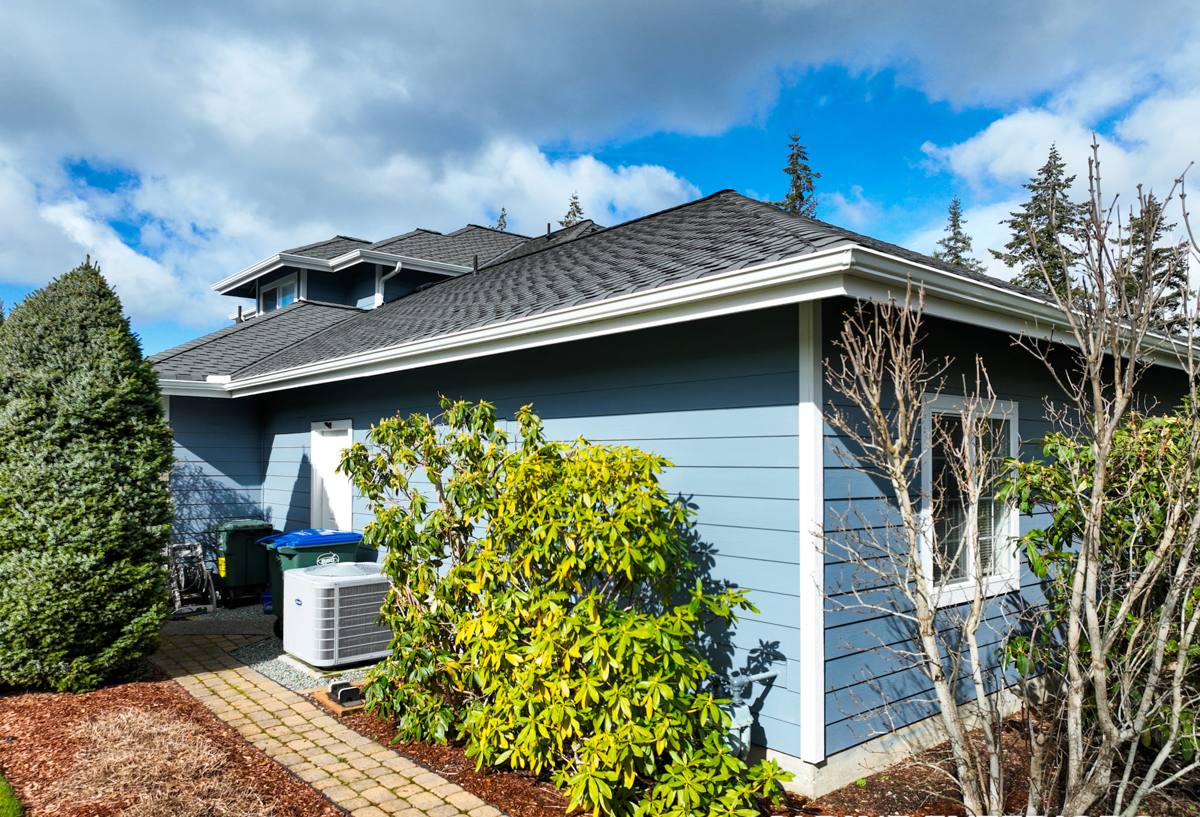
What Whatcom County Storms Actually Do to a Roof
Storm damage isn't always a dramatic gash in the roof deck. More often it's a combination of smaller failures that show up together after a hard weather event:
- Wind lifts the tab edge of a shingle just enough to break the sealant bond, so it doesn't reseal on its own
- Driving rain gets pushed sideways under a shingle edge or around a vent boot that's already starting to crack
- Debris — branches, fir cones, blown grit — abrades the shingle surface or clogs a valley
- Flashing around chimneys, skylights, or wall intersections gets worked loose by wind flex and repeated wet-dry cycles
- Gutters overflow during heavy rain and send water back up under the roof edge instead of off it
Individually, most of these are minor. Left alone through another wet season, they're how a $300 repair turns into a $3,000 one. That's the core reason storm damage repair is worth doing promptly and correctly, not just patched to get through until spring.
Why Moss Season Makes It Worse
Moss doesn't cause storm damage, but it makes storm damage harder to spot and worse when it happens. A shingle edge that's already lifted by wind traps moisture more easily once moss and organic debris start building up around it, which keeps that spot wet far longer than the rest of the roof. Over a long Whatcom County moss season, that constant dampness is what actually rots decking and degrades shingle granules — the storm event is often just what exposes a spot that moss had already weakened.
Signs Your Everson Home May Have Storm Damage
Most homeowners don't get on their own roof after a storm, and they shouldn't — it's not worth the fall risk to check for damage you may not be able to identify anyway. What you can watch for from the ground or inside the house:
- Shingle pieces or granules in the gutters or on the ground after wind or heavy rain
- A new stain on a ceiling or upper wall, even a faint one, especially after the first hard storm of the season
- Visible gaps, curling, or shingles that look out of alignment with the rest of the field when viewed from the street or a neighbor's yard
- A gutter that's suddenly overflowing in a spot it never used to
- Daylight visible in the attic where there wasn't any before
- A musty smell in an upstairs closet or attic space that wasn't there previously
Any one of these is a reason to get a roof looked at — not necessarily replaced, just properly inspected. Waiting for the next storm to "confirm" the problem usually just means more water gets in before it's fixed.
What a Correct Storm Damage Repair Actually Involves
A repair that just covers the visible symptom tends to fail again in the next storm. A repair done right addresses the actual failure point and the conditions around it. That generally means:
1. Finding the real source, not just the visible damage
Water travels before it shows up as a stain. A leak that appears over a bedroom might be entering the roof several feet away, at a flashing seam or a valley, and running along the underlayment or a rafter before it drips. Chasing the wrong spot is the most common reason a "fixed" leak comes back.
2. Matching materials, not improvising
Mismatched shingle profiles, the wrong flashing metal against certain fasteners, or underlayment that doesn't match what's already on the roof all create new weak points instead of solving the old one. A proper repair uses materials compatible with what's already installed, or replaces enough of the surrounding area that the whole section performs as a system.
3. Addressing what let the damage happen in the first place
If wind got under a shingle edge because the sealant strip had already failed, replacing just that shingle without checking the surrounding courses just sets up the next failure. If a valley clogged and backed up water under the shingles, clearing debris without checking the valley metal underneath misses the actual fix.
Our Process
We keep storm damage repair straightforward, because homeowners dealing with a leak don't need a complicated process on top of it.
Inspection
We get on the roof (or use elevated photos where access is limited) and document the actual condition — not just the spot you're worried about, but the surrounding field, flashing points, and any secondary damage the storm may have caused elsewhere on the roof.
Honest assessment
We tell you what we actually found, including if the damage is more limited than it looked from the ground, or if there's a secondary issue that should be addressed at the same time to avoid a repeat call-out. If it's a straightforward repair, we say so — we're not going to sell a full re-roof for a fixable section.
Written scope and price
Before any work starts, you get a clear description of what's being repaired, with what materials, and what it costs. No verbal estimates that turn into a different number on the invoice.
The repair
Work is done to match the existing roof system — same or compatible shingle type, correct flashing details, proper underlayment at any exposed decking — not a quick patch meant to hold until the next storm finds it.
Follow-up documentation
You get photos of the completed work and, where relevant, documentation useful for insurance purposes.
Repair or Replace? How We Make the Call
Not every storm-damaged roof needs a full replacement, and not every roof that "just needs a patch" is actually a good repair candidate. The honest answer depends on a few factors:
| Factor | Favors Repair | Favors Replacement |
|---|---|---|
| Age of existing roof | Under 12-15 years, good remaining shingle life | Near or past expected lifespan already |
| Extent of damage | Isolated to one section or a handful of shingles | Multiple areas affected, or the same storm exposed several separate weak points |
| Decking condition | Dry, solid decking under the damaged area | Soft or water-stained decking found during inspection |
| Shingle availability | Matching or close-match shingles still available | Discontinued profile with no reasonable match, leaving visible patchwork |
| History of repeat issues | First storm-related issue on this roof | Recurring leaks or repairs in different spots over recent years |
We'll walk you through where your roof lands on these factors rather than defaulting to whichever option is more profitable for us. A lot of storm damage in this area is genuinely repairable, and we'll say so.
Materials and Methods We Use
For storm repairs, we prioritize materials suited to Whatcom County's wet, moss-prone conditions rather than the cheapest available match. That generally means synthetic underlayment (more tear- and moisture-resistant than older felt products) at any exposed decking, properly lapped and sealed flashing at valleys and penetrations, and shingles rated for regional wind exposure rather than a minimum-grade product. We don't use flashing or fastener combinations that create galvanic corrosion risk over time — a real concern in a region with salt-laden air moving inland from the coast, since dissimilar metals in contact with each other corrode faster when they're exposed to salt-influenced moisture. It's a small detail, but it's the kind of thing that determines whether a repair holds for years or needs revisiting in one wet season.
Storm Damage and Insurance Claims
If your storm damage may be covered by homeowner's insurance, a few things are worth knowing before you call a contractor:
- Document damage with photos as soon as it's safely possible, before any repair work begins
- Get an independent inspection and written estimate — don't rely solely on the insurance adjuster's assessment, which can undervalue the actual scope of repair needed
- Be cautious of any contractor who pressures you to sign an agreement before an adjuster has been involved, or who asks you to inflate a claim
- Keep your own copy of all photos, estimates, and correspondence
We can provide a detailed written estimate and photo documentation to support a claim, but the claim itself is between you and your insurer — we won't represent ourselves as your insurance advocate or promise a claim outcome we don't control.
Why a Crew That Already Works in Everson Matters
Roofing problems here aren't generic — they're shaped by this specific climate. A crew that regularly works Whatcom County roofs already knows what a valley clogged by moss debris looks like versus one damaged by wind-driven rain, knows which flashing details tend to fail first under repeated wet-dry cycling, and isn't guessing at how the local weather pattern interacts with a given roof's age and orientation. That local familiarity shows up in faster, more accurate diagnosis and repairs that are built for the conditions they'll actually face, not generic conditions from somewhere drier.
It also means we're not driving in from out of the area chasing storm damage after a big weather event and then gone by the time a callback is needed. If a repair needs a follow-up look after the next hard rain, we're still local to come back.
Get an Estimate
If your Everson home has visible or suspected storm damage, or you just want a roof checked after a hard weather stretch, we're glad to take a look. Estimates are free, there's no pressure to move forward, and if the honest answer is "this is a minor repair," that's exactly what we'll tell you. Use the form below to request a no-obligation estimate.