 Blaine Window
 Sandy Point Decks Live a Harder Life Than Most
If you own a home in Sandy Point, you already know your deck doesn't age the way a deck three miles inland does. Being this close to the water in Whatcom County means salt-laden air moving across your property almost constantly, driving rain that comes in sideways off the water during winter storms, and a moss season that can stretch from October well into spring. A deck built to a generic set of specs handles maybe one of those conditions well. Sandy Point decks need to handle all three at once, year after year.
We replace decks specifically in this neighborhood, which matters more than it sounds like it should. A crew that mostly works dry, sheltered lots inland will often under-spec fasteners, skip flashing details that don't matter as much away from the water, and pick materials that look fine in a showroom but struggle here within a few seasons. This page is about what an honest, correctly built deck replacement looks like for a Sandy Point property specifically — not a generic deck page with the city name swapped in.
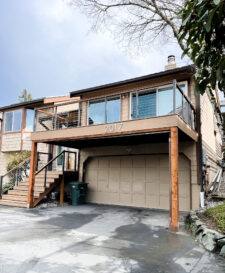
What Salt Air, Rain, and Moss Actually Do to a Deck
Each of these three conditions attacks a deck differently, and understanding that is the difference between a replacement that lasts and one that doesn't.
Salt Air
Airborne salt accelerates corrosion on any exposed metal — nails, screw heads, joist hangers, railing brackets, post bases. Once corrosion starts on a fastener, it weakens the connection long before the wood around it looks bad, which is why decks near the water sometimes fail structurally while still looking okay on the surface.
Driving Rain
Rain that comes in at an angle off the water gets pushed up under railings, into ledger connections, and behind fascia boards in ways that straight-down rain doesn't. Any gap in flashing or any spot where water can sit against wood instead of running off becomes a rot starting point.
Moss
A long moss season means more months where deck boards, stairs, and railings stay damp and shaded even when it isn't actively raining. Moss holds moisture against the surface, and on walking surfaces it also creates a real slip hazard on stairs and ramps.
What a Correct Deck Replacement Actually Involves
"Deck replacement" gets used loosely. A correct one, done for a Sandy Point property, involves more than pulling old boards and screwing down new ones. It should include:
- Full inspection of the substructure — posts, beams, joists, and footings — not just the visible decking
- Assessment of the ledger board connection to the house, since this is the single most common structural failure point on older decks
- Corrosion-resistant or stainless fasteners and hardware appropriate for a marine-influenced environment
- Proper flashing at the ledger and anywhere decking meets the house or a wall
- Correct joist spacing and blocking for the decking material chosen, since composite and PVC products often have different span requirements than wood
- Drainage detailing so water sheds away from the structure instead of pooling against framing
- Railing and stair construction that meets current code, especially if the old deck predates current guard height and baluster spacing rules
Skipping any of these to save money on the front end tends to cost more later, especially in a spot where the environment is actively working against the wood and hardware every day it's exposed.
Decking Material Choices for a Sandy Point Property
There's no single "right" material for every deck, but there are real trade-offs worth understanding before you decide. We'll walk through these honestly during a site visit rather than pushing whatever we happen to have a good margin on.
| Material | How It Handles Salt Air & Moisture | Maintenance Load | Typical Lifespan Here |
|---|---|---|---|
| Pressure-treated wood | Needs sealing and upkeep to resist moisture and salt exposure; can check and splinter over time | Higher — regular cleaning and refinishing | 10-15 years with upkeep |
| Cedar or other natural wood | Naturally moisture-resistant but still affected by salt air and standing moisture without maintenance | Higher — periodic staining/sealing | 10-20 years with upkeep |
| Composite decking | Resists rot and doesn't corrode; surface can still hold moss without regular cleaning | Lower — occasional cleaning, no sealing | 20-25+ years typical warranty range |
| PVC/capped polymer | Best moisture and salt resistance of common options; won't absorb water into the board itself | Lowest — cleaning only | 25+ years typical warranty range |
Wood isn't a bad choice — plenty of homeowners prefer the look and are fine with the maintenance. But in an environment where salt air and a long wet season are working against the material constantly, composite or capped polymer decking tends to reduce the maintenance burden significantly, which matters more here than it would on a sheltered inland lot. The bigger factor in longevity, regardless of decking material, is almost always the substructure and fasteners underneath it.
Fasteners and Hardware: The Part Nobody Sees
The decking surface is what you see every day, but the hardware underneath is what determines whether the deck is actually safe. In a salt-air environment, standard galvanized fasteners can corrode faster than they would inland, and once a joist hanger or ledger bolt starts to fail, the problem is hidden under the decking until it's serious. Our standard for Sandy Point replacements is to use stainless or high-corrosion-resistant fasteners and connectors rated for the exposure, not whatever is cheapest at the yard. It costs more up front and it's the right call for a deck that's supposed to last.
Our Process for a Sandy Point Deck Replacement
- Site visit and assessment — we look at the existing deck's framing, ledger condition, footings, and how exposed the site is to wind-driven rain and salt spray, not just the surface condition of the old boards.
- Honest scope and material discussion — we walk through material options and cost factors specific to your site and how you use the deck.
- Permitting — deck replacements of meaningful scope typically require a permit; we handle that process rather than leaving it to you.
- Demolition — full removal of old decking and, where needed, damaged substructure, disposed of properly.
- Framing and structural work — posts, beams, joists, footings, and ledger connection brought up to current code with corrosion-resistant hardware.
- Decking, railing, and stairs — installed to the chosen material's spec, with attention to drainage and flashing details at every point the deck meets the house.
- Final walkthrough — we go over the finished deck with you, including basic care guidance specific to the material installed.
Permits and Building Requirements
Deck replacements in Whatcom County generally require a building permit once the scope goes beyond a like-for-like board swap, and waterfront-adjacent properties can carry additional review depending on setbacks and shoreline considerations. Requirements shift over time and depend on your specific parcel, so we don't guess at this — we confirm what applies to your property and handle the permit process as part of the job rather than treating it as your problem to sort out separately.
Keeping a New Deck Ahead of the Moss and Salt
Even a well-built deck needs some seasonal attention in this environment. A short, realistic maintenance routine goes a long way toward protecting the investment:
- Sweep debris off the deck regularly, especially in fall when organic matter builds up fastest
- Rinse salt residue off the surface periodically, particularly after storms with onshore wind
- Clean moss off stairs and walking surfaces promptly — it's a slip hazard, not just a cosmetic issue
- Check railings and stair connections annually for looseness, which can be an early sign of fastener corrosion
- Keep gutters and downspouts near the deck clear so runoff isn't dumping extra water onto the structure
- For wood decking, plan on resealing or restaining on the manufacturer's recommended cycle, not "whenever it looks bad"
Why Hiring a Crew That Already Works Sandy Point Matters
A deck replacement is the same basic trade wherever it's done, but the details that make it last are local. A crew that regularly works Sandy Point already knows how exposed a given lot typically is to wind-driven rain, already specs fasteners for the marine environment as a default rather than an upsell, and already understands the permit expectations that apply to properties in this part of Whatcom County. That familiarity shows up in fewer surprises during the project and a deck that's actually built for the conditions it will face, not a generic spec sheet.
If you're weighing whether your current deck needs a repair or a full replacement, or you already know it's time to rebuild, we're glad to take a look and give you a straightforward assessment — no pressure, no upsell on material you don't need. The form below is the easiest way to get a free estimate started.