 Blaine Window
 Siding Built for Custer's Weather, Not Just Its Curb Appeal
Custer sits close enough to the Strait of Georgia and Drayton Harbor that homes here take a steady beating from salt-laden air, wind-driven rain, and a moss season that can stretch from October into May. Add the mix of open farmland and tree-lined lots typical of this part of Whatcom County, and you get two very different exposure problems on the same house: one side scoured by wind and salt, the other shaded and damp for months at a time. Siding that isn't built for both jobs fails at different rates on different walls of the same home — which is exactly what we see when we're called out to look at failing siding in this area.
This page is about one job done right in one place: full siding replacement for homes in and around Custer. We install James Hardie fiber cement exclusively, and we'll explain why, but the bigger point is that a correct siding job here starts with understanding what this specific climate does to a wall system over 10, 20, and 30 years — not just what looks good on install day.
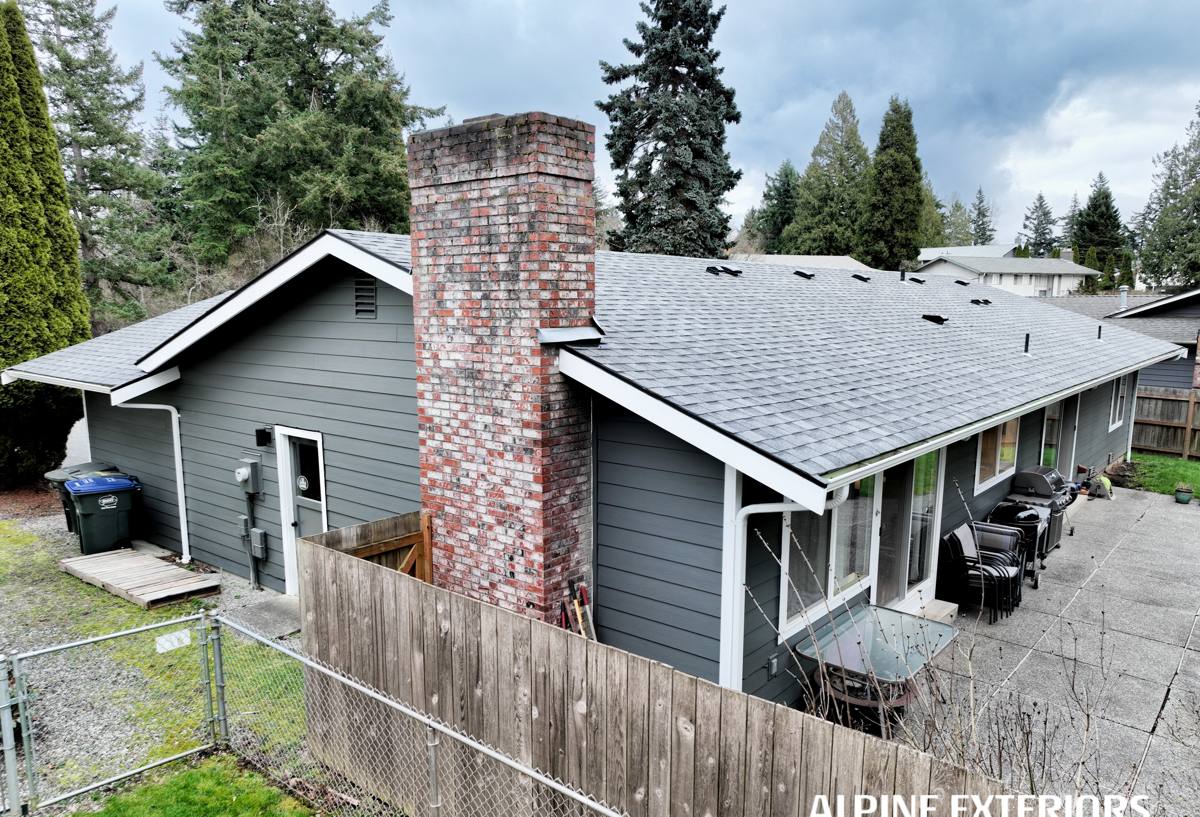
What Custer's Climate Actually Does to Siding
Salt Air and Corrosion
Proximity to saltwater doesn't just mean occasional salt spray on a windy day — it means airborne salt settling on siding, fasteners, and trim continuously, accelerating corrosion in anything not rated for it. Cheap fasteners rust and streak the face of the siding. Metal trim and flashing corrode faster than manufacturer literature (written for a national average climate) usually accounts for.
Driving Rain and Wind-Driven Moisture
Whatcom County's weather doesn't just rain down — storms off the water push rain sideways into wall assemblies, especially on west- and southwest-facing elevations. That means water is testing every seam, joint, and penetration in your siding system far more aggressively than a calm-weather climate would. Poor flashing details or gaps that would be a non-issue in a dry climate become chronic leak points here.
Moss, Algae, and Prolonged Dampness
Shaded lots and the long wet season in this part of the county mean siding surfaces can stay damp for extended stretches, especially on north-facing walls and anywhere overhung by trees. That's an ideal environment for moss and algae growth, which holds moisture against the siding face and, on wood-based products, accelerates rot from the surface inward.
Why We Only Install James Hardie Fiber Cement
We get asked regularly why we don't offer vinyl, LP SmartSide, or the cheaper fiber cement alternatives like Cemplank or Allura. It comes down to what actually holds up under the conditions described above, over the long haul, without turning into a maintenance project for the homeowner.
- Vinyl is inexpensive and low-maintenance in mild climates, but it can warp or become brittle under UV and temperature swings, and its seams and J-channels give wind-driven rain more opportunities to work behind the panel over time.
- LP SmartSide is an engineered wood product — treated to resist moisture, but still wood at its core. In a climate with this much sustained dampness and moss pressure, wood-based sidings are more exposed to the one failure mode (moisture intrusion at cut edges and fastener penetrations) that matters most here.
- Cemplank and Allura are legitimate fiber cement competitors, not junk products — but we've standardized on one manufacturer's system, warranty, and factory finish rather than mixing product lines, and Hardie's HZ5 formulation and ColorPlus finish are specifically engineered for the wet, marine-influenced Pacific Northwest.
James Hardie fiber cement is non-combustible, doesn't support rot or insect damage the way wood-based products can, and its ColorPlus factory finish is baked on and warranted against fading and peeling — which matters in a climate where a lower-quality finish would be tested by both UV exposure on sunny days and near-constant moisture the rest of the year. The HZ5 product line specifically is engineered for climates like ours: freeze-thaw cycling, high moisture, and salt exposure.
Hardie Product Lines We Work With
| Product Line | Best Use | Notable Feature |
|---|---|---|
| HardiePlank Lap Siding | Most common — full home re-siding | Multiple exposure widths and textures, ColorPlus finish |
| HardieShingle | Accent areas, gables, dormers | Staggered or straight-edge shingle profiles |
| HardiePanel | Modern/board-and-batten styling | Vertical panel system with batten trim |
| HardieTrim | Corners, window and door casing | Matches ColorPlus finish, resists moisture at edges |
What a Correct Siding Replacement Involves
Replacing siding isn't just pulling off old material and nailing up new panels. In a climate like Custer's, the work that happens underneath the siding matters as much as the siding itself.
Tear-Off and Sheathing Inspection
Once the old siding is off, we inspect the sheathing for rot, delamination, or hidden moisture damage — this is often where we find the real story behind why the old siding failed in the first place, especially on walls that have been holding moisture behind failing material for years.
Weather-Resistive Barrier and Flashing
A correctly installed weather-resistive barrier (house wrap) and properly integrated flashing at every window, door, and penetration is what actually stops wind-driven rain from reaching the sheathing. This is the step that separates a siding job that lasts decades from one that leaks within a few wet seasons — and it's not visible once the siding goes back on, which is exactly why it has to be done right the first time.
Rainscreen Consideration
On many homes in this area, we evaluate whether a rainscreen (a small gap between the siding and the wall assembly that lets moisture drain and air circulate) makes sense. In a region with Custer's combination of driving rain and prolonged damp shade, that drainage plane can meaningfully reduce moisture retention behind the siding.
Fastening and Finish
Corrosion-resistant fasteners, correct nailing patterns per Hardie's installation specs, and properly caulked and sealed joints and trim are what keep salt air and moisture from finding their way in at the small gaps — the details that are easy to shortcut and expensive to fix later.
Our Process for Custer Homeowners
- On-site assessment — we walk the exterior, check current siding condition, sheathing exposure where visible, and note problem areas (shaded walls, wind-exposed elevations, existing moisture damage).
- Straightforward estimate — a clear scope and price range, no pressure, explained in plain terms.
- Scheduling around the weather — we plan tear-off and sheathing work for stretches of drier weather where possible, since an open wall assembly needs to stay dry during installation.
- Tear-off, inspection, and repair — old siding removed, sheathing inspected and repaired as needed before anything new goes on.
- Barrier, flashing, and siding installation — installed to Hardie's published specifications, not shortcuts.
- Final walkthrough — we review the finished work with you before calling the job done.
Why Local Experience in Custer Matters
Custer isn't a generic suburb — it's a mix of rural properties, older farmhouses, and newer builds spread across a landscape shaped by wind exposure on open ground and heavy shade on tree-lined lots. A crew that already works this area knows which elevations typically take the worst of the driving rain, which lots hold moisture and moss longest, and how the salt air off the water factors into fastener and trim choices. That's the kind of judgment that only comes from doing this work here repeatedly, not from a general contractor passing through Whatcom County once.
Signs It's Time to Replace, Not Repair
- Soft or spongy spots when you press on the siding, especially on shaded or north-facing walls
- Persistent moss or algae growth that returns quickly after cleaning
- Visible warping, cracking, or buckling panels
- Paint that's peeling or bubbling rather than just fading
- Rusty streaks running down from fasteners or trim
- Rot or soft sheathing discovered at window and door edges
- Rising energy bills that suggest the wall assembly isn't performing as it should
If your siding shows one or two of these signs, a repair may be enough. If several are present, or the underlying sheathing is already compromised, full replacement is usually the more cost-effective path — patch repairs on a wall that's already failing rarely hold up through another wet season.
What Affects the Cost of a Siding Replacement
| Factor | Why It Matters |
|---|---|
| Home size and elevation complexity | More corners, gables, and dormers mean more cutting, trim, and labor |
| Sheathing condition underneath | Rot or moisture damage found during tear-off adds repair scope |
| Product line and profile | Lap siding, shingle, and panel systems carry different material and labor costs |
| Trim and accent work | Extensive trim detailing adds finish time and material |
| Access and site conditions | Tree cover, slope, or tight lot access can affect staging and labor time |
Every home in Custer carries its own exposure profile — some walls take the brunt of the wind and salt, others sit shaded and damp most of the year. If you'd like a straightforward look at what your siding needs and an honest estimate for a Hardie fiber cement replacement, we're happy to come take a look. There's no pressure and no cost for the visit — just a clear picture of where things stand.