 Blaine Window
 Siding Replacement in Cherry Point: A Shoreline Climate That Doesn't Forgive Shortcuts
Cherry Point sits along the water in Whatcom County, close enough to Blaine and the Strait of Georgia that homes out here take on a heavier dose of salt air and open-water wind than most inland parts of the county ever see. It's a quieter, more rural stretch of coastline than a lot of the towns nearby, with wooded lots and homes that often sit exposed to weather coming straight off the water. That exposure is exactly what shortens the useful life of siding here, and it's why a siding replacement done for a Cherry Point property needs to be planned differently than the same job would be a few miles inland.
We install siding, roofing, windows, and decks, and on siding specifically we install James Hardie fiber cement exclusively. This page is about one job in one place: replacing worn-out siding on a Cherry Point home, what that job should actually involve, and why the details matter more here than they do in a calmer, drier climate.
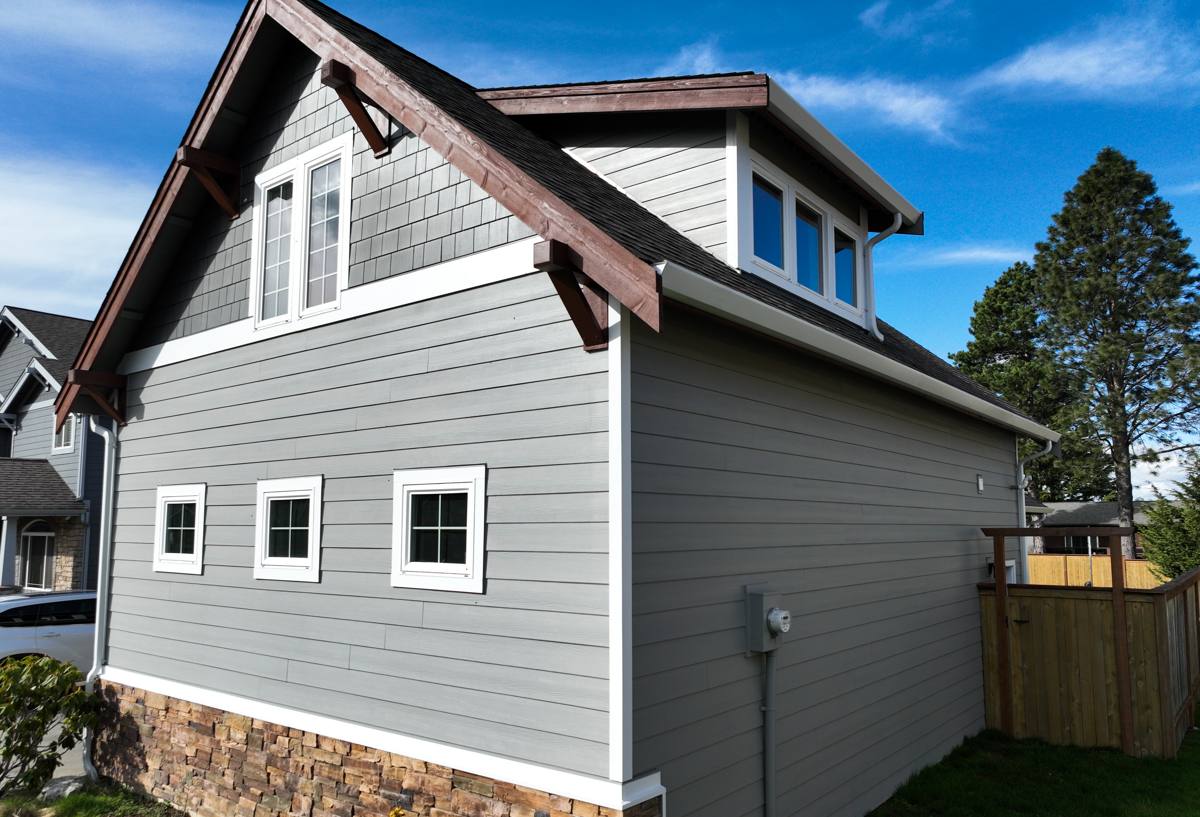
What Cherry Point's Climate Does to Siding
Salt Air Off the Water
Homes near the water at Cherry Point pick up a steadier dose of salt-laden air than properties set back from the shoreline. Salt speeds up corrosion on fasteners, flashing, and any exposed metal trim, and it wears down lower-quality paint and coatings faster than a dry inland climate would. That matters most at the end of a siding system's life, when failing caulk, tired fasteners, and a worn finish all start compounding at once.
Driving Rain With Nothing to Break It Up
Open water exposure means storms don't just drop rain straight down — wind pushes it sideways into wall assemblies, trim joints, and anywhere a seam has started to open up. Older siding installations, especially ones nearing the end of their service life, are exactly where that sideways-driven rain finds its way in first. A property with open exposure toward the water tends to take this harder than a similar home tucked into trees or shielded by other structures.
A Moss Season That Runs Most of the Year
Mild temperatures and near-constant moisture give moss and mildew a long growing season on shaded or north-facing walls. Any siding surface with even a little porosity becomes a place for it to take hold, and once a wall stays damp longer than it should, that moisture works against the substrate underneath, not just the visible finish. This is one of the clearest signs a home is due for replacement rather than another round of spot repairs.
Signs Your Cherry Point Home Needs Siding Replacement, Not Just a Repair
Not every siding problem calls for a full tear-off. But in a climate like this one, a handful of signs usually mean the siding system as a whole has reached the end of its useful life rather than needing another patch:
- Soft, spongy, or crumbling siding when pressed, especially low on the wall or around window and door trim
- Moss or dark staining that comes back quickly after cleaning, particularly on shaded or north-facing walls
- Visible warping, cupping, or separation at panel joints and seams
- Paint or finish that's peeling or chalking across large sections rather than one isolated spot
- Rust streaking from corroded fasteners or trim, more common this close to the water
- Rot or discoloration visible at the bottom edge of siding boards or around penetrations
- Interior signs like staining or soft drywall on exterior walls, which often means moisture has already gotten behind the siding
Any one of these on its own might be a localized repair. Several of them together, especially on a home that's carried its original siding for a couple of decades, usually means the whole system is past the point where patching makes economic sense.
Tear-Off vs. Overlay: Why We Don't Cut This Corner
Installing new siding directly over old, failing siding is faster and cheaper up front, but it buries whatever problems are already there instead of solving them. In a wet, salt-exposed climate like Cherry Point, that's a real risk — if moisture has already gotten behind the existing siding, covering it over just traps that moisture against the wall assembly where nobody can see it until it becomes a much bigger repair. We do a full tear-off on siding replacement projects so we can actually see the sheathing and wall assembly underneath before anything new goes on.
What a Tear-Off Actually Uncovers
Pulling old siding is the only reliable way to find soft or rotted sheathing, failed or missing house wrap, and any spots where past flashing work was never done correctly in the first place. On homes in this area, the extent of hidden moisture damage isn't always obvious until the old siding comes off — which is also why we're upfront that a siding replacement quote can shift once we're actually looking at the wall underneath.
What a Correct Siding Replacement Involves
Sheathing and Moisture Barrier
Any soft or damaged sheathing gets replaced before new siding goes on — installing over compromised sheathing just guarantees a shorter lifespan for the new system. A properly lapped weather-resistive barrier goes over sound sheathing, shingle-style from the bottom up, so water is directed out and down rather than trapped behind the wall.
Rain Screen Gap
A small drainage cavity behind the new siding lets any moisture that does get past the exterior surface drain and evaporate instead of sitting against the wall. This detail matters more on an exposed, waterfront property like Cherry Point than it would on a sheltered inland lot, because there's simply more moisture load for the wall assembly to manage over a given year.
Fastening and Flashing
Hardie specifies fastener type and spacing for a reason, and loose spacing or the wrong fastener is one of the more common causes of early siding failure we find on tear-offs. Every window, door, and penetration gets flashed and lapped so water sheds outward and downward, especially on walls that catch wind-driven rain directly off the water.
Sealed Joints and Trim Transitions
Butt joints, corners, and trim transitions are where salt-laden moisture finds its way behind siding first if they're not sealed correctly. We treat these as full installation steps, not a quick caulk pass at the end of the job.
Why We Only Install James Hardie Siding
We used to work with a broader range of siding products. We stopped, and the reason came from what we kept finding on tear-offs and service calls in coastal, high-moisture spots like Cherry Point — not from a supplier deal or a sales pitch.
- Non-combustible core: Fiber cement doesn't feed a fire the way wood-based siding products can, which matters for both safety and insurance considerations.
- Factory-applied ColorPlus finish: The color is baked on under controlled factory conditions rather than brushed on in the field, so it holds up longer against fading, chalking, and salt-air exposure.
- Climate-engineered HZ product lines: Hardie's HZ5 formulation is built for regions with sustained moisture and freeze-thaw cycling, which describes coastal Whatcom County well.
- Dimensional stability: Fiber cement doesn't swell, cup, or warp the way engineered wood products can after repeated exposure to wet weather off the water.
- Strong transferable warranty: Hardie backs the product with one of the stronger warranty structures in the industry, provided installation follows their spec.
We won't install LP SmartSide, vinyl siding, Cemplank, Allura, primed spruce, or cedar. Each has a place in the market and homeowners who are satisfied with them. But on an exposed, waterfront property like the ones at Cherry Point, we've made a professional call to install one system we fully stand behind rather than offer something cheaper that quietly shifts maintenance risk onto the homeowner a few years down the road.
Our Siding Replacement Process
We start with an on-site walkthrough of the existing siding, looking specifically at how it's held up against this property's actual exposure to wind and water, not a generic assessment. From there we give a straightforward read on what's driving the problem and whether repair or full replacement is the right call. Once a replacement is scoped, the sequence is consistent: full tear-off, sheathing repair where needed, a properly lapped moisture barrier, rain screen detailing, and Hardie siding installed to the manufacturer's fastening and flashing spec. We walk the finished job with the homeowner before calling it done.
Cost Factors for a Cherry Point Siding Replacement
| Factor | What Drives It | Cherry Point Consideration |
|---|---|---|
| Tear-off scope | Number of siding layers, ease of removal and disposal | Full tear-off is standard here to catch hidden moisture damage |
| Sheathing repair | Extent of rot or soft spots found once old siding is off | More common on walls with long-term exposure to wind-driven rain |
| Siding profile and trim | Lap width, panel vs. plank, trim and corner detailing | Same cost drivers as anywhere, chosen for the home's style |
| House size and wall complexity | Square footage, number of corners, windows, and penetrations | Each penetration is another flashing detail to get right |
| Access and site conditions | Lot grading, tree cover, staging space for materials | Wooded, waterfront lots can affect equipment access and staging |
These are general drivers, not a quote. Every property at Cherry Point sits a little differently relative to the water and tree cover, and the real scope of a siding replacement usually isn't clear until the old siding is off and we can see the wall underneath. That's why we're cautious about giving a firm number before walking the property in person.
Why Hiring a Crew That Already Works Cherry Point Matters
A crew that works this stretch of Whatcom County coastline regularly has already seen how salt air, wind-driven rain, and a long moss season behave on real homes here over a full year, not just on a spec sheet. That experience shapes practical decisions on install day — where extra flashing attention pays off, which walls take the worst of the weather, and which fastener and sealing details are worth the extra time so a homeowner isn't dealing with a callback after the next storm off the water. Cherry Point's exposure isn't identical to more sheltered towns further inland, and a siding replacement built for that difference holds up longer than one that treats every property the same.
If your Cherry Point home has siding that's showing its age — soft spots, recurring moss, peeling finish, or signs of moisture getting in behind the walls — we're glad to take a look and give you a straightforward, honest read on whether it needs repair or full replacement. Reach out using the form below to schedule a free, no-pressure estimate.