 Blaine Window
 Fiber Cement Siding in Birch Bay: A Job That Has to Account for the Water
Birch Bay sits directly on the water in northern Whatcom County, and that location changes what a siding job actually needs to hold up to. Homes here take on salt-laden marine air coming off the bay, long stretches of wind-driven winter rain, and a moss and mildew season that can run for most of the year on shaded or north-facing walls. Siding that performs fine a few miles inland can start showing problems within a handful of years out here, which is exactly why the material and the installation both matter more in Birch Bay than they do in a milder, more sheltered part of the county.
We're a windows contractor first, and that background shapes how we think about siding. A window is only as good as the wall assembly around it, and the flashing, drainage, and moisture management that make a window installation last are the same fundamentals that make a siding job last. When we added fiber cement siding to what we install, we brought that same attention to water management with us, and we settled on one product system: James Hardie. We don't install LP SmartSide, vinyl, Cemplank, Allura, primed spruce, or cedar, and on a job in Birch Bay specifically, that standard isn't academic — it's the difference between a wall assembly that sheds this climate and one that slowly absorbs it.
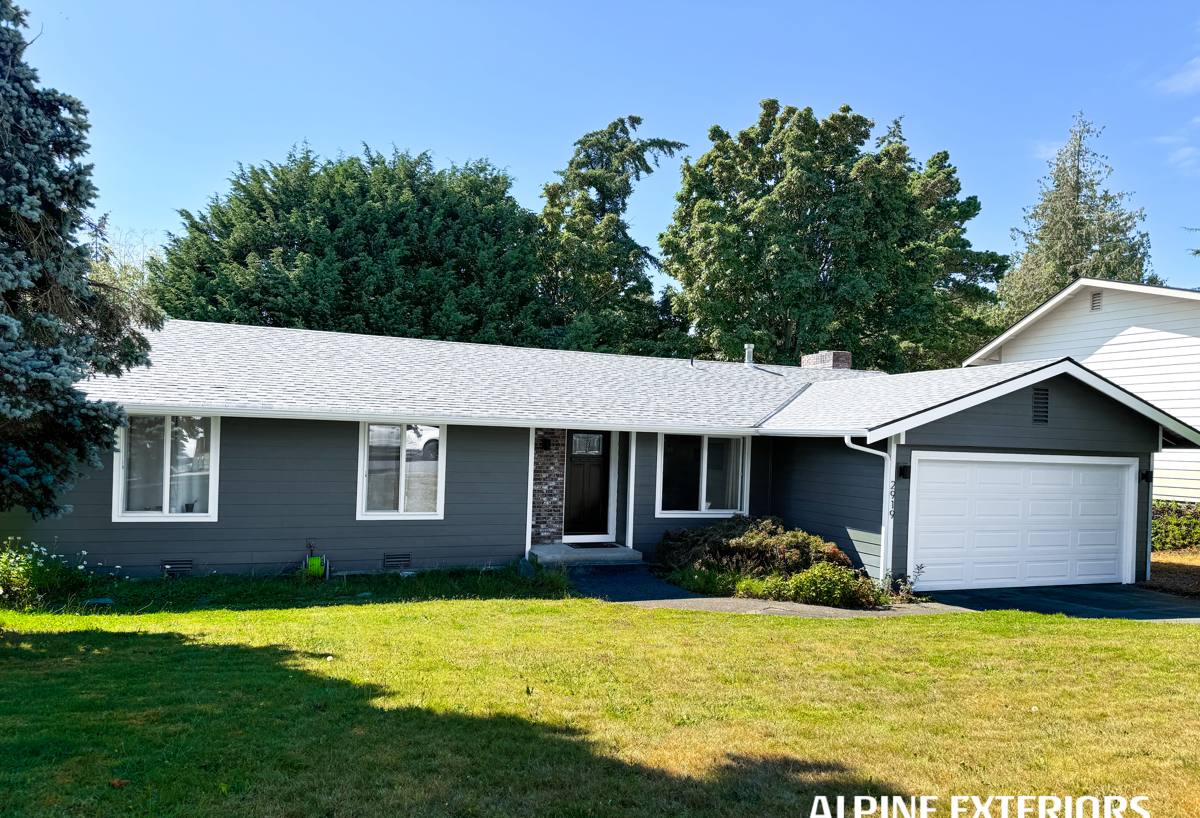
What Birch Bay's Climate Actually Does to Siding
Salt Air, Close to the Water
Being directly on Birch Bay means a steadier dose of salt-laden air than towns set back even a mile or two inland. Salt accelerates corrosion on fasteners, flashing, and any exposed metal trim, and it breaks down lower-quality paints and coatings faster than a drier climate would. On a siding job here, hardware and finish choices carry more weight than they would elsewhere in Whatcom County, because the margin for a cut corner is thinner this close to salt water.
Driving Rain Off the Water
Wind coming off the bay pushes rain sideways into wall assemblies, window and door flashing, and the joints where trim meets siding, rather than letting it simply fall straight down and run off. That sideways-driven moisture finds gaps a careless installation would leave behind, and it does so more often here than in towns with more shelter from the water. Any siding system installed in Birch Bay needs to assume wind-driven rain as a baseline condition, not an occasional event.
A Long Moss and Mildew Season
Mild temperatures combined with near-constant moisture give moss and mildew a long growing season on shaded or north-facing walls, often stretching across most of the year. Surfaces that stay damp longest are the first to show growth, and any siding material with even slight surface porosity becomes an easier foothold for it over time. Homes with heavy tree cover or limited direct sun tend to see this earliest and worst.
Why Fiber Cement, and Why James Hardie Specifically
Fiber cement as a category holds up to this climate better than wood-based or vinyl siding because it doesn't absorb and release moisture the way wood-based products do, and it doesn't distort under heat and cold the way vinyl can. But not all fiber cement is installed, finished, or engineered the same way, and the differences matter enough in a place like Birch Bay that we standardized on one manufacturer rather than mixing products from job to job.
- Non-combustible core: Fiber cement doesn't feed a fire the way wood-based siding products can, which matters for safety and can matter for insurance considerations as well.
- Factory-applied ColorPlus finish: The color is baked on under controlled factory conditions instead of brushed on in the field, so it holds up longer against fading, chalking, and the constant moisture exposure a waterfront property sees.
- Climate-engineered HZ product lines: Hardie's HZ5 formulation is built for regions with sustained moisture and freeze-thaw cycling, which describes waterfront Whatcom County accurately.
- Dimensional stability: Fiber cement doesn't swell, cup, or warp the way engineered wood siding can after repeated exposure to wet weather off the water.
- Strong transferable warranty: Hardie backs its products with one of the stronger warranty structures in the industry, provided the installation follows their published spec.
Products like LP SmartSide, vinyl, Cemplank, Allura, primed spruce, and cedar all have a place in the market, and plenty of homeowners are satisfied with them in less demanding settings. But on a shoreline exposure like Birch Bay, we made a professional call to install one system we can fully stand behind rather than offer something cheaper that quietly shifts long-term maintenance risk onto the homeowner. That standard came out of what we saw on tear-offs and service calls, not from a supplier relationship.
What a Correct Fiber Cement Installation Involves Here
Hardie siding only performs the way it's engineered to when it's installed to spec, and in a climate like Birch Bay's, the details that are easy to skip are exactly the ones that matter most once the walls are closed up. A correct installation includes:
- A drainage gap or rain-screen detail behind the siding so any moisture that gets past the exterior surface can drain and evaporate instead of sitting against the wall sheathing
- Corrosion-resistant fasteners installed at the type and spacing Hardie specifies, not a generic substitute
- Properly lapped house wrap and flashing at every seam, window, door, and penetration, oriented to shed wind-driven rain downward and outward
- Sealed butt joints and trim transitions, since open or poorly sealed joints are where salt-laden moisture finds its way behind the siding first
- Correct clearance from grade, decks, and roof lines, so the bottom edge of the siding isn't sitting in standing water or constant splash-back
None of this is exotic. It's the manufacturer's own published installation spec, followed consistently on the parts of the job that are hardest to see once the siding is up and the project looks finished.
How We Approach a Siding Project in Birch Bay
Because we come at exterior work from the windows side, we start every siding project by looking at the whole wall assembly, not just the surface material.
- On-site assessment: We walk the exterior, check existing siding and trim for moisture damage, and look specifically at how the current system has handled salt exposure and wind-driven rain over time.
- Scope and product selection: We put together a clear, written scope covering tear-off versus overlay, trim details, and the correct Hardie HZ product line for a waterfront property.
- Substrate and flashing check: Before new siding goes up, we confirm the sheathing and house wrap underneath are sound, and correct any flashing issues at windows, doors, and roof-to-wall transitions rather than covering them over.
- Installation to spec: Fasteners, drainage detailing, joint sealing, and clearances are handled to Hardie's published requirements, not shortcut on the details a homeowner won't see once the job wraps up.
- Final walk-through: We review the finished work with the homeowner and go over warranty coverage before considering the project complete.
Cost Factors for a Birch Bay Fiber Cement Siding Job
| Factor | What Drives It | Birch Bay Consideration |
|---|---|---|
| Tear-off vs. overlay | Condition of existing siding and sheathing | Waterfront homes more often need substrate repair if moisture has already gotten behind old siding |
| Trim and detail complexity | Number of windows, corners, and architectural features | Every trim transition is a potential entry point for wind-driven rain and needs proper sealing |
| Hardie product line and finish | Panel style, plank width, and ColorPlus color selection | HZ5 formulation is the correct match for this moisture and freeze-thaw exposure |
| Fasteners and hardware | Corrosion-resistant fastener grade | Salt air makes standard fasteners a false economy near the water |
These are general cost drivers, not a quote. Every home in Birch Bay sits at a slightly different distance from the water and under different tree cover, and two houses on the same street can need very different scopes once old siding actually comes off. We walk the property in person before putting a real number on the work, and we're cautious about any estimate that skips that step.
Signs a Birch Bay Home's Siding Needs Attention
- Moss or dark staining that returns quickly after cleaning, especially on shaded or north-facing walls
- Soft or spongy siding, particularly low on the wall or around window and door trim
- Rust staining or visibly corroded fasteners and trim, more common this close to salt water
- Peeling paint, chalking, or visible warping on panels that get little direct sun
- Gaps opening up at butt joints, corners, or trim transitions
- Interior staining near exterior walls after a windy storm off the water
Why a Crew That Already Works Birch Bay Matters
A contractor who works this stretch of coastline regularly already knows how salt air, wind-driven rain, and a long moss season behave on real Birch Bay houses over a full year, not just how a product performs on a spec sheet. That familiarity shows up in specific decisions on install day: where extra flashing attention pays off, which walls stay wet longest through the winter, and which fastener and clearance details are worth the extra time so a homeowner isn't dealing with a callback after the next storm off the water. Birch Bay's direct waterfront exposure isn't the same as more sheltered parts of Whatcom County, and a crew that treats it as such builds differently because of it.
If your Birch Bay home needs new siding or you're not sure whether what's on the walls now is still doing its job, we're glad to take a look. Reach out using the form below to schedule a free, no-pressure estimate.