 Blaine Window
 Why Bellingham Roofs Wear Differently
A roof in Bellingham does not age the same way a roof does in a drier inland climate. Between the marine air rolling off Bellingham Bay, the long stretch of overcast, drizzly weeks that define a Whatcom County winter, and the shade from mature evergreens that keeps roof decks damp for days after a storm, local roofs are under near-constant low-grade stress. It is rarely one dramatic event that causes a leak here. It is months of moisture sitting where it shouldn't, moss holding water against the roof deck, and fasteners and flashing slowly corroding in salt-laden air.
That means roof repair in this area is less about patching a single obvious hole and more about understanding how water actually moves across a roof during a real Pacific Northwest rain event, and fixing the specific point where it's getting past the shingles or the flashing.
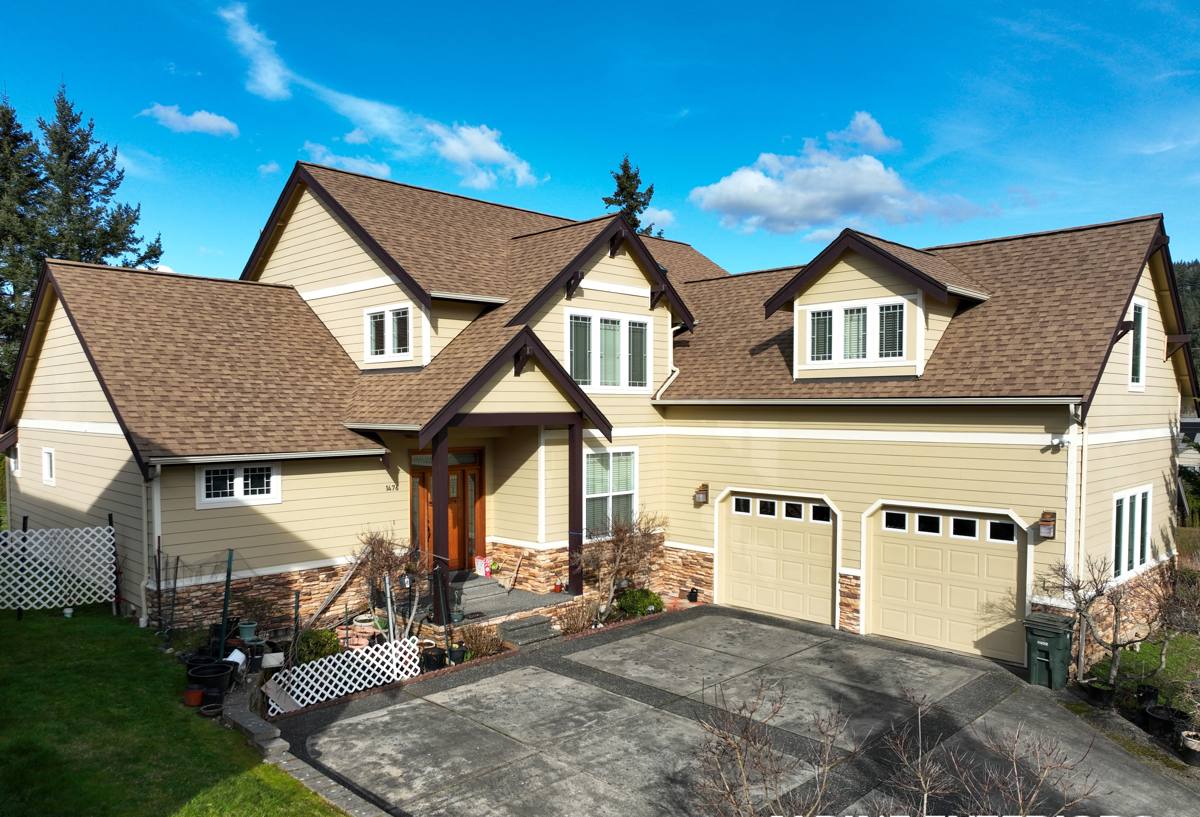
Signs a Bellingham Roof Needs Repair — Not a Full Tear-Off
Most of the calls we get for roof repair fall into one of these categories. If any of these sound familiar, a repair is usually a realistic option before jumping to full replacement:
- A stain on an interior ceiling or wall that only appears after a heavy or wind-driven rain
- Visible moss buildup concentrated on the north-facing slope or under tree shade
- Shingles that are cupping, curling, or missing granules in a localized area rather than across the whole roof
- Flashing around a chimney, skylight, or vent pipe that looks rusted, lifted, or gapped
- A valley (where two roof slopes meet) that shows granule loss, moss, or a soft spot underfoot
- Gutters that overflow during storms because debris and moss are backing water up under the shingle edge
None of these on their own mean the whole roof is failing. They mean water has found a weak point, and that point can usually be repaired properly if it's addressed before the deck underneath starts to rot.
Where Bellingham Roofs Actually Leak
Valleys and Flashing
In a region with driving rain, valleys and flashing do more work than the shingle field itself. Wind-driven rain pushes water sideways and uphill in ways flat, calm-weather rain never does, so any gap in step flashing, counter-flashing, or valley metal becomes an entry point. A large share of the repairs we do are flashing repairs, not shingle repairs — the shingles around the leak are often fine, but the metal underneath them has failed.
Roof Penetrations
Plumbing vents, exhaust fans, and skylight curbs are sealed with boots and flashing that degrade faster than the surrounding roofing. Rubber vent boots in particular tend to crack years before the shingles around them wear out, and a cracked boot is one of the most common single-point leak sources we find on an otherwise sound roof.
Moss-Damaged Shingles
Moss doesn't just sit on top of a roof — its root structure lifts shingle edges and holds water against the granule surface, which accelerates wear in exactly the spots where moss has established itself. A roof with heavy moss in one section often has real, localized shingle damage there even if the rest of the roof looks fine.
Moss, Algae, and Whatcom County's Long Wet Season
Moss is close to unavoidable on a shaded roof in this part of Washington, but how it's handled makes a real difference in whether a roof gets a repair or a replacement in a few years. Pressure washing moss off a roof is a mistake we see often on homes that have had work done elsewhere — it strips granules, drives water under the shingle edge, and can shorten a roof's remaining life significantly. Proper moss removal uses low-pressure methods and manual clearing, followed by treatment that slows regrowth, plus attention to whatever is keeping that section of roof shaded and damp longer than the rest.
Zinc or copper strips near the ridge can help reduce moss regrowth on future maintenance, but they are a supplement to good removal and drainage, not a substitute for repairing shingles that moss has already damaged.
Roofing Materials We Commonly Repair in This Area
What a repair involves depends heavily on what's already on the roof. Here's how the common materials in Whatcom County compare when it comes to repair work specifically:
| Material | How it typically fails | Repair approach |
|---|---|---|
| Composition (asphalt) shingle | Granule loss, cracking, wind-lifted edges, moss undermining | Section replacement with matched shingles; usually the most straightforward repair |
| Metal roofing | Fastener backout, sealant failure at seams and penetrations, occasional panel damage | Re-fastening, seam and penetration resealing, or targeted panel replacement |
| Cedar shake or shingle | Splitting, moss and moisture retention, individual shake failure | Selective shake replacement and moss management; more labor-intensive per repair |
| Flat or low-slope membrane | Seam separation, ponding water, membrane punctures | Seam re-welding or patching; drainage correction if ponding is the root cause |
We repair to match what's already there whenever the existing material is sound enough to justify it, rather than pushing a different system on a roof that doesn't need it.
What a Correct Roof Repair Actually Involves
A repair that's done right isn't just sealing over the visible symptom. Our process on a typical repair looks like this:
- Interior and exterior inspection — we trace the leak from the interior stain or damp spot back to its likely source on the roof, since water often travels sideways along the deck before it drips through.
- Roof-level diagnosis — checking flashing, penetrations, valleys, and the shingle field around the suspected area, not just the first thing that looks wrong.
- Deck check — if there's been standing moisture for a while, we check the roof deck itself for soft spots before doing any surface repair, since patching over a soft deck doesn't hold.
- Written scope and honest recommendation — including whether a repair is the right call or whether the damage has spread far enough that replacement is the more cost-effective long-term option.
- The repair itself — matched materials where possible, proper flashing technique (not just sealant over a gap), and correct shingle or panel integration so the repaired area sheds water the way the rest of the roof does.
- Follow-up — a clear explanation of what was found, what was fixed, and anything worth keeping an eye on going forward.
What Roof Repair Typically Costs, and What Changes the Price
Roof repair pricing has a wide range because the underlying cause of a leak varies so much. In broad terms, a small, single-point repair (a vent boot, a section of flashing, a handful of shingles) tends to sit in the low hundreds of dollars, while a repair involving a valley, extensive flashing rework, or deck damage from a longstanding leak can run well into four figures. The factors below are what actually move the number:
| Factor | Why it matters |
|---|---|
| Roof pitch and access | Steep or hard-to-access roofs take longer and require more safety setup |
| Deck condition under the leak | Rotted sheathing has to be cut out and replaced before any surface repair, which adds material and labor |
| Extent of moss or algae damage | Determines whether it's a spot repair or a larger section replacement |
| Material availability/match | Older or discontinued shingle colors and profiles can be harder to match seamlessly |
| Number of penetrations involved | Each vent, pipe, or skylight in the repair area adds its own flashing and sealing work |
We give a firm, itemized quote after inspecting the roof in person — not a phone estimate — because the difference between a simple flashing fix and a deck repair isn't visible from the ground or from photos.
Maintenance That Extends the Life of a Bellingham Roof
Between repairs, a few habits go a long way in this climate:
- Clear gutters and downspouts before the fall rains set in, so water has somewhere to go
- Have moss checked and addressed at the first sign of buildup rather than waiting until it's thick
- Keep overhanging branches trimmed back to reduce shade, debris, and abrasion on the roof surface
- Walk the attic after major storms looking for new damp spots, even small ones
- Have flashing and roof penetrations inspected every couple of years, since these fail well before shingles typically do
Why a Crew That Already Works in Bellingham Matters
Roof repair diagnosis is largely pattern recognition — knowing which flashing details tend to fail on which roof ages and styles, which slopes hold moss longest given the area's tree cover and exposure, and how wind-driven rain off the bay behaves differently than a straight-down rain. A crew that repairs roofs across Bellingham and the surrounding Whatcom County area regularly sees the same handful of failure points repeat house after house, which makes diagnosis faster and repairs more targeted, instead of guessing and over-scoping the work.
If you're dealing with a leak, a mossy section of roof, or damage from a recent storm, we're happy to come take an honest look and tell you straight whether it's a repair or something bigger. The estimate is free, there's no pressure attached to it, and you can use the form below to get started.