 Blaine Window
 Composite Decking Built for Bellingham's Marine Climate
Bellingham sits along the Salish Sea in Whatcom County, just down the water from Blaine, and that location comes with a specific set of conditions that outdoor structures have to deal with year-round. Salt-laden air off the water, long stretches of driving rain, and a moss season that can run from fall through spring all put real stress on a deck. Composite decking can handle that environment well when it's designed and installed correctly for it — but "correctly for it" is doing a lot of work in that sentence, and it's where a lot of decks in this area go wrong.
We work on homes throughout Bellingham and the surrounding Whatcom County communities regularly, so we're not guessing at how a deck holds up here — we're building to what we've already seen happen to decks that weren't detailed right for this climate.
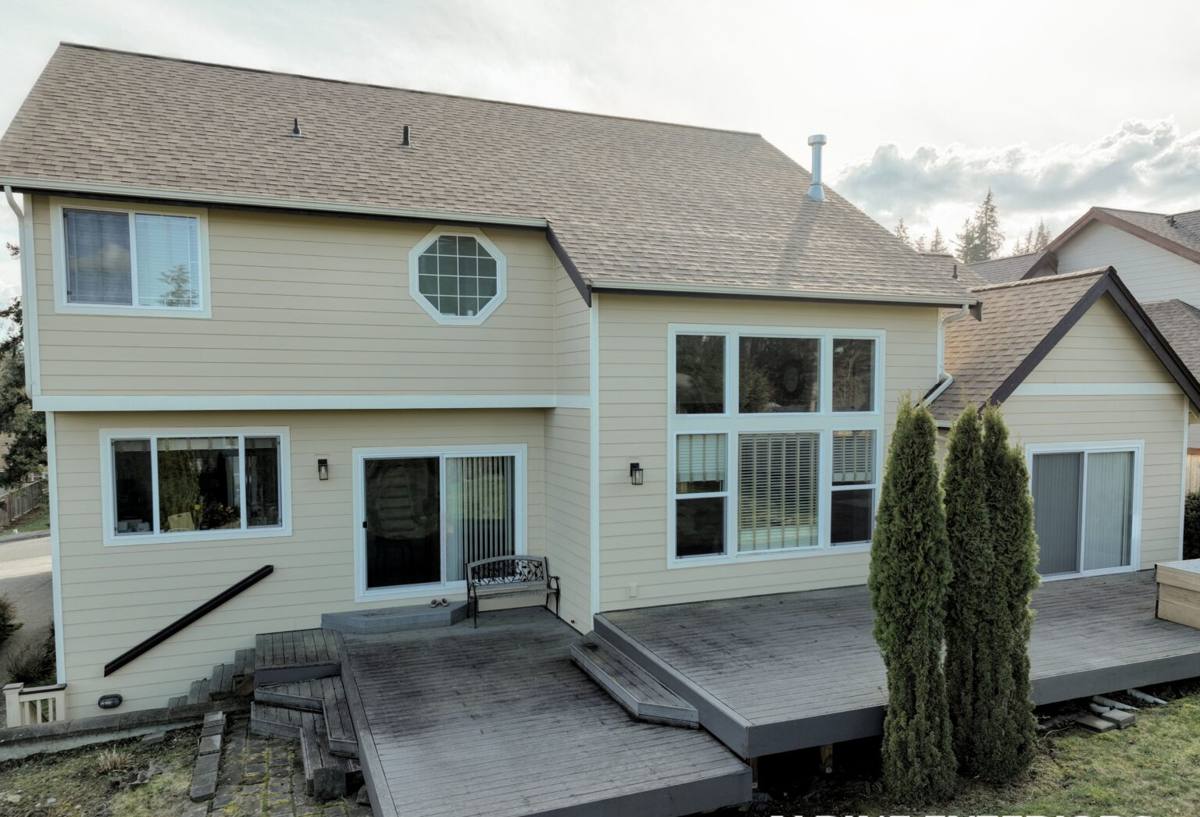
What Whatcom County Weather Actually Does to a Deck
Salt Air and Corrosion
Proximity to saltwater means metal components — fasteners, brackets, flashing, railing hardware — are exposed to corrosive air even if the deck never gets splashed directly. Standard hardware can start showing rust or pitting well before the decking itself shows any wear, and once fasteners corrode, they can stain the boards around them and weaken the connection they're supposed to be holding.
Driving Rain
Rain here doesn't just fall straight down. Wind off the water pushes it sideways, which means it gets up under railings, into ledger connections, and behind fascia boards in ways a calmer climate doesn't have to plan for. Any gap in the water management on a deck becomes an entry point, and once moisture gets trapped against wood framing or fascia, it stays wet far longer than it would in a drier region.
Moss and Algae
Shade, moisture, and mild temperatures are exactly what moss and algae need to establish, and Bellingham has all three for a large part of the year. Moss on a deck surface isn't just cosmetic — it holds moisture against the board, and on a slippery surface it's a real fall hazard, especially on stairs.
Freeze-Thaw Swings
Whatcom County doesn't get brutal winters, but it does get enough freeze-thaw cycling that any water trapped in a joint, a fastener hole, or a poorly sealed connection can do damage over a few seasons, even if no single freeze looks severe.
What a Correct Composite Deck Build Requires Here
None of the issues above are reasons to avoid composite decking — they're reasons to build it a specific way. A composite deck done right for this climate includes:
- Corrosion-resistant fasteners throughout — stainless steel or coated fasteners rated for coastal exposure, not standard galvanized hardware that's fine inland but not here.
- Ledger flashing done properly where the deck meets the house, so wind-driven rain can't work its way behind the band board and into the structure.
- Joist tape over the framing to keep the substructure dry even where the composite decking's protective cap doesn't extend — the framing underneath is still typically wood, and it's the part most likely to fail first if it's neglected.
- Correct board spacing for drainage and expansion, since composite material moves with temperature more than people expect, and tight or uneven gaps trap standing water and debris.
- Hidden fastener systems on the walking surface where possible, which reduce the number of exposed metal penetration points that salt air can attack over time.
- Ventilation under low-clearance decks so airflow can dry out the space below instead of leaving it perpetually damp — a common problem on decks built close to grade.
Skipping any one of these doesn't usually cause an immediate problem. It shows up two, three, or five years later as rot in the framing, corroded fasteners bleeding rust into the boards, or a substructure repair that costs more than doing it right the first time would have.
Our Installation Process
- On-site assessment. We look at drainage around the existing structure, sun and shade exposure, wind exposure relative to the water, and the condition of any ledger connection or existing substructure.
- Design and material selection. We talk through board tier, color, railing style, and layout based on how the space is actually used, not just what looks good in a sample.
- Permitting. Elevated decks and any structural work typically require a permit through the local jurisdiction. We handle that process as part of the job rather than leaving it for the homeowner to sort out.
- Substructure and waterproofing. Framing, ledger flashing, and joist tape go in before a single composite board is installed — this is the part that determines how the deck performs in ten years, not just how it looks on day one.
- Decking, fastening, and railing installation. Boards are laid with proper spacing and fastened with corrosion-resistant hardware appropriate to a marine climate.
- Final walkthrough. We check fastener finish, board alignment, drainage, and railing stability before calling the job done.
Composite vs. Wood Decking in This Climate
Both materials can work here, but they behave differently against salt air, rain, and moss, and it's worth understanding the trade-offs honestly rather than assuming one is simply "better."
| Factor | Composite Decking | Wood Decking |
|---|---|---|
| Moisture absorption | Capped boards resist water absorption into the board itself | Absorbs moisture, which drives swelling, warping, and splintering over time |
| Moss and algae | Still needs regular cleaning, but the surface doesn't feed rot the way bare wood can | Trapped moisture under moss accelerates decay in the wood fibers |
| Refinishing | No staining or sealing required | Needs periodic sealing or staining to keep water out — easy to fall behind on |
| Upfront cost | Higher material cost | Lower material cost |
| Long-term maintenance labor | Lower — mostly cleaning | Higher — sealing, sanding, spot repairs |
| Fastener sensitivity | Still critical to use corrosion-resistant hardware | Same requirement — this isn't a wood-vs-composite issue |
The honest summary: composite costs more upfront and saves ongoing maintenance labor and refinishing cost. Wood costs less upfront but demands more consistent upkeep in this climate to avoid the moisture and rot problems that Bellingham's weather makes easy to develop.
Cost Factors for a Bellingham Composite Deck
Every deck is priced around its own specifics, but these are the main variables that move the number:
| Factor | Why It Matters |
|---|---|
| Deck size and shape | Square footage and complexity of the layout (angles, multiple levels) both add labor and material |
| Board tier | Composite lines range from entry-level capped boards to premium high-density options with longer warranties |
| Substructure condition | Existing framing that needs repair or replacement adds cost before the visible decking even starts |
| Height and railing requirements | Elevated decks need code-compliant railing systems, which adds material and labor |
| Stairs | Each stair run adds framing, decking, and railing work |
| Site access | Tight backyards or limited equipment access can increase labor time |
| Permitting | Required for most elevated or structural deck work through the local jurisdiction |
Maintaining Your Deck Through Moss Season
Composite decking is lower-maintenance than wood, but "low-maintenance" doesn't mean "no maintenance" — especially with the moss and algae pressure this area sees. A simple seasonal routine keeps a composite deck performing the way it's supposed to:
- Sweep debris off regularly, especially leaves and needles that trap moisture against the board.
- Clean with a soft-bristle brush and a mild soap-and-water solution or a cleaner made for composite decking — avoid harsh chemical cleaners that can affect the cap finish.
- Use a garden hose or low-pressure setting if pressure washing; high pressure held too close can damage the composite cap surface.
- Keep gutters and downspouts clear so roof runoff isn't dumping extra water directly onto or near the deck.
- Trim back overhanging branches and vegetation to reduce shade and let the deck surface dry between rain events.
- Check railing and stair fasteners periodically for early signs of corrosion, and address it before it spreads.
Why a Local Blaine Crew Matters for Bellingham Homes
A crew that only shows up in Bellingham occasionally doesn't build the same working knowledge as one that's out here on a regular basis. Being based nearby in Blaine means we're familiar with how homes in this part of Whatcom County are exposed to wind and salt air off the water, how quickly moss establishes on north-facing or shaded decks in this specific area, and what the local permitting process actually requires. It also means that if a warranty question or a maintenance question comes up two years after installation, we're not far away and not hard to reach.
That local familiarity shows up in small decisions during a build — which side of the deck needs extra attention to wind-driven rain, where moss is most likely to become a problem given the sun exposure, how the substructure should be detailed given the age and construction of homes common in this area. Those are the kinds of judgment calls that come from doing this work here repeatedly, not from a generic installation checklist.
Get a Free Estimate
If you're planning a new composite deck or replacing an aging one in Bellingham, we're happy to come take a look, walk through your options, and give you a straightforward, no-pressure estimate. Use the form below to get started.