 Blaine Window
 Roofing on the Semiahmoo Spit Is Its Own Job
Semiahmoo sits out on a narrow spit facing Drayton Harbor on one side and open water toward the Strait of Georgia and Boundary Bay on the other. That position is what makes the neighborhood beautiful, and it's also what makes roofing here harder than roofing three miles inland in Blaine proper. Homes out here take wind off open water from more than one direction, get more direct salt spray, and sit in shade pockets from mature trees and neighboring structures that keep north-facing slopes damp for days after a storm passes. A shingle roof that would last two decades in a drier, more sheltered part of Whatcom County can wear out faster here if it wasn't installed with that exposure in mind.
We're not describing a different product for Semiahmoo — it's still asphalt shingle roofing, still one of the most cost-effective and widely used roofing systems available. What changes is how it's detailed: the underlayment choice, the metal flashing spec, the fastening pattern, the ventilation plan. Get those details right and a shingle roof handles this exposure fine for its full service life. Skip them, and you're looking at premature granule loss, curling, and leaks at the valleys and penetrations years before the shingles themselves wear out.
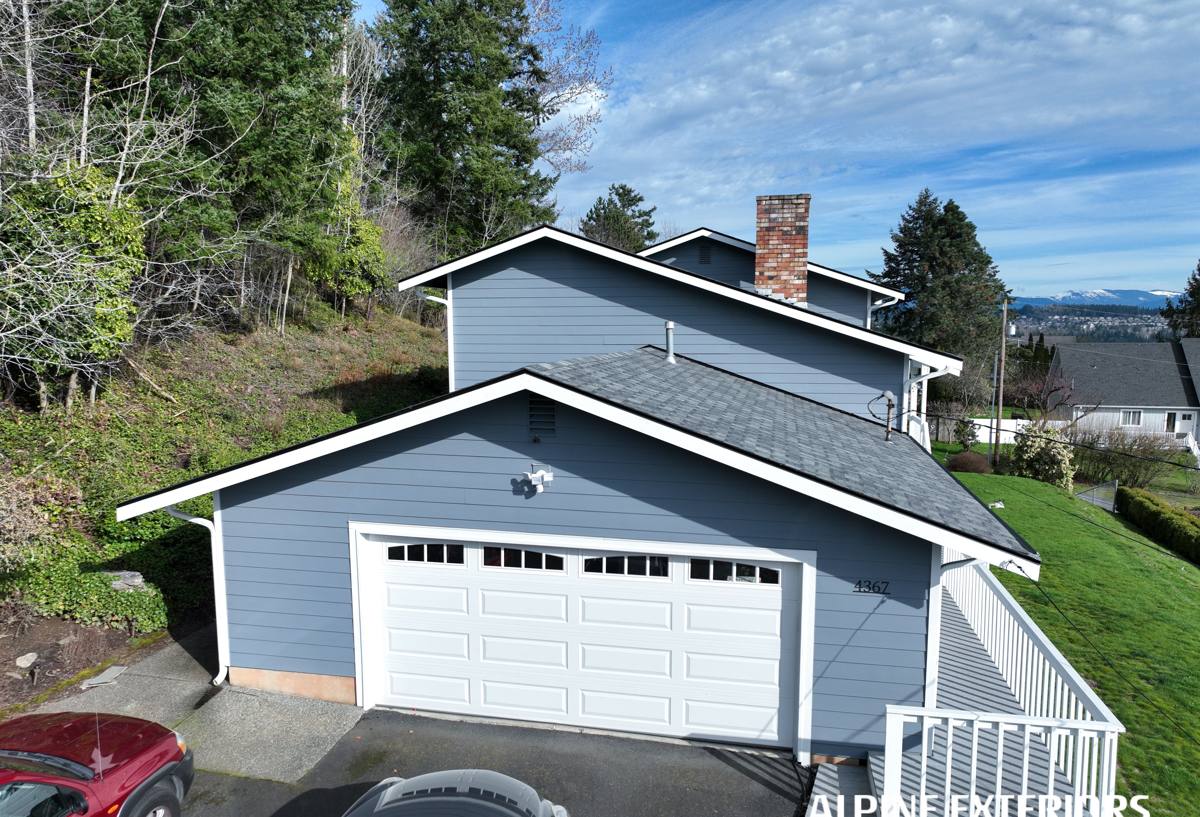
What Salt Air and Driving Rain Actually Do to a Roof
Salt Air
Airborne salt doesn't dissolve asphalt shingles the way it corrodes metal, but it accelerates the breakdown of anything metallic on the roof — nails, drip edge, flashing, and vent caps. Cheaper galvanized fasteners and flashing can start showing rust streaks and pinholing well before the shingles are due for replacement. Once flashing fails, water gets behind it regardless of how good the shingles above it are.
Driving Rain
Wind off open water pushes rain sideways and up under shingle tabs, not just straight down onto them. That means the standard fastening pattern and standard underlayment lap that work fine on a sheltered inland roof aren't always enough on an exposed waterfront elevation. Ice-and-water shield or a fully adhered synthetic underlayment at eaves, valleys, and rakes matters more here than it does a few miles inland.
Moss and Sustained Moisture
Whatcom County's long wet season keeps shaded and north-facing slopes damp for extended stretches, and moss takes hold in that moisture. Moss isn't just cosmetic — it holds water against the shingle surface, works its way under tab edges, and lifts shingles as it grows, which opens a path for wind-driven rain to get underneath.
Signs a Semiahmoo Roof Needs Attention
- Granules collecting in gutters or downspouts after normal rain, not just after a storm
- Moss or dark streaking concentrated on north-facing or shaded slopes
- Rust staining running down from nail heads, flashing, or vent stacks
- Curling or cupping shingle edges, especially on the side of the roof facing open water
- Soft spots, staining, or a musty smell in the attic near valleys or chimney flashing
- Shingles that look intact but are noticeably brittle or crack when lifted at the edge
Any one of these can be a minor maintenance item or an early warning sign — the difference is usually how long it's been going on and whether it's isolated or spreading across the roof.
What a Correct Installation Looks Like Here
Underlayment
We use ice-and-water shield at eaves, valleys, and around all penetrations as standard practice on Semiahmoo roofs, with a synthetic underlayment across the rest of the field. That combination gives the roof deck a second line of defense if wind-driven rain does get past the shingles, which is a real possibility on exposed water-facing slopes.
Flashing and Fasteners
Metal quality matters more here than inland. We spec corrosion-resistant flashing and fasteners rather than the cheapest galvanized option, specifically because of the salt-air exposure. This isn't an upsell — it's the difference between flashing that lasts as long as the shingles above it and flashing that starts failing at year eight or ten.
Fastening Pattern
Manufacturers publish a minimum nail count per shingle, and that minimum is written for average exposure, not for a spit catching wind from two directions. On higher-exposure slopes we follow the manufacturer's high-wind fastening schedule, which typically means additional nails per shingle and tighter placement tolerances. It's a small labor difference at install time and a large difference in how the roof performs during a windstorm.
Ventilation
Proper intake and exhaust ventilation keeps the underside of the roof deck dry and at a stable temperature, which reduces condensation-driven moisture problems and helps the shingles themselves last their full rated life. On homes with additions, dormers, or older attic conversions, ventilation is often the first thing that got compromised, and it's something we check on every reroof, not just when there's an obvious problem.
Our Process, Start to Finish
- On-site assessment — we walk the roof (or inspect from the eaves and attic if steep pitch or safety conditions require it), check the deck, flashing, ventilation, and note exposure-specific wear
- Written scope and estimate — what's being replaced, what underlayment and flashing spec is going in, and an honest range, not a lowball number that grows once the tear-off starts
- Deck inspection during tear-off — any soft, rotted, or delaminated sheathing gets flagged and replaced before anything new goes down; we don't roof over a bad deck
- Underlayment and flashing installation — ice-and-water shield at vulnerable areas, synthetic underlayment field-wide, corrosion-resistant metal at all valleys, edges, and penetrations
- Shingle installation — correct fastening pattern for the exposure level of that specific slope
- Ventilation check and correction — intake and exhaust balanced before we close the job out
- Final walkthrough — cleanup, magnetic sweep for stray fasteners, and a review of the completed work with the homeowner
Shingle Grade and Cost Factors
Most Semiahmoo reroofs land somewhere between a standard three-tab or basic architectural shingle and a heavier-duty laminate rated for higher wind exposure. The right choice depends on the slope's exposure, the roof's pitch and complexity, and what the homeowner wants to spend up front versus over the life of the roof. Below is a general comparison — actual pricing depends on your roof's size, pitch, tear-off scope, and deck condition, which is why we always quote from an on-site look rather than a phone estimate.
| Shingle Type | Typical Wind Rating | Best Fit | General Cost Position |
|---|---|---|---|
| Standard 3-tab | Lower | Sheltered inland slopes, budget-driven projects | Lowest |
| Standard architectural/laminate | Moderate | Most Semiahmoo homes with typical exposure | Mid-range |
| High-wind-rated laminate | Higher | Water-facing slopes, open exposure, higher elevations | Higher |
| Premium/designer laminate | Moderate to higher | Homeowners prioritizing appearance plus durability | Highest |
We'll never sell a homeowner a higher-tier shingle than their roof actually needs, but we also won't put a standard 3-tab on a fully exposed water-facing slope just to hit a lower number — that's a decision that tends to cost more in the long run through earlier replacement.
Maintenance That Actually Extends Roof Life Here
- Clear gutters and downspouts at least twice a year — clogged gutters back water up under the shingle edge
- Have moss treated (not power-washed) before it spreads across a full slope, not after
- Trim back branches that keep a slope shaded and damp longer than the rest of the roof
- After any significant windstorm off the water, do a visual check for lifted or missing shingles
- Have flashing and fastener condition checked every few years, especially on older roofs, since metal fails before shingles do in this environment
Why a Crew That Already Works Semiahmoo Makes a Difference
A roofing crew that mainly works drier, more sheltered inland neighborhoods can do a technically fine installation and still under-spec it for a spit exposed to open water on more than one side. We work Blaine and the surrounding Whatcom County waterfront regularly, so the ice-and-water shield placement, the corrosion-resistant flashing, and the higher fastening standard aren't upgrades we suggest after the fact — they're what we spec from the first estimate, because we've seen what happens when they're left out. That familiarity also means a straighter answer on what your specific roof actually needs, rather than a generic package sold the same way regardless of where the house sits.
Get a Straight Answer on Your Roof
If you're seeing granule loss, moss buildup, or rust staining on a Semiahmoo roof, or you just want an honest read on how many years you've got left before it needs attention, we're happy to take a look. Request a free, no-pressure estimate using the form below — we'll walk the roof, tell you what we see, and give you a straight answer either way.