 Blaine Window
 Roof Repair in Lynden: Fixing the Actual Problem
Lynden sits inland in the Nooksack River valley, in the northern part of Whatcom County near the Canadian border. It doesn't take direct salt spray the way our waterfront service areas do, but it still sits inside the same marine-influenced weather system that shapes exterior work across this whole corner of Washington. Salt-tinged air moves up the valley off the Sound, rain arrives frequently and is often driven sideways by wind rather than falling straight down, and mild temperatures give moss a long season to establish itself on any roof surface that stays shaded or damp. Roof repair in this climate isn't just about stopping today's leak — it's about understanding why that spot on the roof failed while the rest held up.
Blaine Window Co works on windows, siding, roofing, and decks across Whatcom County, and while windows are where we started, roof repair calls on the same core skill: diagnosing where water is actually getting in, not just where it's showing up inside the house. Those two points are often several feet apart. For a Lynden roof, that means accounting for wind-driven rain, moss that's been quietly holding moisture against the roofing material, and the wear that comes from a climate that rarely lets a roof fully dry out between storms.
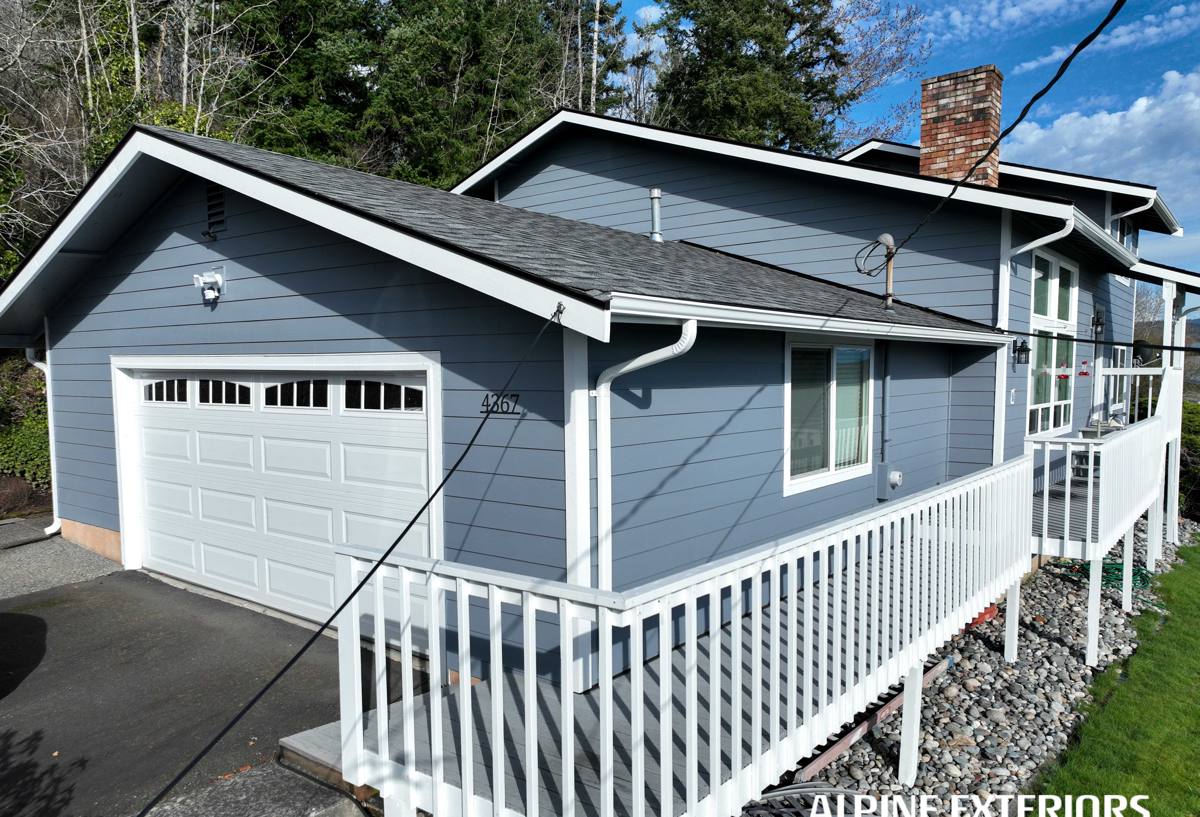
What This Climate Does to a Roof That Needs Repair
Moss That Traps Moisture Where You Can't See It
Shaded slopes, north-facing planes, and roof sections under mature trees hold moisture longer than sun-exposed areas. Over a few wet seasons that shows up as visible moss, and moss does more than look bad — it holds water directly against the roofing surface, works into shingle laps and seams, and can lift edges enough to let wind-driven rain underneath. A repair that clears the moss but doesn't address what's happening underneath it is only a temporary fix.
Wind-Driven Rain Finding the Weak Point
Rain in the Nooksack valley doesn't fall straight down as often as you'd think. Wind pushes it sideways into valleys, around chimneys and vent pipes, and up under flashing that's lapped the wrong way or has lost its seal. That's a different, more demanding load than a simple rainfall total suggests, and it's exactly why flashing details fail before the field of the roof does. Most leaks we're called out to repair trace back to a flashing or transition point, not a bad section of shingle.
Repeated Wet-Dry Cycling
Whatcom County doesn't see extreme heat or deep cold most years, but roofing materials here go through a lot of cycles between saturated and dry rather than a clean seasonal pattern. Asphalt shingles that stay damp more often than they fully dry age faster than the same product would in a drier climate, and fasteners exposed to that cycle need to hold up to it. A repair using materials that aren't rated for sustained moisture exposure tends to need doing again sooner than it should.
What a Correct Roof Repair Actually Involves
Diagnosing the Real Leak Path, Not Just the Symptom
Water rarely enters a roof at the same spot it shows up on a ceiling. It can travel along the underside of the deck, follow a rafter, or run down inside a wall cavity before it becomes visible as a stain or a drip. A correct repair starts with tracing that path from the interior sign of damage back to the actual entry point, usually by inspecting the roof surface, the flashing, and the attic or roof deck from the inside where that's possible. Patching the ceiling stain without finding the entry point just hides the problem until it resurfaces, often somewhere new.
Matching Materials and Technique to the Existing Roof
A repair has to integrate with what's already there — matching shingle profile and granule color where that matters for appearance, tying new underlayment and flashing into the existing lapped system correctly, and not creating a new seam that becomes tomorrow's leak. On an older roof nearing the end of its service life, that also means being honest about whether a given repair is a reasonable extension of the roof's life or a stopgap that's going to need revisiting within a year or two.
Common Roof Repairs We Handle Around Lynden
Most of the repair calls we get in this area fall into a handful of categories. A quick, honest look usually tells us which one we're dealing with:
- Flashing repair or replacement at valleys, chimneys, vent pipes, and roof-to-wall transitions — the most common source of active leaks
- Localized shingle replacement after wind damage, granule loss, or cracking from age and sun exposure
- Moss and debris remediation combined with an inspection of the roofing underneath to check for damage the moss was hiding
- Gutter, drip edge, and fascia repair where backed-up water has started working its way under roofing at the eaves
- Sheathing repair where sustained moisture has softened or rotted the roof deck beneath the roofing material
- Ventilation corrections where trapped attic moisture is accelerating wear from underneath, not just from weather above
Some of these are an hour or two of work. Others, especially sheathing repair, mean opening up a section of roof to see how far the damage actually extends before it can be closed back up correctly.
Our Roof Repair Process
- Inspection and diagnosis. We look at the roof surface, flashing, gutters, and, where accessible, the attic or roof deck from underneath to trace the actual source of the problem.
- A straightforward explanation. We tell you what we found, what's causing it, and what it will take to fix — including if the honest answer is that a repair is a short-term fix on a roof that's better served by planning for replacement.
- The repair itself. We remove and replace only what's actually compromised, tie new flashing and underlayment into the existing system correctly, and match materials to the surrounding roof where appearance matters.
- Cleanup and a final check. We clear debris, confirm the repair area sheds water correctly, and let you know what to watch for going forward.
Repair or Replace? How We Help You Decide
Not every roof problem calls for full replacement, and we don't default to recommending one just because it's a bigger job. The right call depends on a handful of practical factors:
| Situation | Repair Usually Makes Sense | Replacement Is Usually the Honest Answer |
|---|---|---|
| Roof age | Well within its expected service life | At or past its rated lifespan for the material |
| Extent of damage | Localized to one area or a single flashing detail | Spread across multiple slopes or repeated repair sites |
| Deck condition | Solid, no soft spots or rot | Soft spots or moisture damage found in the sheathing |
| Repair history | First or second repair on this roof | Roof has had several patch repairs already |
A localized leak on a roof that's otherwise sound is usually a straightforward repair. A roof with moss-related damage spread across several slopes, a soft deck, or a long history of patchwork is more honestly addressed by planning for replacement rather than paying for another repair that buys a season or two. We'll walk you through which situation your roof is actually in.
Cost Factors in Roof Repair
Roof repair costs vary a lot based on what's actually wrong, and we won't quote a number without seeing the roof. What drives the cost up or down on most jobs:
| Factor | Why It Matters |
|---|---|
| Accessibility and roof pitch | Steep or hard-to-reach roof planes take longer and require more safety setup |
| Extent of hidden damage | Sheathing rot found once shingles are pulled back can change the scope significantly |
| Material match | Matching an older or discontinued shingle color can add cost or limit options |
| Number of penetrations involved | Chimneys, skylights, and multiple vent pipes each add their own flashing work |
| How the roof was previously repaired | Undoing improperly layered past patch jobs takes extra time before the real fix can start |
We give a firm estimate after inspecting the roof, not a ballpark over the phone, because guessing on a roof repair usually means either overcharging for a simple fix or underquoting a job that turns out to involve deck repair.
Timing Repairs Around the Whatcom County Weather Calendar
Roof repair is weather-dependent work, and in this part of Washington that means planning matters more than in a drier climate. Late spring through early fall generally offers the most reliable dry stretches for repair work, which matters for anything involving the roof deck or underlayment. That said, an active leak shouldn't wait for ideal weather — a temporary, properly done seal to stop water intrusion, followed by the full repair when conditions allow, is often the right approach for anything found mid-winter. Fall, before the heaviest rain sets in, is also a good time for a proactive inspection, since it catches moss buildup and minor flashing wear before a full winter of driving rain turns them into an active leak.
Signs a Lynden Roof Needs Repair
- Water staining on interior ceilings or walls, especially near exterior walls, chimneys, or skylights
- Moss buildup in valleys or on shaded slopes that keeps coming back after cleaning
- Granules collecting in gutters or at the base of downspouts
- Curling, cracked, cupped, or missing shingles, particularly after a windstorm
- Flashing that looks lifted, rusted, or has visibly failing sealant
- Daylight visible through the roof deck from inside the attic
- A soft or spongy feel when the roof deck is walked on
Any one of these is worth a professional look before it's ignored through another wet season. Caught early, almost all of them are a repair. Left alone, several of them turn into deck damage that's a bigger job than it needed to be.
Why a Crew That Already Works in Lynden Matters
A crew that repairs roofs across this county through every season learns how moss, wind-driven rain, and moisture actually behave on real houses over years, not just how a product performs on a spec sheet. That shows up in practical decisions on a repair call: recognizing which flashing details in a valley town like Lynden tend to fail first because of tree shade and prevailing wind, knowing how much of a moss problem is cosmetic versus how much has already compromised the roofing underneath, and not cutting corners on a repair just because it's a smaller job than a full re-roof. It also means someone who already understands the difference between an inland valley roof and a coastal-exposure roof, and treats them differently instead of applying one approach to both.
Beyond the Roof: Windows, Siding, and Decks
Roof repair is one part of what we do in Lynden, but the same climate that wears on a roof wears on the rest of the exterior too. We also handle window replacement, siding, and deck construction, and we install James Hardie fiber cement siding as our standard, chosen for how it holds up against sustained moisture and moss compared to lower-cost alternatives. If a roof repair turns up moisture damage at a wall-to-roof transition, aging trim, or a window that's been letting water track down behind the siding, we can address it as part of the same conversation instead of sending you to find a second contractor.
Get a Free, No-Pressure Estimate
If your Lynden roof has a leak, moss buildup, storm damage, or you're just not sure whether what you're seeing needs attention, we're glad to take a look and give you a straightforward, honest read on what it actually needs. Reach out using the form below to schedule a free estimate — no pressure, no upsell script.