 Blaine Window
 Ferndale's Climate Asks More of Your Siding Than Most Places
Ferndale sits close enough to the water that salt-laden air is a regular visitor, and it sits far enough into Whatcom County's rain pattern that "driving rain" isn't a figure of speech — it's a fall-through-spring reality. Add in the tree cover and shaded north walls that a lot of Ferndale lots have, and you get a long moss and algae season that can run most of the year in the right (or wrong) spot. None of that is unusual for this part of the Pacific Northwest, but it does mean siding here is doing real work, not just sitting there looking good.
Salt air accelerates corrosion on fasteners and trim metal. Driving rain finds every gap in flashing and caulk that a calmer climate would never expose. And moss doesn't just look bad — it holds moisture against the wall assembly long after a storm has passed, which is exactly what wood-based sidings least want. Any siding project in Ferndale should start with those three facts, not with a color chart.
Why We Only Install James Hardie Fiber Cement
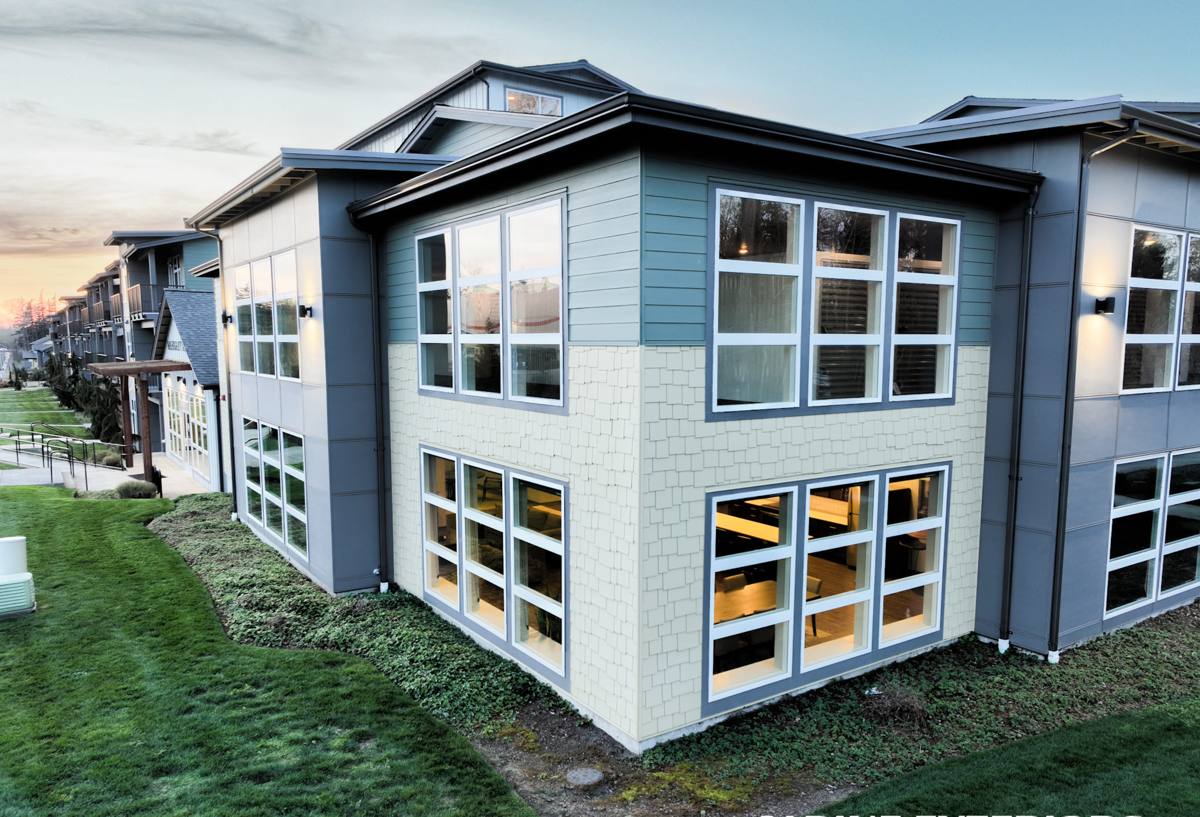
We don't install vinyl, cedar, primed spruce, LP SmartSide, or other fiber cement brands like Allura or Cemplank. That's not a marketing line — it's a standard we settled on after weighing what actually holds up in this climate against what's cheaper or faster to install. James Hardie fiber cement is non-combustible, dimensionally stable in wet-dry cycling, and comes factory-finished with ColorPlus technology, which matters a lot in a place where a wall can stay damp for days at a time.
Wood-based products, including engineered wood siding, depend on an intact factory coating and diligent field caulking to keep water out of the substrate — once moisture gets past that layer, the material itself is vulnerable to swelling and rot. Vinyl handles moisture fine but moves a lot with temperature swings and can crack or fade over the decades of exposure a coastal Whatcom County home sees. Fiber cement, installed correctly, resists all three of Ferndale's stressors — salt, rain, and sustained damp — better than the alternatives we've chosen not to carry.
HZ5 Matters More Here Than the Brochure Suggests
James Hardie engineers its plank and panel products in different formulations for different climate zones, and the Pacific Northwest falls into the HZ5 category — the zone built around moisture management rather than just temperature. That's not a marketing tier, it's a different engineered mix designed to perform in exactly the kind of wet, temperate, coastal-influenced climate Ferndale sits in. Installing the wrong regional formulation, or installing the right product with the wrong details, gives up most of that advantage.
What a Correct Fiber Cement Installation Actually Involves
The material is only half the equation. Fiber cement siding fails early almost exclusively because of installation shortcuts, not because the board itself gave out. In a climate like Ferndale's, the details below are not optional extras — they're the difference between siding that looks good for a couple of decades and siding that starts showing problems in five years.
- Rain screen gap: A drainage plane behind the siding lets any water that gets past the surface drain and dry out instead of sitting against the wall sheathing.
- Weather-resistive barrier, lapped correctly: Every seam and penetration needs to shed water downward, not funnel it inward — this is the layer doing the real waterproofing work.
- Flashing at every horizontal transition: Windows, doors, trim boards, and roof-to-wall intersections all need metal or manufactured flashing sized and lapped to Hardie's published details.
- Correct clearances: Siding held off the roofline, deck surfaces, and grade by the manufacturer's minimum gap so splash-back and standing moisture don't sit against the board edge.
- Fastening pattern: Corrosion-resistant fasteners, placed and spaced to Hardie's schedule, not just "close enough" — this matters even more with salt air in the mix.
- Caulk only where Hardie's details call for it: Over-caulking traps moisture behind joints instead of letting it drain; under-caulking leaves gaps exposed. Both are common mistakes from crews that don't install this product every day.
Signs Ferndale Siding Is Already Losing the Battle
Homeowners often call us after noticing something small, unsure whether it's cosmetic or structural. In this climate, these are the signals worth taking seriously:
- Persistent green or black staining on north- or shade-facing walls that pressure washing only removes temporarily
- Soft, spongy, or bubbling spots on wood-based or engineered wood siding, especially near the bottom courses
- Visible gaps opening up at butt joints, trim edges, or window casings
- Paint or factory finish that's chalking, peeling, or fading unevenly across the same wall
- Rust streaking below fastener heads or metal trim
- A musty smell near an exterior wall, which can mean moisture has already reached the sheathing
How Fiber Cement Stacks Up Against the Alternatives Here
Every siding material has a reasonable case somewhere. The question for a Ferndale home is how each one behaves specifically under salt air, driving rain, and long damp/shade periods.
| Material | Moisture & moss resistance | Salt air behavior | Typical maintenance |
|---|---|---|---|
| James Hardie fiber cement | Strong — non-combustible, dimensionally stable when wet | Holds up well; factory finish resists fading | Occasional gentle wash; recaulk joints on the normal caulk lifecycle |
| Vinyl siding | Doesn't absorb moisture, but can trap it behind panels if not vented | Can fade and become brittle over time | Low, but panels can warp or crack with age and impact |
| Cedar / wood siding | Vulnerable once the finish is compromised; moss holds moisture against the board | Salt accelerates finish breakdown | Regular refinishing, sealing, and moss treatment |
| Engineered wood (e.g. LP SmartSide) | Depends heavily on intact coating and field-applied sealant at cuts and joints | Coating wear can expose the wood-strand core to moisture | Vigilant caulk and touch-up maintenance |
This is the comparison that led us to standardize on one product line rather than offering several. We'd rather install one system correctly, every time, than spread our crews thin across products with very different failure modes.
Our Process, Start to Finish
- On-site assessment: We walk the exterior, check for existing moisture damage, and note shaded or low-airflow areas where moss and algae are already a factor.
- Tear-off and substrate check: Old siding comes off, and we inspect the sheathing underneath for rot or soft spots before anything new goes on.
- Weather-resistive barrier and rain screen: Installed and lapped per manufacturer detail, with drainage in mind from the start, not as an afterthought.
- Flashing at every transition: Windows, doors, roof lines, and trim get flashed before the siding goes over them.
- James Hardie siding installation: Fastened and spaced to Hardie's published specifications, with correct clearances at rooflines, decks, and grade.
- Trim, caulk, and touch-up: Caulking only where called for, and any factory-finish touch-up done with Hardie-approved products.
- Final walkthrough: We go over the finished work with the homeowner and flag anything worth watching in the first year.
Why a Crew That Already Works Ferndale Matters
Siding installation isn't just about knowing the manufacturer's manual — it's about knowing how a specific place behaves. A crew that regularly works Ferndale and the surrounding Whatcom County area already understands which wall orientations collect moss fastest, how much of a factor salt air is this close to the water, and what kind of driving-rain exposure a given lot layout is likely to see. That local pattern recognition shapes decisions on the job — where to be extra careful with flashing, where a rain screen detail earns its keep, and which walls will need closer attention over time.
There's also a practical side: a local crew is easier to reach if a question comes up two years after installation, understands the permitting expectations in this part of Whatcom County, and has a track record in the community rather than a one-time visit from out of the area. When we register a James Hardie warranty for a Ferndale project, we're doing it as a crew that plans to still be working in this area long after the job is done.
Color and Finish Choices for a Coastal Climate
James Hardie's ColorPlus factory-applied finish is baked on and cured under controlled conditions, which gives it more consistent fade and moisture resistance than field-applied paint — a meaningful advantage in a climate that puts a lot of UV-and-moisture cycling on a wall over the year. For Ferndale homes, we generally steer clients toward finishes and lines suited to the coastal exposure of their specific lot: how much direct salt air the walls see, how much shade and moss risk the site has, and how the home sits relative to prevailing weather. The right color and product line choice on paper still needs to be backed by correct installation — a great finish over bad flashing detail is still a bad install.
Caring for Fiber Cement Siding in a Moss-Prone Climate
Fiber cement asks for less upkeep than wood, but "less" isn't "none," especially here. A gentle wash once or twice a year keeps moss and algae from establishing on shaded walls, and it's worth checking caulk joints periodically for gaps, since Ferndale's winter freeze-thaw and summer dry-out cycle will eventually work any sealant loose. Keeping gutters clear and vegetation trimmed back from the walls reduces the standing moisture and shade that moss needs to take hold in the first place. None of this is heavy maintenance — it's the kind of periodic attention that lets a correctly installed system reach its full lifespan instead of fighting an uphill battle from year one.
If your Ferndale home needs new siding, or you're not sure whether what's on the walls now is holding up the way it should, we're happy to take a look. We offer free, no-pressure estimates — use the form below to get in touch.