 Blaine Window
 Why Cherry Point's Exposure Changes the Siding Equation
Cherry Point sits close enough to the water that homes here take a different kind of weathering than siding built for an inland lot. Salt-laden air rides in off the Strait of Georgia and settles on every exterior surface, wind-driven rain gets pushed sideways into seams and laps that would stay dry elsewhere, and the region's long wet season keeps north-facing and shaded walls damp for weeks at a stretch. None of that is exotic — it's just Whatcom County's coastal climate doing what it does, month after month, year after year. The problem is that most siding products, and a lot of standard installation practices, are specified for average conditions, not this specific combination of salt, wind, and sustained moisture.
That's the starting point for how we think about a siding job in this neighborhood. It's not a cosmetic project — it's a decision about what's going to hold up against salt corrosion on fasteners, moisture intrusion at every joint, and the moss and algae growth that thrives wherever a wall stays damp longer than it should.
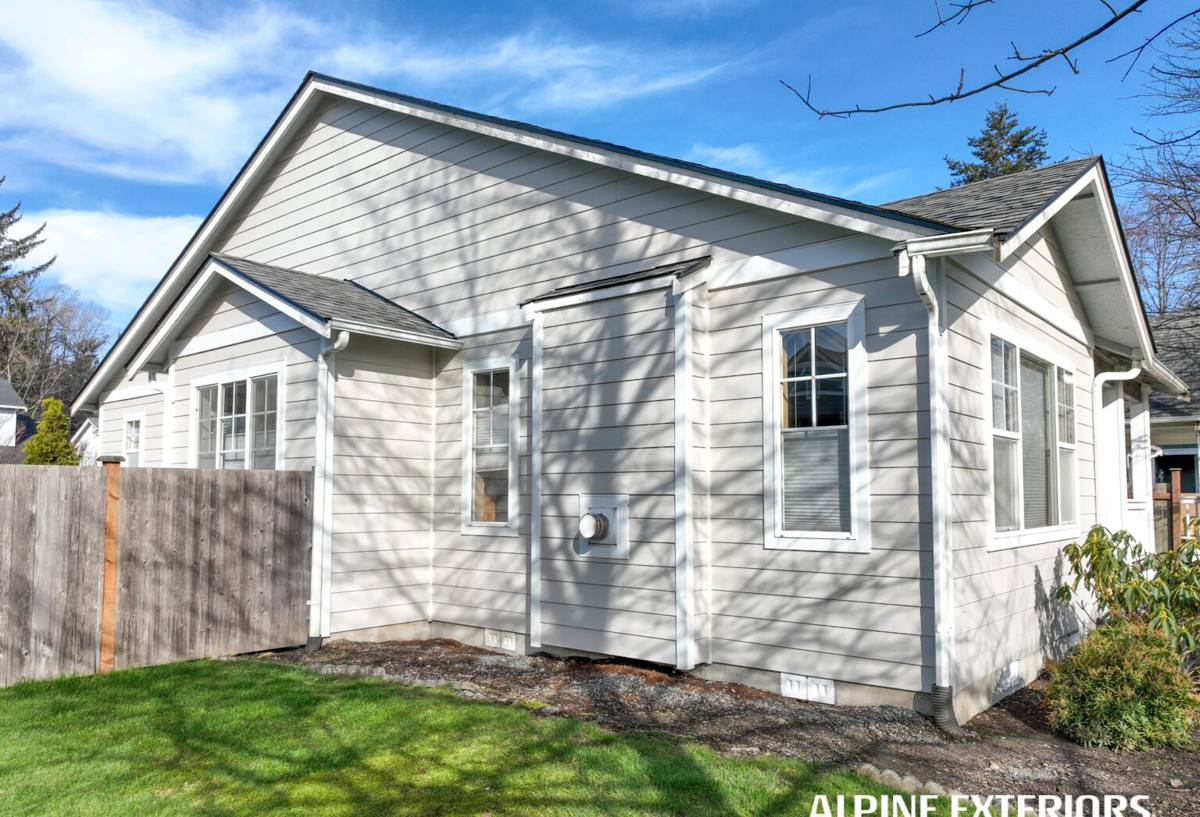
What Salt Air, Rain, and Moss Actually Do to Siding Over Time
Salt Air
Airborne salt is corrosive to exposed metal — fasteners, flashing, trim edges — and it accelerates the breakdown of coatings that aren't formulated to resist it. Over years, a siding system with unprotected or under-spec'd metal components will show rust streaking, loosened fasteners, and premature finish failure well before the siding material itself would normally need replacing.
Driving Rain
Wind off the water doesn't just fall on a wall, it drives into it — up under laps, into corner joints, and through any gap that wasn't sealed or flashed correctly. A siding system that relies on face-sealing alone (caulk as the only line of defense) tends to fail here faster than one built with proper drainage and flashing behind the cladding.
Moss and Sustained Dampness
Whatcom County's wet season is long, and shaded or north-facing walls near mature trees can stay damp for extended stretches. That's exactly the environment moss and algae need. On some siding materials that's mostly a cleaning issue; on others, sustained moisture at the surface can work its way into seams, fastener holes, and cut edges and cause damage that isn't visible until it's already advanced.
Why We Install James Hardie Fiber Cement — Not Vinyl, LP SmartSide, or Cedar
We standardized on James Hardie fiber cement siding for every job we do, including Cherry Point, and we're upfront about why. Fiber cement is non-combustible, dimensionally stable, and holds a factory-applied ColorPlus finish that's built to resist fading and moisture better than field-applied paint. James Hardie also engineers specific product lines — including HZ5 formulations — for climate zones that see more moisture and temperature swing, which is exactly the profile of this stretch of coastline.
We won't install vinyl siding, LP SmartSide, cedar, primed spruce, Cemplank, or Allura on a home. That's a professional standard, not a knock on every homeowner who has one of those products already. Vinyl can warp and crack under UV and temperature swings and offers limited defense once water gets behind it. Engineered wood and solid wood products depend on maintaining an intact factory or field coating to keep moisture out of the wood fiber — miss a spot, and the material underneath is vulnerable in exactly the way this climate exploits. Fiber cement removes that vulnerability at the material level: there's no wood fiber to swell, rot, or feed moss growth, and the color coat is backed by a manufacturer warranty rather than depending on how carefully a field paint job was done.
What a Correct Cherry Point Siding Installation Actually Involves
Weather-Resistive Barrier and Flashing
The siding you see is the last line of defense, not the only one. Behind it, we install a continuous weather-resistive barrier and detail flashing at every window, door, roofline, and penetration so that any water that does get past the surface has a way to drain back out rather than sitting against the sheathing. In a driving-rain environment, this layer matters as much as the siding itself.
Fastening and Clearances
James Hardie specifies fastener type, spacing, and placement for a reason — get it wrong and you create stress points where water and salt exposure will find a way in over time. We also hold the manufacturer's minimum clearances from grade, roof lines, and decks, which keeps the bottom edge of the siding out of standing water and splash-back, a common failure point on homes close to the shoreline.
Joints, Caulking, and Finish Work
Butt joints and trim transitions get treated as moisture-management details, not just cosmetic seams — proper flashing or engineered joints where possible, and manufacturer-approved sealants where caulk is required. ColorPlus finished panels also mean less reliance on field-applied paint at cut edges, which is where a lot of coating failures start on lesser products.
Our Process for a Cherry Point Job
- Site assessment — we look at sun/shade exposure, prevailing wind direction relative to the walls, existing moisture damage, and how close the home sits to the shoreline, since that changes how aggressively we detail flashing and clearances.
- Removal and sheathing check — old siding comes off and we inspect the sheathing underneath for rot or hidden moisture damage before anything new goes up. This is often where a home's real condition shows up, especially on walls that have been fighting moss and damp for years.
- Barrier and flashing installation — the weather-resistive barrier and all flashing details go in before a single piece of Hardie siding is installed.
- Siding installation to spec — correct fastening, clearances, and joint treatment throughout, not just on the street-facing walls.
- Final detailing and walkthrough — trim, caulking, and touch-up review, plus a walkthrough so you understand what was done and why.
Signs Your Current Siding Is Already Struggling
- Visible moss or algae streaking that comes back quickly after cleaning
- Soft spots, bubbling, or warping anywhere on the wall surface
- Rust staining running down from fasteners or metal trim
- Paint or coating that's peeling, chalking heavily, or bare in patches
- Gaps opening up at seams, corners, or trim boards
- Higher heating bills than a similarly sized home nearby, which can point to moisture-compromised insulation behind the siding
Any one of these on its own isn't necessarily an emergency, but a few of them together on a Cherry Point home usually means the siding is past the point where patching makes sense.
What Affects the Cost of a Siding Installation Here
| Factor | Why It Matters | Typical Impact |
|---|---|---|
| Home size and wall complexity | More square footage and more corners, gables, and trim details mean more material and labor | Moderate to significant |
| Existing siding removal | Multiple layers or damaged sheathing underneath add time before new siding can go up | Moderate |
| Accessibility | Waterfront lots, steep grades, or tight setbacks near Cherry Point can limit staging and equipment access | Low to moderate |
| Trim and finish level | Custom trim profiles or additional flashing detail at a high-exposure wall add labor | Moderate |
| Product line selected | Panel vs. lap profiles and specific HZ formulations vary in material cost | Low to moderate |
Why the Crew Matters as Much as the Product
Fiber cement siding is only as good as its installation. On a shoreline-adjacent property, the details that separate a job that lasts decades from one that starts failing in a few years are things like flashing sequencing, fastener placement, and how clearances are held at grade and rooflines — all details that are easy to shortcut and hard to inspect once the wall is closed up. A crew that regularly works homes in this specific stretch of Whatcom County has already worked out how to detail for wind-driven rain and salt exposure on real walls, not just in the abstract. That experience shows up in fewer callbacks, fewer surprises, and a job that's built for the exposure this neighborhood actually gets rather than a generic spec.
Maintenance After Installation
Correctly installed James Hardie siding is low-maintenance, not no-maintenance. In a salt-air, high-moss environment, a periodic rinse-down to clear salt residue and moss spores goes a long way, along with an annual look at caulking around windows, doors, and trim joints. Because the color is baked into the ColorPlus finish rather than field-applied, you're not on a repainting schedule the way you would be with a wood-based product — but keeping debris and standing moisture off the lower courses near grade is still worth doing every year.
If your Cherry Point home's siding is showing its age, or you're planning ahead before the next wet season sets in, we're happy to take a look and give you a straightforward, no-pressure estimate — just fill out the form below.