 Blaine Window
 California Creek's Climate Is Hard on Siding
California Creek sits close enough to the water that homes here take a steady combination of salt-laden air, wind-driven rain, and a moss season that can stretch from October well into spring. That combination is tougher on exterior cladding than most homeowners realize. Salt air accelerates corrosion on fasteners and trim metal. Driving rain finds its way into any gap, seam, or poorly lapped joint, and once moisture gets behind a wall assembly in Whatcom County's damp, mild winters, it doesn't dry out quickly. Add shaded, north-facing walls and mature tree cover common in this neighborhood, and you get long stretches where siding stays wet, cool, and hospitable to moss and mildew.
Siding in this pocket of Blaine isn't just a cosmetic decision. It's the first line of defense against a climate that combines coastal exposure with Pacific Northwest rainfall totals. Whatever material goes on the wall needs to handle constant moisture cycling, resist rot at the bottom courses and around penetrations, and hold its finish without needing repainting every few years.
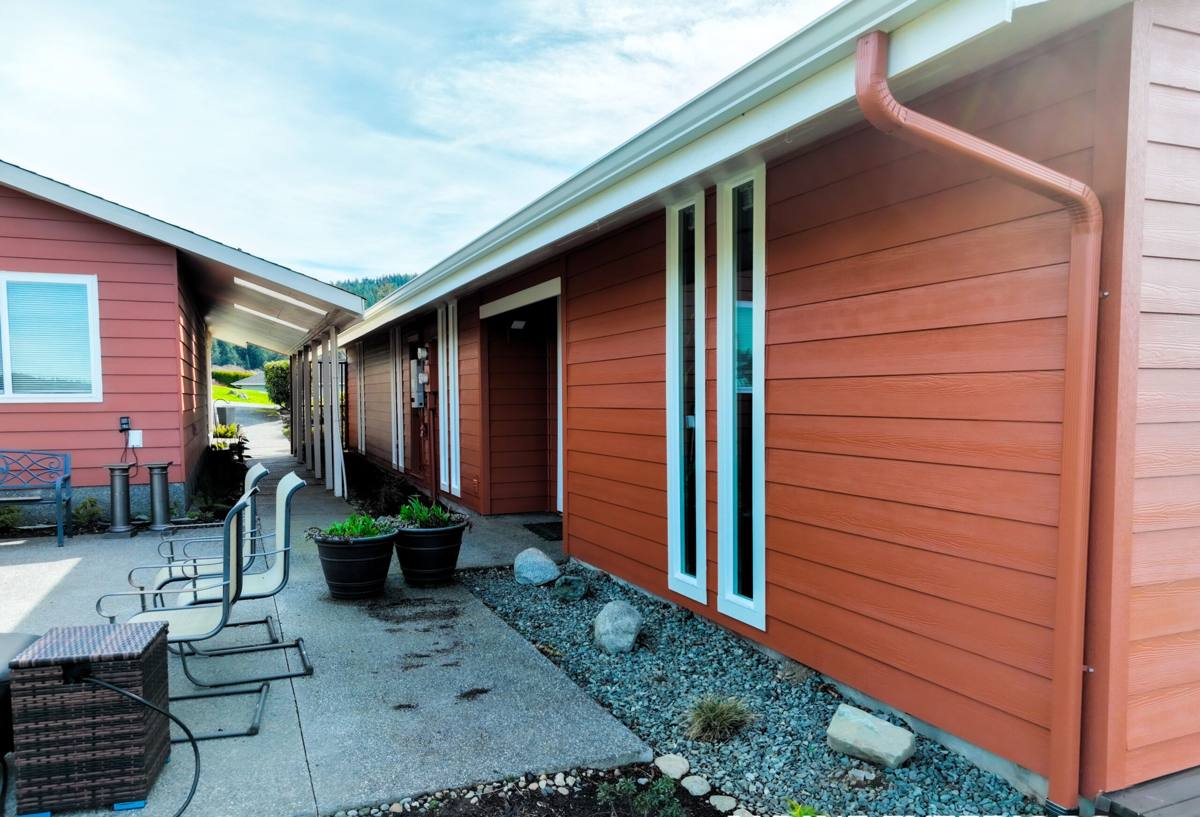
Why Fiber Cement Fits This Environment
Fiber cement siding is cement, sand, and cellulose fiber formed under pressure into a dense, stable board. That composition matters for a property near California Creek for a few concrete reasons:
- It doesn't rot. Wood-based products, including engineered wood siding, rely on a resin-saturated strand structure that still depends on paint and caulk staying intact to keep water out. Fiber cement has no wood fiber for rot fungus to feed on.
- It doesn't corrode or pit the way some metal-faced products can in salt air.
- It's dimensionally stable across wet-dry cycles, so seams and caulk joints stay tighter over time instead of opening up and letting water behind the wall.
- It holds a factory-applied finish far longer than field-applied paint, which matters when a house is exposed to constant damp and UV.
Vinyl siding is common in this area because it's inexpensive, but it expands and contracts significantly with temperature swings, and driving rain can work its way behind loose panels at butt joints and corners. Cedar and primed wood siding look good on day one, but in a climate with this much sustained moisture, they demand a maintenance schedule most homeowners don't keep up with, and once paint fails, rot follows fast. We install James Hardie fiber cement exclusively because it's the product we've found holds up to this specific combination of salt exposure, rain, and moss without asking the homeowner to babysit it every year.
Moss Is a Symptom, Not Just a Nuisance
A long moss season doesn't just make siding look neglected — moss holds moisture directly against the wall surface for months at a time. On a material that can absorb or swell with sustained dampness, that's a slow path to soft spots and rot. On properly installed fiber cement with a factory finish, moss can be washed off without damaging the substrate or stripping paint, which is a real practical difference over a full Whatcom County winter.
What a Correct Installation Actually Involves
Fiber cement siding fails prematurely almost exclusively because of installation mistakes, not because the material itself is weak. In a high-moisture, salt-air location like California Creek, the details matter more than they would somewhere drier. A correct job includes:
- A code-compliant weather-resistive barrier installed shingle-style so every layer drains outward and down, never trapping water against the sheathing.
- Rainscreen furring strips to create a drainage gap behind the siding, which is especially important on shaded or north-facing walls that stay damp longer.
- Correct minimum clearances — siding held up off decks, patios, and grade so splashback and standing moisture can't wick into the bottom edge of the boards.
- Stainless steel or hot-dip galvanized fasteners rated for coastal exposure, driven correctly (not overdriven, which crushes the board's fiber structure and creates a moisture entry point).
- Properly lapped and sealed flashing at every window, door, and penetration, with compatible sealants that won't degrade the ColorPlus finish.
- Tight, correctly caulked joints at butt seams and trim, using sealants rated for the coastal, high-UV, high-moisture combination this area sees.
Miss any one of these and you can end up with a house that looks like it has premium siding but behaves like it has a leaky, poorly detailed wall assembly underneath. This is the main reason we don't treat fiber cement as a commodity install — the product only performs to spec when the installation matches the spec.
James Hardie Product Lines for a Coastal, High-Rain Property
James Hardie engineers its siding in climate-specific formulations, called HZ5 and HZ10 zones, matched to regional weather patterns. For a property near California Creek, that means selecting a formulation designed for wetter, more moisture-cycled conditions rather than a generic national product. It also means choosing a factory ColorPlus finish, which is baked on under controlled conditions and backed by its own finish warranty — a meaningful advantage over field-applied paint that has to cure and perform outdoors in a climate that doesn't offer many dry weeks in a row.
| Product Line | Best Use | Why It Matters Here |
|---|---|---|
| HardiePlank Lap Siding | Primary wall cladding | Most common profile; handles wind-driven rain well when lapped and flashed correctly |
| HardiePanel Vertical Siding | Accent walls, gables | Fewer horizontal seams for water to find on exposed elevations |
| HardieTrim | Corners, fascia, window trim | Matches siding durability so trim doesn't fail before the field siding does |
| ColorPlus Technology | Factory finish on all lines | Cures under controlled conditions, holds color longer than field paint in constant damp |
Our Process on California Creek Projects
1. On-Site Assessment
We look at more than the visible siding — soffit and eave condition, existing flashing details, grade and drainage around the foundation, and how much shade and moss exposure each elevation gets. That tells us which walls need extra attention during install.
2. Tear-Off and Sheathing Check
Once the old siding is off, we inspect sheathing for hidden rot or moisture damage before anything new goes on. Covering up a compromised wall with new siding just hides the problem for a few more years.
3. Weather Barrier and Rainscreen
We install the water-resistive barrier and drainage gap system correctly the first time, since this layer is invisible once siding goes on but does most of the long-term work.
4. Fiber Cement Installation
Boards, trim, and panels go on to James Hardie's fastening and clearance specifications, with attention to every joint, corner, and penetration.
5. Final Detailing and Walkthrough
Caulking, touch-up, and a walkthrough so the homeowner understands what was done and what maintenance, if any, is actually needed going forward.
Cost Factors for a California Creek Home
Every property is different, but the main variables that move a fiber cement project's cost are consistent:
| Factor | Why It Affects Cost |
|---|---|
| Existing wall condition | Rot repair or added sheathing adds labor and material before new siding goes on |
| Home size and wall complexity | More corners, gables, and dormers mean more cutting, trim, and flashing detail |
| Siding profile chosen | Lap, panel, and shingle-style profiles differ in material and labor time |
| Trim and accent scope | Full HardieTrim packages cost more than matching existing trim in kind |
| Access and site conditions | Slopes, tight setbacks, and mature landscaping near the home affect staging and labor |
We don't quote broad numbers here because guessing at a price without seeing the walls does homeowners a disservice — an honest estimate requires an actual look at the property.
Signs Your Current Siding Is Already Losing the Fight
- Persistent moss or black streaking that returns within weeks of cleaning
- Soft, spongy spots when you press on siding near the bottom courses or under windows
- Paint that's chalking, peeling, or requires repainting more often than every several years
- Visible gaps or separation at butt joints and corners
- Warping, bowing, or wavy panels, especially on shaded or north-facing walls
- Rising energy bills that suggest moisture or air infiltration behind the wall
Any one of these is worth a look. Several together usually mean the wall assembly, not just the paint, needs attention.
Why Hiring a Crew That Already Works This Neighborhood Matters
Correct fiber cement installation isn't generic — it's a set of details that change based on exposure, shade, and moisture load, and California Creek has its own version of all three. A crew that regularly works this stretch of Blaine already understands which elevations need extra rainscreen attention, how much drainage clearance local grading requires, and how the salt air and moss cycle here actually behave over a full year, not just on a sunny install day. That local pattern recognition is the difference between a siding job that looks right at handoff and one that's still performing correctly five winters later.
If your California Creek home needs new siding, or you want a second opinion on aging siding before it becomes a bigger repair, we're happy to take a look. Reach out for a free, no-pressure estimate — the form below gets you started.