 Blaine Window
 Composite Decking Built for Blaine Harbor's Marine Climate
Blaine Harbor sits right where Puget Sound weather meets Whatcom County's wet, gray stretch of the year. Homes here get a steady mix of salt-laden air off the water, driving rain that comes in sideways more often than straight down, and a moss season that can run from October well into May. A deck built for a drier inland climate does not hold up the same way here. Composite decking can be an excellent fit for Blaine Harbor properties, but only when it is chosen and installed with this specific environment in mind — not treated as a generic product dropped onto a generic frame.
This page is about composite decking specifically for homes in and around Blaine Harbor. We are not trying to sell you on decking in general — we want to walk through what this climate actually does to a deck, what a correct composite installation looks like in response, and why hiring a crew that already works this stretch of Whatcom County coastline matters more than it would somewhere drier.
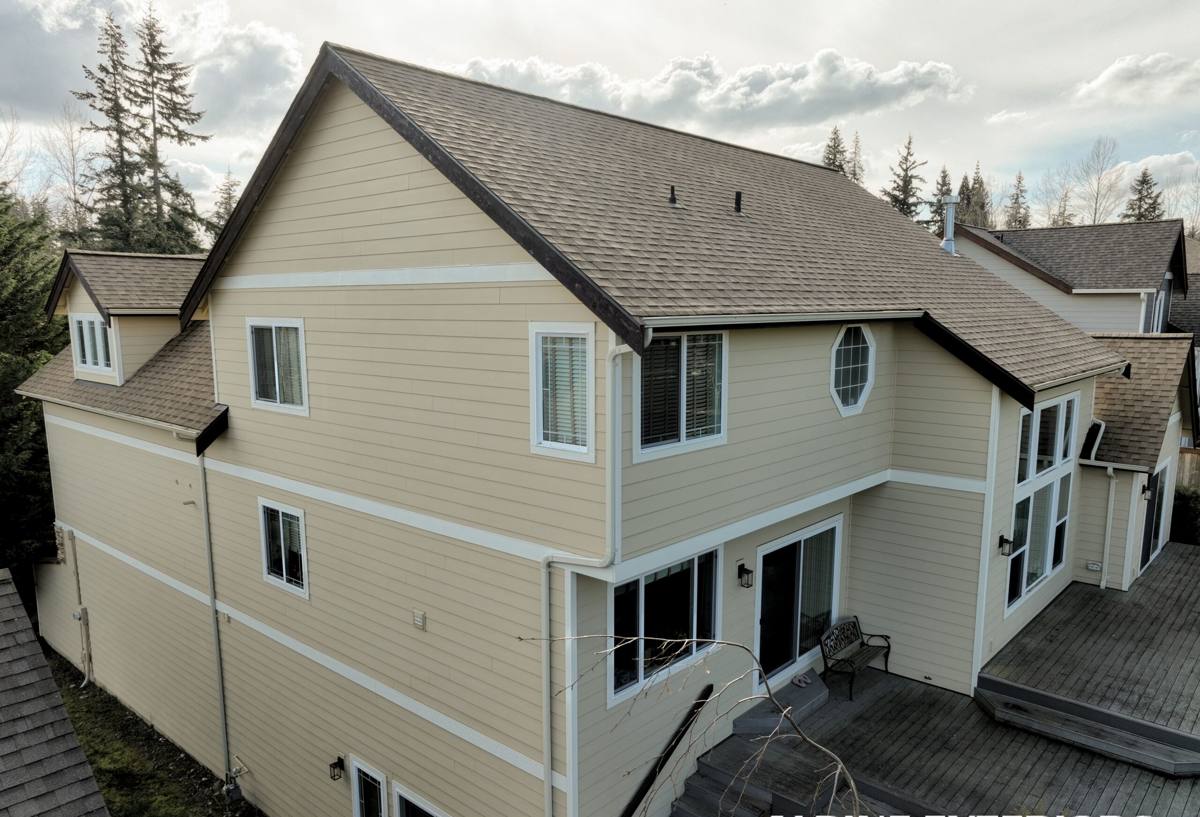
What Salt Air, Driving Rain, and Moss Season Do to a Deck
Every material choice on a Blaine Harbor deck should be answering one of these three pressures.
Salt Air
Proximity to the water means airborne salt settles on every exterior surface, including deck boards, railings, and hardware. Salt does not damage composite decking the way it corrodes metal, but it does accelerate corrosion in fasteners, brackets, and any exposed steel in the substructure. Over years, that corrosion can loosen connections long before the decking itself shows wear.
Driving Rain
Wind-driven rain off the Strait means water gets pushed into places a calm rainstorm never would — under rail bases, into end grain at board cuts, behind ledger boards, and into any gap where flashing was skipped. Composite decking sheds surface water well, but the substructure underneath and the connections at the house are where driving rain actually causes problems.
Moss and Algae Season
Long stretches of damp, shaded, cool weather are exactly what moss and algae need to establish. Composite boards with a textured, uncapped surface, or boards installed with poor airflow underneath, give moss and algae spores a foothold. Once established in the grain texture of a board, they are far harder to remove than they were to prevent.
What a Correct Composite Deck Installation Actually Involves
A composite deck that holds up in Blaine Harbor is not just "install the boards." The parts that matter most are usually the parts a homeowner never sees once the job is done.
Substructure and Ventilation
Composite boards themselves are largely inert to moisture, but the framing underneath is typically still wood, and wood framing under a low-clearance deck in a wet climate is where rot starts. We build in enough airflow beneath the deck to let framing dry between rain events, and we keep joists protected with joist tape or an equivalent barrier so fastener penetrations do not become entry points for standing water.
Fasteners and Hardware
Given the salt exposure here, we use stainless steel or coated fasteners rated for coastal and treated-lumber contact, along with corrosion-resistant structural hardware at ledger connections, stair stringers, and rail posts. Standard interior-grade hardware corrodes faster near the water and can fail quietly, well before any visible sign on the deck surface.
Flashing at the Ledger
Where a deck attaches to the house, proper flashing keeps driving rain from working its way behind the ledger board and into the wall structure. This is one of the most common shortcuts on lower-quality deck builds, and it is one of the most expensive mistakes to fix after the fact, since it usually means removing decking to get at the wall.
Board Spacing and Drainage
Correct gapping between boards lets water pass through rather than pool on the surface, and it lets the substructure breathe. Too tight, and you get standing water and algae growth on the surface. Too loose, and the deck feels unfinished and can be uncomfortable underfoot.
Choosing a Composite Board for a Coastal Setting
Not all composite decking behaves the same way in a wet, salty, low-light climate. The table below covers the main categories homeowners in Blaine Harbor are usually choosing between.
| Decking Type | Moisture Behavior | Moss/Algae Resistance | Maintenance |
|---|---|---|---|
| Capped composite | Cap layer blocks moisture from reaching the wood-plastic core | Smooth cap sheds spores better; textured caps still need periodic cleaning | Occasional washing; no staining or sealing |
| Uncapped composite | Core can absorb some moisture over time, especially at cut ends | More susceptible to moss and mildew taking hold in surface texture | More frequent cleaning; cut ends should be sealed |
| Cellular PVC | Essentially non-absorbent | Very good resistance; smooth surface sheds spores easily | Low; occasional washing |
| Pressure-treated wood | Absorbs and releases moisture constantly; prone to cupping and checking | Requires regular treatment to resist moss and algae | Annual cleaning, staining, or sealing |
For most Blaine Harbor homes, a capped composite or cellular PVC board is the more sensible long-term choice given the amount of moisture and shade many lots deal with. Uncapped composite and wood can still be reasonable choices depending on budget and the specific site — sun exposure and drainage on your lot matter as much as the product itself.
Why We Don't Push Every Product on Every Job
Some composite lines are more sensitive to installation conditions than others — tighter tolerances on gapping, specific fastener requirements, or expansion and contraction behavior that has to be accounted for at every board end. We stick to lines and installation methods we know perform well in wet coastal conditions, and we will tell you honestly if a particular product or color is a poor match for a shaded, low-airflow section of your yard rather than install it anyway.
Our Process for a Blaine Harbor Composite Deck
- On-site assessment. We look at sun exposure, drainage, proximity to the water, existing structure condition, and any moss or moisture issues already present on your property.
- Product and layout recommendation. Based on that assessment, we recommend board type, color, and layout — including where extra ventilation or drainage detailing is worth the investment.
- Substructure inspection or rebuild. If we are replacing an existing deck, we inspect the framing for rot or corrosion before deciding whether it can be reused or needs to be rebuilt.
- Flashing and moisture barriers installed first. Ledger flashing, joist protection, and any barrier detailing happen before a single composite board goes down.
- Installation with coastal-rated hardware. Fasteners and structural connectors are chosen for salt air exposure, not generic interior-grade hardware.
- Final walkthrough. We go over basic care with you, including what to expect during moss season and how to keep the deck looking good with minimal effort.
Maintaining a Composite Deck Through Whatcom County's Wet Season
Composite decking is lower maintenance than wood, but "low maintenance" does not mean "no maintenance" in a climate like this one. A short seasonal routine goes a long way.
- Sweep debris and organic buildup off the deck regularly, especially in fall when leaves and needles accumulate and hold moisture against the surface
- Rinse or wash the deck a few times a year to remove salt film and any early moss or algae growth before it establishes
- Keep gutters and downspouts near the deck clear so water is not dumping directly onto or under the deck surface
- Trim back overhanging branches or shrubs that keep sections of the deck shaded and damp longer than the rest
- Check railing posts and stair connections periodically for any looseness, which can signal fastener corrosion underneath
- Avoid pressure washing on high settings directly into board seams, which can force water into the substructure
What Affects the Cost of a Composite Deck in Blaine Harbor
| Factor | Why It Matters Here |
|---|---|
| Board and hardware grade | Coastal-rated fasteners and capped or PVC boards cost more upfront but reduce corrosion and moisture-related repairs |
| Substructure condition | Rebuilding rotted or undersized framing adds cost but is not optional if the existing structure is compromised |
| Site drainage and grading | Poor drainage under the deck footprint may need correction before installation to avoid future moisture problems |
| Deck size and layout complexity | Multiple levels, curves, or built-in features add labor time and material waste |
| Sun exposure and shading | Heavily shaded lots may warrant a higher-resistance board to offset slower drying and heavier moss pressure |
We do not quote a job without seeing the site, since drainage and shading vary a lot even between neighboring properties in Blaine Harbor.
Why It Matters That We Already Work in Blaine Harbor
A crew that only occasionally works this close to the water can miss things that are second nature to a crew that builds decks here regularly — how much salt exposure a given lot actually gets depending on its orientation to the harbor, which sections of a yard stay damp and shaded long after the rest of the property has dried out, and which fastener and flashing details actually hold up through a full Whatcom County winter rather than just looking right on installation day. We have seen what happens to decks built with the wrong assumptions for this climate, and we build differently because of it.
Get a Free Estimate for Your Blaine Harbor Deck
If you are considering composite decking for a home in Blaine Harbor, we are happy to come take a look, walk the site with you, and talk through what makes sense for your specific lot and budget. There is no pressure and no obligation — just a straight assessment from a crew that already knows this stretch of coastline. Use the form below to request your free estimate.