 Blaine Window
 Why Decks in Birch Point Wear Out Faster Than the Manual Says
Birch Point sits close enough to the water that every deck out here lives a harder life than the lumber yard's warranty card assumes. Salt-laden air corrodes fasteners and hardware from the inside of the joint, not just the surface you can see. Driving rain off the Strait doesn't fall straight down — it drives sideways under railings, into end grain, and behind ledger boards where builders in drier parts of the state never have to think twice. And then there's the long moss season: months of low sun angle, shade from mature trees, and damp air that never quite dries the decking between rains. Put those three together and you get decks that look fine from the yard but are quietly failing underneath — soft joists, rusted-through hangers, and decking that's holding water instead of shedding it.
We build and replace decks throughout Blaine and Whatcom County, and Birch Point properties consistently show a specific pattern of wear tied to exposure and elevation relative to the water. A deck replacement here isn't just "put down new boards" — it's an opportunity to fix the structural and drainage decisions that let the last deck fail early in the first place.
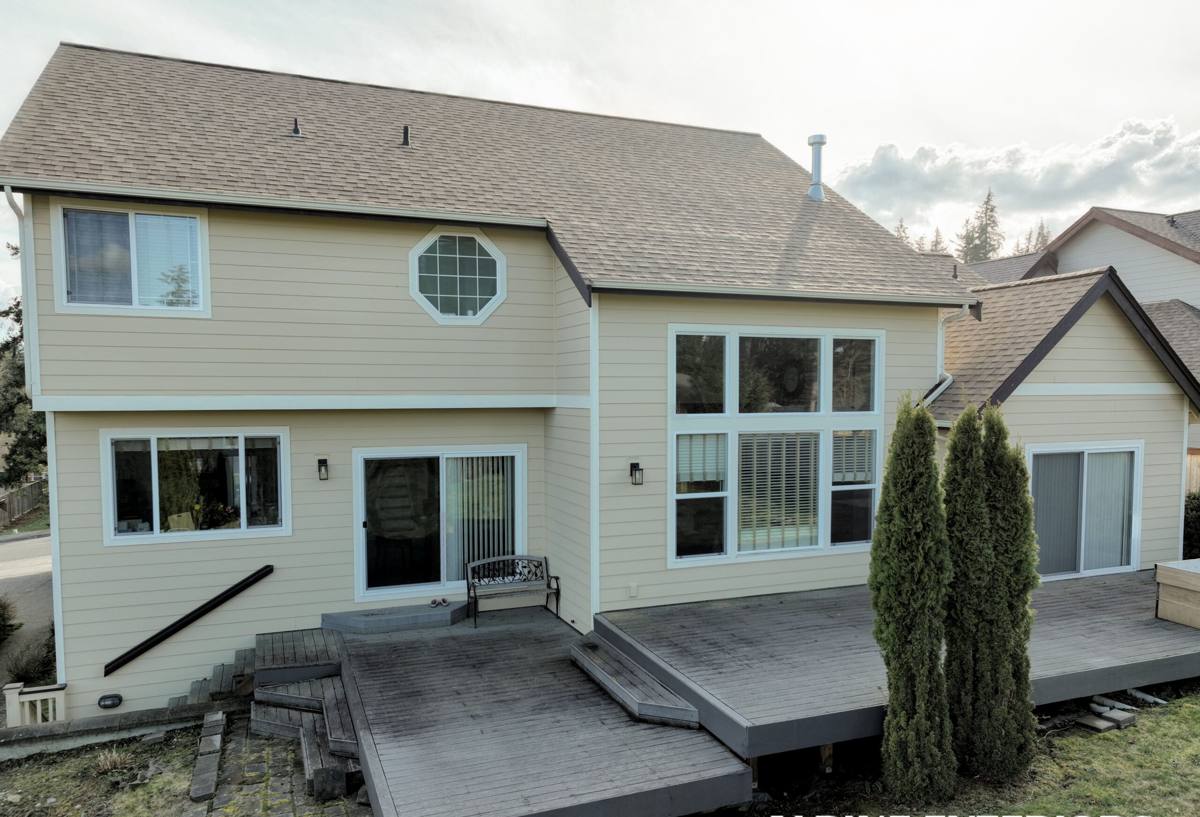
How to Tell You Need a Replacement, Not a Repair
Homeowners often call us thinking they need a few boards swapped, and sometimes that's true. But there are signs that mean the deck has crossed the line from "repairable" to "replace it before someone gets hurt."
- Joists or beams that feel spongy or give slightly when you walk near the rim, especially close to the house
- Rust streaks bleeding through decking boards from the fasteners or hardware below
- A ledger board (where the deck attaches to the house) that's soft, stained, or separating slightly from the siding
- Railing posts that wiggle at the base — often the first sign of rotted post anchoring
- Persistent green-black staining on the north or shaded side that pressure washing only removes for a few weeks
- Boards cupping or crowning noticeably, which changes how water sits and drains on the surface
Any one of these on its own might be a repair. Two or more together, especially structural ones, usually means the framing has been absorbing moisture for years and a repair would just be patching over a deck that's already lost its margin of safety.
What a Correct Deck Replacement Actually Involves
A deck replacement done right in this climate is as much about what's underneath as what you walk on. We treat every replacement as a full system: footings, framing, ledger connection, fasteners, and decking, all matched to how much rain and salt exposure the specific location gets.
Footings and Framing
We check existing footings for frost depth and settling before reusing anything — a lot of older Birch Point decks were built on undersized or shallow footings that have since shifted. Framing lumber gets upgraded to a grade and treatment rated for ground contact where it's exposed to splash-back or standing moisture, not just the minimum the old deck used.
The Ledger Connection
This is the single most common failure point we find on waterfront and near-waterfront decks. The ledger has to be properly flashed so water is directed away from the house, not trapped between the deck and the siding. We install ledger flashing correctly the first time, because a poorly flashed ledger is a slow leak that can rot both the deck framing and the wall behind it.
Fasteners and Hardware
Standard galvanized hardware corrodes faster than most homeowners expect this close to salt air. We use stainless steel or coated fasteners and structural hardware rated for corrosive coastal environments on every replacement, even when it costs more up front, because replacing rusted-out joist hangers in eight years costs a lot more than upgrading them now.
Choosing Decking Material for a Birch Point Property
There's no single "best" decking material — there's the right one for how much upkeep you want to do and how the deck sits relative to sun, shade, and salt air. Here's how the common options actually perform out here, not just on paper.
| Material | Moss & Algae Resistance | Salt Air Durability | Maintenance | Typical Lifespan |
|---|---|---|---|---|
| Pressure-treated lumber | Low — needs regular cleaning and sealing | Fair, if fasteners are upgraded | Annual cleaning, periodic sealing | 10-15 years |
| Cedar | Moderate — naturally rot-resistant but still grays and can host moss in shade | Good, with proper fasteners | Sealing every 1-2 years to keep color and repel moisture | 15-20 years |
| Composite decking | Good — resists moisture absorption, though surface algae can still form in deep shade | Excellent | Occasional washing, no sealing or staining | 25-30+ years |
| Tropical hardwood | Good, but dense grain can trap surface grime in shaded spots | Excellent | Periodic oiling to maintain appearance | 25+ years |
For shaded, damp lots typical of tree-lined Birch Point yards, we usually steer homeowners away from pressure-treated as the sole decking material for long-term satisfaction — not because it's a bad product, but because in low-sun, high-moisture conditions it needs more sealing and cleaning than most people are willing to keep up with. Composite tends to be the lowest-maintenance long-term choice for exactly the conditions this neighborhood deals with, though it costs more up front. Cedar remains a solid, better-looking option for homeowners who don't mind the maintenance rhythm.
Design Choices That Cut Down on Moss Before It Starts
A lot of moss problems are baked into the deck's design, not just its material. When we replace a deck here, we look at a few things that make a real difference over the following decade:
- Board spacing — slightly wider gaps between boards let air move and water drain instead of pooling, which is the single biggest factor in moss growth
- Deck orientation and drainage slope — a correct slight slope away from the house keeps water moving instead of sitting on shaded boards
- Under-deck airflow — skirting or enclosures need vents; a sealed-up under-deck space stays damp and encourages rot in the framing above
- Trimming back overhanging vegetation — we'll flag branches that keep a deck in permanent shade, since that's often the real cause of a moss problem no amount of cleaning fixes
None of this eliminates moss entirely — that's not realistic in Whatcom County's climate — but it stretches the time between cleanings and keeps moss from becoming a slip hazard or a moisture trap.
Our Deck Replacement Process
We keep the process straightforward and give you a clear look at what's underneath before we commit to a plan:
- On-site assessment — we inspect the existing deck's framing, footings, and ledger connection, not just the surface boards
- Honest scope review — we tell you plainly whether you need a full replacement, a partial rebuild, or whether repair is genuinely still an option
- Material and layout discussion — we walk through decking options against your budget, sun exposure, and how much upkeep you want long-term
- Permitting — deck replacements in Blaine and unincorporated Whatcom County often require a permit depending on size, height, and attachment; we handle that paperwork
- Demolition and disposal — old decking and framing removed and hauled off, footings inspected and reused or replaced as needed
- Rebuild — framing, ledger flashing, corrosion-resistant hardware, and decking installed to current code and to the corrosion-resistant standard we hold for coastal sites
- Final walkthrough — we go over the finished deck with you, including basic care guidance specific to the material you chose
Why a Crew That Already Works Birch Point Matters
Deck framing failures out here are rarely dramatic — they're slow, hidden, and driven by moisture patterns specific to proximity to the water, shade, and prevailing wind. A crew that hasn't worked this stretch of Whatcom County coastline will often build to a generic code minimum and move on. We've seen what a ledger without proper flashing does after a decade of driving rain, and what standard galvanized hardware looks like after years of salt air, so we don't treat those as optional upgrades — they're the baseline on every deck we replace here.
We also know the practical side: which footings tend to need attention on older Birch Point lots, what permitting looks like locally, and how to sequence a replacement around the wetter months so the project doesn't drag out through a rainy stretch.
What to Ask Before Hiring Anyone for a Deck Replacement
Whoever you hire, a few questions will tell you quickly whether they've thought through coastal conditions or are just quoting a standard build:
- Will you inspect and reflash the ledger, or just reattach the new decking to the existing connection?
- What grade of fasteners and hardware do you use, and are they rated for coastal or corrosive environments?
- Will the footings be inspected, and what happens if they're undersized or shifted?
- What's the board spacing and drainage slope, and why?
- Is a permit required for this project, and who's pulling it?
- What does routine maintenance look like for the material we choose, realistically, not just on the product label?
A contractor who answers these clearly and specifically, without hedging, is one who's actually built decks in this kind of climate before.
Get a Straight Answer on Your Deck
If your Birch Point deck is showing soft spots, rust stains, or a moss problem that never really goes away, it's worth having someone look at what's happening underneath before deciding between repair and replacement. We offer a free, no-pressure estimate — use the form below to get a time on the calendar.