 Blaine Window
 Why Birch Bay Decks Wear Out Faster Than Inland Decks
Birch Bay sits right on the water, and that changes how a deck ages compared to one a few miles inland in Blaine or further into Whatcom County. Three things drive most of the early failures we see out here: salt-laden air, driving rain that comes in sideways off the Strait of Georgia, and a moss season that runs longer than most homeowners expect. None of these are exotic problems, but they compound each other, and a deck built without them in mind will show damage years before it should.
Salt Air and Fastener Corrosion
Airborne salt doesn't just affect boats and railings within sight of the water — it travels on the wind and settles on every exposed surface, including decks set back from the beach. The most common failure point isn't the decking itself, it's the hardware. Standard fasteners, joist hangers, and structural screws that aren't rated for coastal exposure start rusting from the inside of the wood outward, which means by the time you see staining or a loose board, the connection underneath may already be compromised.
Driving Rain and Water Management
Blaine and Birch Bay get plenty of rain that doesn't fall straight down — wind-driven rain gets pushed under railings, behind ledger boards, and into any gap in the flashing. A deck that would shed water fine in a calmer climate can trap moisture here because the water is coming from the side, not just from above. This is why drainage detailing matters more on a Birch Bay deck than it would on the same design somewhere with less coastal wind.
Moss Season and Surface Degradation
Whatcom County's wet, mild winters mean moss and algae have a long window to establish themselves — often eight months or more of the year. On a deck, that growth isn't just cosmetic. Moss holds moisture against the wood or composite surface, keeps boards from drying between rain events, and turns tread surfaces slippery. Decking with poor drainage gaps or boards installed too tight together give moss more surface area and less airflow to fight it off.
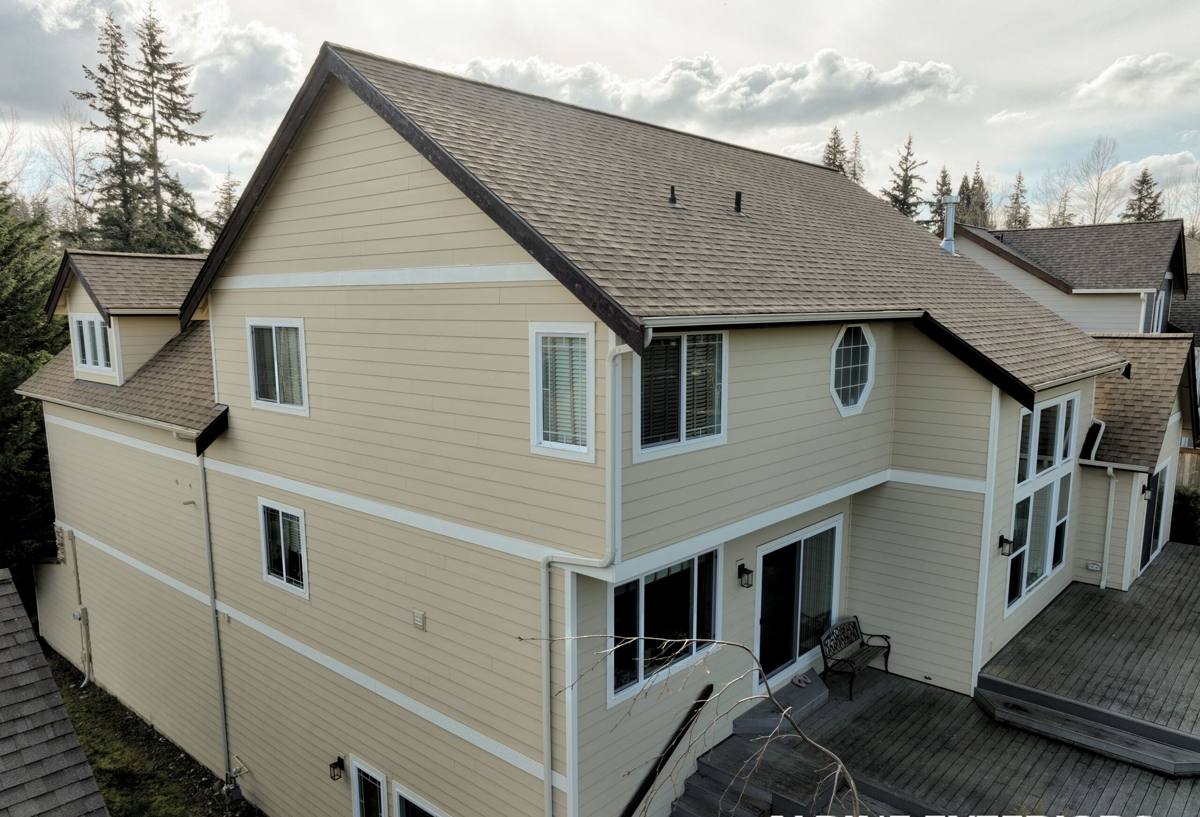
Signs Your Deck Needs Replacement, Not Repair
Not every aging deck needs a full tear-out. But there's a point where patching individual boards is throwing money at a structure that's already failing underneath. Here's what tells us a deck has crossed that line:
- Soft or spongy spots in the decking, especially near the house or stair landings
- Rust streaking around fasteners or visible corrosion on joist hangers
- Gaps or separation where the ledger board meets the house siding
- Persistent moss or dark staining that comes back within weeks of cleaning
- Posts that feel loose or show rot at the base, near ground contact
- Railings that flex more than they should under light pressure
- A deck more than 15-20 years old built with fasteners or flashing that predate current coastal-grade hardware standards
If you're only seeing one or two of these and the framing underneath tests solid, a repair may still make sense. Once rot has reached the ledger connection or the main support posts, replacement is almost always the more honest answer — and the safer one.
What a Correct Deck Replacement Involves
A deck is a structure, not just a surface, and the parts you don't see are what determine whether it lasts 10 years or 30 in this climate.
Ledger Board and Flashing
The ledger board — where the deck attaches to the house — is the single most important detail on any deck replacement, and it's the spot driving rain targets hardest. Proper flashing (not caulk alone, which fails over time) needs to direct water away from the house framing, not toward it. This is also where we typically find the worst hidden rot on older Birch Bay decks, because a small gap here lets water into the wall framing for years before it's visible from outside.
Footings and Frost Depth
Footings need to be sized and set to current code depth so the deck doesn't heave or settle with seasonal ground movement. On replacement projects we evaluate whether existing footings can be reused or need to be re-poured — reusing undersized or shallow footings just to save a step is a common shortcut that shows up as a wobbly deck a few years later.
Framing and Fasteners
Given the salt air here, we use structural hardware and fasteners rated for coastal or marine-grade exposure rather than standard interior-grade galvanized products. It costs more upfront and it's the difference between hardware that's still solid at year 15 and hardware that's rusting through by year 5.
Decking Surface
Boards need consistent gapping for drainage and airflow — tight-fit decking looks clean on install day but holds moisture and speeds up moss growth in a climate this wet. Board spacing, direction, and ventilation underneath the deck all affect how fast the surface dries out after rain.
Choosing a Decking Material for This Climate
There's no single "best" decking material — the right choice depends on your budget, how much maintenance you're willing to do, and how the deck sits relative to sun and wind exposure. Here's how the common options actually perform in a Birch Bay setting:
| Material | Moisture & Salt Air Behavior | Maintenance | Typical Lifespan Here |
|---|---|---|---|
| Pressure-treated lumber | Resists rot with proper sealing, but end grain and cut edges need re-treatment | Annual cleaning, re-staining every 2-3 years | 15-20 years with upkeep |
| Cedar | Naturally rot-resistant, ages well but grays without finish; softer surface | Regular sealing to hold color and resist moss | 15-25 years with upkeep |
| Composite decking | Doesn't absorb water like wood; low-quality boards can still trap moisture at poor drainage gaps | Periodic washing to prevent moss/algae buildup | 25-30+ years, varies by product line |
We install the material a homeowner chooses, but we'll always tell you honestly where a product's weak points are — for example, composite boards still need proper airflow underneath and correct gapping, because moisture problems in this climate come from installation details as much as the material itself.
Our Process for a Birch Bay Deck Replacement
- On-site evaluation. We check the ledger connection, framing, footings, and any hidden rot before quoting — not just the surface boards.
- Honest scope. You get a clear picture of what's structural (must-fix) versus what's cosmetic (your choice), with straightforward pricing.
- Permitting. We handle the permit process with Whatcom County or the City of Blaine, depending on your property's jurisdiction.
- Demo and structural rebuild. Old decking, framing, and any compromised footings come out; new structure goes in to current code with coastal-rated hardware.
- Decking, railing, and finish work. Installed with drainage and airflow as a priority, not an afterthought.
- Final walkthrough. We go over care and maintenance specific to your material choice before we consider the job done.
Permits and Whatcom County Considerations
Most deck replacements that involve structural work — new footings, changes to the ledger connection, or a deck attached at a different height or footprint — require a permit. Whether that goes through Whatcom County or the City of Blaine depends on exactly where your property sits, since Birch Bay itself is unincorporated county land while parts of Blaine proper fall under city jurisdiction. We sort out which applies to your address as part of the estimate, so there are no surprises once work starts.
Why It Matters to Hire a Crew That Already Works This Area
A contractor who mostly builds decks inland doesn't always think in terms of wind-driven rain or salt-air hardware ratings by default — those aren't universal deck-building concerns, they're specific to living on the water in a place like Whatcom County. Working regularly in Blaine and Birch Bay means we've already seen how ledger flashing fails here, which fastener grades hold up and which don't, and how fast moss takes over a deck with poor drainage in this exact climate. That's knowledge you don't get from a generic deck-building checklist.
Keeping a New Deck Healthy After Install
Even a well-built deck needs some seasonal attention in this climate:
- Sweep debris and standing water off the surface after storms, especially in fall and winter
- Wash down the deck once or twice a year to knock back early moss and algae growth
- Check railings and stair connections annually for looseness
- Keep gutters and downspouts near the deck clear so runoff isn't draining directly onto it
- Reseal wood decking on the schedule appropriate to the product — don't wait until it's visibly gray or dry
If your deck is showing rot, rust, or persistent moss, or you're just ready to replace an aging one before it becomes a safety issue, we're happy to take a look and give you a straight assessment. Reach out for a free, no-pressure estimate using the form below.