 Blaine Window
 Why Dakota Creek Roofs Take a Different Kind of Beating
Homes along the Dakota Creek corridor near Blaine sit close enough to the water that the weather doesn't behave like it does further inland. You get wind that comes off Semiahmoo Bay and Georgia Strait with real force behind it, rain that doesn't fall straight down so much as get driven sideways under shingle tabs and flashing laps, and a damp, shaded growing season that keeps moss and algae working on the roof surface almost year-round. None of that is dramatic on its own. It's the combination, storm after storm, season after season, that wears a roof down faster than a spec sheet would suggest.
When a storm does real damage — a gust that lifts a section of shingles, a limb that comes down across a slope, rain that finds its way past a compromised flashing detail — the repair has to account for that local exposure, not just patch the visible hole. A repair that would hold up fine on a roof twenty miles inland can fail within a season out here if it doesn't respect the salt air and the wind-driven rain.
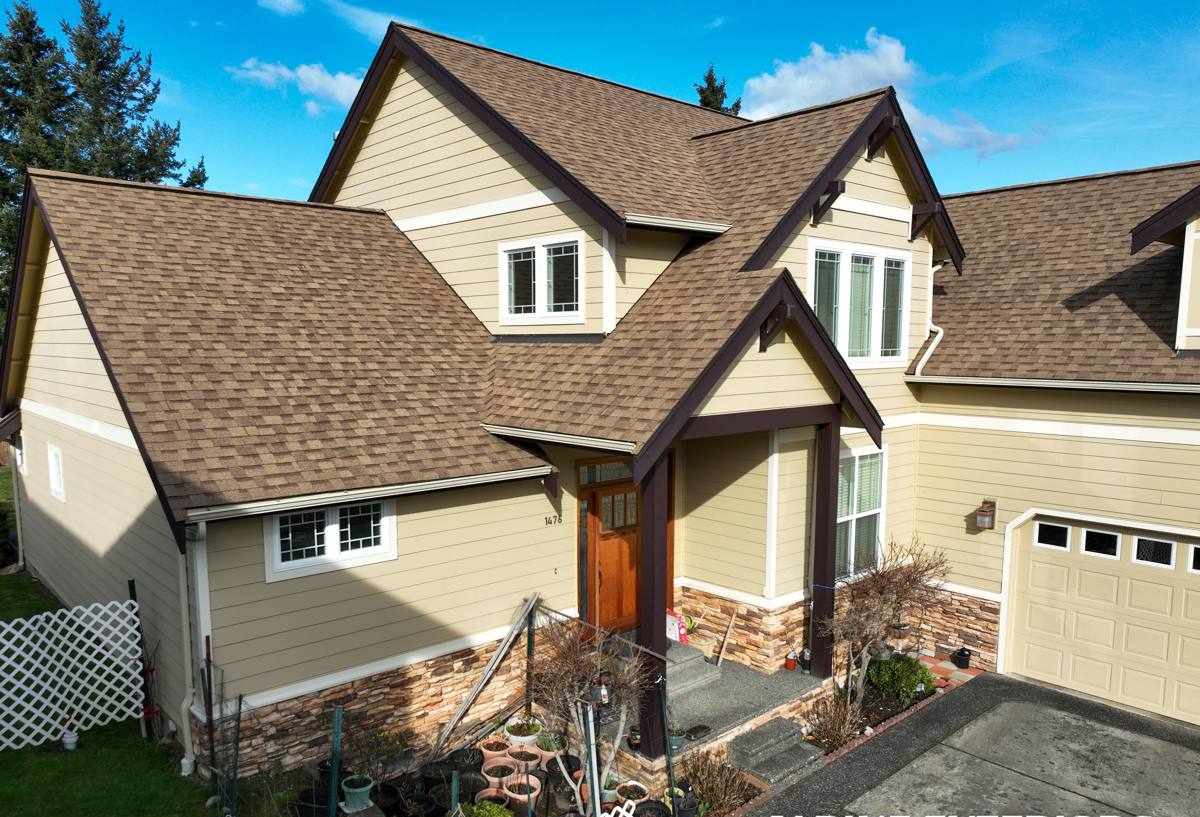
What Counts as Storm Damage (And What Doesn't)
One of the most useful things we do on a first visit is help a homeowner separate genuine storm damage from ordinary wear that a storm simply exposed. That distinction matters for the repair itself and, often, for how an insurance claim gets handled.
Wind and Uplift
Wind damage usually shows up as shingles that are creased, torn, or missing outright, most often starting at ridges, hips, and roof edges where uplift pressure is highest. A few missing shingles rarely means the whole roof failed — it usually means the wind found the weakest fastening point first, which is often an area that was already due for attention.
Driving Rain and Wind-Driven Leaks
Because storms here tend to bring rain sideways rather than straight down, water gets pushed up under shingle edges and into laps that were never designed to handle rain moving in that direction. This is a very different failure mode than a simple leak, and it's why a roof can pass a dry-day look-over and still be actively letting water in during the next storm.
Impact Damage
Limb strikes, wind-blown debris, and occasional hail can crack shingles, dent flashing, or damage vents and skylight curbs. Impact damage is usually the easiest to point to and document, but it's also the type most often understated — the visible dent or tear is rarely the full extent of what happened underneath.
The Moss and Algae Factor After Every Storm
Whatcom County's long wet season means moss and algae are already working on most roofs before a storm ever hits. That matters for storm repair for a practical reason: moss holds moisture against the roof surface, and a roof that's been carrying a moss mat for a year or two has shingles that are softer, more brittle at the edges, and more prone to tearing when wind gets under them. A storm that would only strip a few shingles off a clean, well-maintained roof can strip considerably more off one with an established moss problem, simply because the shingles themselves are already weaker.
This is why part of an honest storm repair estimate includes telling a homeowner if moss is a contributing factor — not to upsell a moss treatment, but because ignoring it means the same storm damage is likely to recur in the same spots next season.
Our Storm Damage Repair Process
Storm repair work goes better when it follows a consistent sequence. Skipping steps to move faster usually costs more later, either in a leak that wasn't fully addressed or in a repair that doesn't match what an insurance adjuster needs to see.
1. Stop the Water First
If there's an active leak or exposed decking, the first priority is a proper emergency tarp — secured well enough to survive the next round of wind, not just draped over the damaged area. This buys time to do the actual repair correctly instead of rushing it.
2. Full Roof Inspection, Not Just the Damaged Spot
We walk the whole roof, not only the area the homeowner noticed. Wind damage often has a companion problem on the opposite slope or at a flashing detail that wasn't obviously affected. We also check attic and decking condition where accessible, since a leak that's been running longer than one storm will show up as staining or soft decking.
3. A Repair Plan That Matches What's Actually There
We identify the shingle type, age, and exposure, and repair with materials that match as closely as possible in both product and weathering. A patch that's an obvious mismatch isn't just a cosmetic issue — a poorly integrated patch is often where the next leak starts.
4. Documentation for Insurance
Photos, measurements, and a written scope of the damage, kept separate from any pre-existing wear we identify along the way. Clear documentation is one of the biggest factors in how smoothly a storm claim moves.
Repair vs. Replace: What Actually Drives the Decision
Not every storm-damaged roof needs full replacement, and not every roof that looks fine on the surface is a good candidate for a simple patch. The honest answer depends on a handful of factors we walk through with every homeowner.
| Factor | Favors Repair | Favors Replacement |
|---|---|---|
| Roof age | Under roughly 12-15 years | Near or past expected service life |
| Extent of damage | Localized to one or two areas | Spread across multiple slopes |
| Moss/algae condition | Minimal, recently maintained | Established growth, softened shingles |
| Decking condition | Dry, sound | Soft, delaminated, or stained from prior leaks |
| Shingle availability | Matching product still available | Discontinued line, visible mismatch likely |
| Insurance scope | Adjuster approves targeted repair | Adjuster or homeowner opts for full slope/roof |
We'll always give a straight answer on which category a given roof falls into. A repair that's genuinely the right call is what we recommend — there's no reason to push a full replacement on a roof that a correct repair will serve well for years.
What a Correct Storm Repair Actually Includes
A rushed storm repair and a correct one can look similar from the ground. The difference is in the details, and it's worth knowing what to ask a contractor about before work starts.
- Removal of all damaged and compromised shingles in the repair area, not just the ones that are visibly gone
- Inspection and, where needed, replacement of underlayment beneath the damaged section
- Decking checked for soft spots, rot, or delamination before new material goes down
- Flashing at valleys, chimneys, vents, and roof-to-wall transitions checked and resealed or replaced as needed
- Fasteners set to current wind-exposure practice, not just matched to what was there before
- Shingle color, style, and exposure matched as closely as the available product allows
- Gutters and downspouts checked for debris that could redirect water back under the new repair
- A final walkthrough with the homeowner before calling the job complete
Working With Your Insurance Company
Most storm damage claims move faster and settle more fairly when the documentation is thorough and honest from the start. We provide a written scope and photo documentation that separates storm-caused damage from ordinary wear, which helps adjusters process the claim without back-and-forth. We're glad to meet an adjuster on-site if that's useful, and we'll answer questions about our scope directly rather than leaving a homeowner to relay technical detail secondhand.
One thing worth knowing going in: insurance covers storm damage, not the underlying condition of an aging roof. If moss, age, or prior wear contributed to how much damage a storm caused, we'll say so plainly. It doesn't help anyone to inflate a claim, and it's not how we want to build a reputation in this area.
Why a Crew That Already Works Dakota Creek Matters
Storm repair isn't just a generic skill — the right approach changes with the roof's exposure. A crew that regularly works the Dakota Creek area around Blaine already has a feel for how wind moves across these lots, how much moss buildup is typical for the shade and moisture levels here, and which flashing details tend to be the weak point on homes of a given age in this part of Whatcom County. That local pattern recognition shortens the inspection, sharpens the repair plan, and avoids the wasted step of relearning what the coastal exposure does to a roof from scratch.
It also means faster response. After a significant windstorm, response time matters — a tarp that goes up within a day protects a home far better than one that goes up a week later after the damage has spread into the decking and insulation below.
Signs Your Roof Needs a Storm Inspection Now
Not every homeowner sees the moment their roof gets damaged. Storms often do their work at night or while no one's looking at the roofline. A few signs are worth a call even without an obvious event to point to:
- Granules collecting in gutters or at downspout outlets after a windy stretch
- A new stain on a ceiling or in the attic that wasn't there before the last storm
- Shingles that look lifted, curled, or out of line along an edge or ridge
- Visible daylight through the roof deck from inside the attic
- A noticeably louder rattle or flutter sound from the roof during high wind
If any of these sound familiar, it's worth having someone look before the next storm system moves through — small issues after wind events tend to get worse, not better, with the next round of driving rain.
If you're dealing with storm damage on a Dakota Creek area home, or just want an honest read on whether your roof came through the last storm in good shape, we're happy to take a look. Reach out for a free, no-pressure estimate using the form below.